NOTÍCIAS
Entrevista: Flávio Gikovate

Amor ou individualidade? Para psicanalista, o ideal de amor romântico está fadado ao fracasso

Foto: Divulgação
 

Eu sem você não tenho porquê, porque sem você não sei nem chorar. Sou chama sem luz, jardim sem luar (…) Tristeza que vai, tristeza que vem. Sem você, meu amor, eu não sou ninguém Os versos da canção Samba em Prelúdio, de Baden Powell e Vinícius de Moraes retratam o amor dos sonhos de todos que buscam por um final feliz, certo?

Errado! Para o Psicanalista Flávio Gikovate, em seu 26º livro Uma História de Amor… Com Final Feliz, o ideal de amor romântico que predomina no imaginário coletivo está com os dias contados. Baseado nas experiências de seus 40 anos de atuação na psicoterapia e em suas vivências pessoais, Gikovate apresenta uma proposta inusitada acerca da questão do amor: formar laços que respeitem a individualidade; ou viver só, estabelecendo vínculos afetivos e eróticos mais superficiais.
Médico psiquiatra formado pela USP, apresentador do programa No Divã do Gikovate, da Rádio CBN, e autor de diversos livros sobre a sexualidade humana e o tema do amor, Flávio Gikovate conversou com o Guia da Semana e aconselha que o famoso ficar pode ser um interessante método para atingir a maturidade nos relacionamentos.
Guia da Semana: No livro Uma História de Amor… Com Final Feliz, você diz que o amor como vivenciamos hoje é imaturo e regressivo e propõe que os relacionamentos sejam mantidos pelo +amor . Como você define este sentimento?

Flávio Gikovate: O +amor traz uma relação compatível com os tempos modernos, que respeita a individualidade. Existe respeito, alegria e prazer de estar junto, e não mais uma relação de dependência, em que um responsabiliza o outro pelo seu bem-estar. É parecido com a amizade porque aproxima duas unidades e não duas metades . Basicamente, é uma forma adulta e sólida de relacionamento, na qual a palavra concessão é substituída por respeito.

GDS: Muitos relacionamentos acabam porque o parceiro estava se sentindo sufocado pelo outro. Como você explica este comportamento?

FG: Esse comportamento nada mais é do que medo de se relacionar. Parte desse medo é o de perder a individualidade. Então, o indivíduo foge. Se não foge, chega uma hora em que começa a se sufocar pela falta da individualidade de novo. Mas com o tempo o medo vai diminuindo junto com a vontade de ficar grudado e vai aumentando a individualidade. É como se o amor bem resolvido curasse o indivíduo do mal de amar.

GDS: Neste contexto, como fica o ideal de fusão de um relacionamento?

FG: Primeiro, é importante lembrar que o sonho de fusão continua presente. Mas duas coisas modificaram esse ideal do amor: a independência da mulher, desequilibrando a idéia de fusão com uma liderança masculina, e o avanço tecnológico, que criou condições extraordinárias para o entretenimento individual. Hoje, há uma briga muito mais ostensiva entre amor e individualidade. Nesse sentido, acho que o +amor tem grande chance de prevalecer.

GDS: E o ficar , onde se enquadra?

FG: As relações amorosas sempre vão existir. O que eu defendo, e acredito, é que elas vão mudar. Porque o mundo mudou e está impondo a necessidade de levar em conta a individualidade. As relações casuais também vão continuar acontecendo. E, nessa nova ordem, ela nem sempre será considerada ruim. Se houver maturidade de ambas as partes, restará sempre uma boa relação afetiva, ainda que superficial. O status do ficar , criado pelos jovens, é uma condição de relacionamento simplesmente perfeita. É um bom ensaio para atingir a maturidade.

GDS: As mulheres sentem mais dificuldade em lidar com a solidão?

FG: Depende. A mulher que consegue trabalhar a sua individualidade consegue viver bem sozinha. Elas são as que mais caminham no processo de individuação, pois são vítimas dos relacionamentos de fusão romântica . As maiores renúncias são exigidas das mulheres. Hoje, as relações são mais cooperativas e ambos, por meio de negociações, decidem o que será feito em conjunto.

GDS: O que é preciso para viver uma relação amorosa mais individualizada?

FG: Temos que ser observadores imparciais e tirarmos vantagens das coisas em vez de ficar lamentando. A vantagem é: avanço moral, avanço da capacidade dos seres humanos de ficarem sozinhos e aprendizado para resolver essa situação de incompletude. Essa é uma novidade que mata a idéia do amor no seu sentido tradicional, como remédio para a incompletude. O amor como remédio tem que desaparecer porque é um mau remédio.

Foto: Divulgação
 

GDS: Como a mulher deve lidar com a pressão que a sociedade impõe a favor do casamento?

FG: Atualmente, há muitos solteiros felizes. E a pressão em relação ao casamento reduziu muito nos últimos anos. A maioria das pessoas leva uma vida serena e sem conflitos. Quando sentem uma sensação de desamparo, aquele vazio no estômago por estarem sozinhas, resolvem a questão sem ajuda. Mantêm-se ocupadas, cultivam bons amigos, lêem um bom livro, vão ao cinema. Com um pouco de paciência e treino, driblam a solidão e se dedicam às tarefas que mais gostam. Os solteiros que não estão bem são, geralmente, os que ainda sonham com um amor romântico. Ainda possuem a idéia de que uma pessoa precisa de outra para se completar. Pensam, como Vinícius de Moraes, que é impossível ser feliz sozinho . Mas isso já caducou! Então, acabam vivendo tristes e deprimidos.

GDS: E quanto ao sexo, para um casal se dar bem na cama é preciso separar sexo e amor?

FG: O sexo é uma área em que ainda precisamos avançar. Em nossa cultura, o sexo vai melhor quando há briga. As pessoas gostam mais de transar com inimigos do que com amigos. Isso mostra como precisamos avançar no entendimento da questão sexual. Ainda é preciso inventar um erotismo que não seja comprometido com vulgaridade e violência. Para superar isso, é preciso ser criativo e entender que as leis da atração sexual não são as mesmas das relações afetivas de boa qualidade. Na hora do sexo, talvez seja necessário mudar o canal, no qual o outro tem de deixar de ser o parceiro sentimental para ser um outro parceiro. É assim que os casais que se amam de verdade descobrem estratégias para que o sexo flua.

GDS: A mulher moderna concilia diversas tarefas: ser mãe, profissional, dona de casa e amante. Essa multiplicidade feminina pode prejudicar o relacionamento?

FG: As mulheres ainda pensam como suas mães. Embora elas sejam maioria nas universidades, elas ainda imaginam o casamento como estabilidade sentimental e material. Isso mostra que, apesar da multiplicidade de papéis, a mulher ainda relaciona amor e casamento. Amor é um assunto e casamento é outro. Nos relacionamentos baseados no que chamo de +amor , os maridos não serão mais protetores ou provedores. Eles terão de ser encarados como companheiros, parceiros de viagem. Mas isso só é possível para aqueles que conseguem trabalhar a sua individualidade.

1


 Museum of Fine Arts

465 Huntington Ave.

 Boston’s Fall Film Festivals

      Maria Olia

 With a population of graduate students and intellectuals, Boston supports the screening of many thought-provoking art films throughout the city.
One of the best movie houses in town that regularly screens independent and international film is the Remis Auditorium at the Museum of Fine Arts.  for those watching their entertainment budge note that tickets are a relative bargain too- general admission for all screenings is just $10.
This fall, several international film festivals are scheduled. The Boston Palestine Film Festival is scheduled for October 4-October 12.  This year’s highlights include the screening of 10 films, many of which address the issues of the Palestinian diaspora. There will be a visit by filmmaker Michel Khleifi on October 11 and a concert by acclaimed international musician Simon Shaheen on October 10th.

Although the exact film and event schedules have not been finalized, the Boston Jewish Film Festival runs from November 5-Novenmber 16 and will screen recent film festival features and documentaries with Jewish themes. And finally, the Boston Festival of Films from Iran is planned for November 7-28 and always has an impressive line-up of internationally awarded art films made in Iran which offer an interesting perspective of modern-day Iranian society.

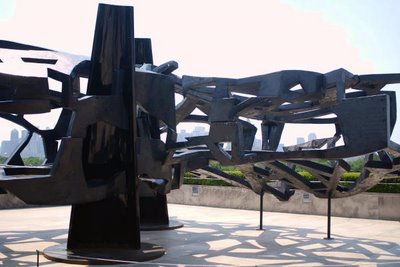
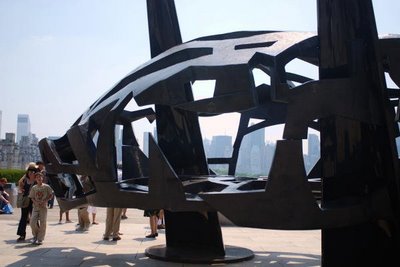
Earlier today, I visited the special exhibition at the Metropolitan Museum of Art called “FRANK STELLA ON THE ROOF,” featuring the recent works in stainless steel and carbon fiber by the prolific American artist Frank Stella (b. 1936) at the Iris and B. Gerald Cantor Roof Garden. This sculpture exhibition marks the artist’s first solo presentation at the Met, simultaneous with Frank Stella: Painting into Architecture, on view through July 29. The roof garden, aside from being an exciting outdoor space for sculpture, offers spectacular views of Central Park and the Manhattan skyline.


Photo above is part of a bus stop ad for HAIRSPRAY, a funny and delightful movie that I saw over the weekend at the AMC Theatres at 68th Street and Broadway. This movie is an adaptation of the still-running 2002 Tony Award-winning Broadway musical of the same title, itself adapted from John Waters’ 1988 comedy film with Ricki Lake. Set in 1962 Baltimore, the film tells the story of Tracy Turnblad as she simultaneously pursues stardom as a dancer on a local TV program, “The Corny Collins Show,” and rallies for racial integration.

Review from the New York Times:

By A. O. SCOTT

That “Hairspray” is good-hearted is no surprise. Adam Shankman’s film, lovingly adapted from the Broadway musical, preserves the inclusive, celebratory spirit of John Waters’s 1988 movie, in which bigger-boned, darker-skinned and otherwise different folk take exuberant revenge on the bigots and the squares who conspire to keep them down. The surprise may be that this “Hairspray,” stuffed with shiny showstoppers, Kennedy-era Baltimore beehives and a heavily padded John Travolta in drag, is actually good.

Appropriately enough for a movie with such a democratic sensibility, there is plenty of credit to go around. Mr. Shankman, drawing on long experience as a choreographer, avoids the kind of vulgar overstatement that so often turns the joy of live musical theater into torment at the multiplex. The songs, by Marc Shaiman and Scott Wittman, are usually adequate, occasionally inspired and only rarely inane. And they are sung with impeccable diction and unimpeachable conviction by a lively young cast that includes Nikki Blonsky, Amanda Bynes, Zac Efron and the phenomenally talented Elijah Kelley.

Of course there are better-known, more-seasoned performers on hand as well, notably Queen Latifah, Michelle Pfeiffer, Christopher Walken and Mr. Travolta. But “Hairspray” is fundamentally a story about being young — about the triumph of youth culture, about the optimistic, possibly dated belief that the future will improve on the present — and its heart is very much with its teenage heroes and the fresh-faced actors who play them.

Ms. Blonsky, a ball of happy, mischievous energy, is Tracy Turnblad, a hefty Baltimore high school student whose dream is to dance with the city’s most telegenic teeny-boppers on “The Corny Collins Show.” Ms. Bynes plays Penny Pingleton, Tracy’s timid best friend, whose prim mother (Allison Janney) won’t even let Penny watch the show, much less appear on it. Mrs. Pingleton can scarcely imagine that her daughter will eventually fall for Seaweed (Mr. Kelley), part of a group of black kids whom Tracy befriends in the detention hall after school.

As Penny and Seaweed test the taboo against interracial romance, Tracy and Link Larkin (Mr. Efron), a “Corny Collins” dreamboat, take on the tyranny of slenderness. That “Hairspray” cheerfully conflates racial prejudice with fat-phobia is the measure of its guileless, deliberately simplified politics. Upholding both forms of discrimination is Velma Von Tussle (Ms. Pfeiffer), a television station executive who uses “The Corny Collins Show” — against the wishes of Corny (James Marsden) himself — as a way of maintaining the color line and promoting the celebrity of her blond, smiley daughter, Amber (Brittany Snow).

“Hairspray” does not seriously propose that Tracy and her new African-American friends face equivalent forms of injustice. But it does make the solidarity between them feel like an utterly natural, intuitive response to the meanness and arrogance of their common enemies. “Welcome to the ’60s,” Tracy sings to her mother, conjuring up the New Frontier hopefulness of that decade’s early years rather than the violence and paranoia of its denouement.

In freezing history at a moment of high possibility — a moment whose glorious popular culture encompasses “West Side Story” and the Twist, early Motown and Phil Spector’s Wall of Sound — “Hairspray” is at once knowingly corny and unabashedly utopian. On “The Corny Collins Show” Seaweed and his friends are relegated to a once-a-month Negro Day, presided over by Motormouth Maybelle (Queen Latifah). Tracy envisions a future when, as she puts it, “every day is Negro Day.”

What is missing from “Hairspray” is anything beyond the faintest whisper of camp. The original “Hairspray” may have been Mr. Waters’s most wholesome, least naughty film, but there was no containing the volcanic audacity of Divine, who created the role of Edna Turnblad. Divine, who was born Harris Glen Milstead and who died shortly after the first “Hairspray” was released, belonged to an era when drag performance still carried more than a touch of the louche and the dangerous, and was one of the artists who helped push it into the cultural mainstream.

Perhaps wisely Mr. Travolta does not try to duplicate the outsize, deliberately grotesque theatricality of Divine’s performance or to mimic the Mermanesque extravagance of Harvey Fierstein’s Broadway turn, choosing instead to tackle the role of Edna as an acting challenge. The odd result is that she becomes the most realistic, least stereotypical character in the film, and the only one who speaks in a recognizable (if not always convincing) Baltimore accent. (“Ahm tryna orn,” she complains when she’s trying to iron.)

A shy, unsophisticated, working-class woman, Edna is ashamed of her physical size even as she seems to hide inside it, as if seeking protection from the noise and indignity of the world outside. It is Tracy who pulls her out of her shell, and without entirely letting go of Edna’s timidity, Mr. Travolta explores the exhibitionistic and sensual sides of her personality.

Mr. Walken’s gallantry in the role of Edna’s devoted husband, Wilbur, is unforced and disarmingly sincere, and their duet, “(You’re) Timeless to Me,” is one of the film’s musical high points. Another is “Without Love,” in which the two young couples express their yearning with the help of some ingenious and amusing special effects.

There are, to be sure, less thrilling moments, and stretches in which the pacing falters. But the overall mood of “Hairspray” is so joyful, so full of unforced enthusiasm, that only the most ferocious cynic could resist it. It imagines a world where no one is an outsider and no one is a square, and invites everyone in. How can you refuse?

Tarsila do Amaral

Tarsila do Amaral
Birth name Tarsila do Amaral
Born September 1, 1886
Capivari, São Paulo, Brazil
Died January 17, 1973
São Paulo, Brazil
Nationality Brazil
Field Painter

Tarsila do Amaral, (b. September 1, 1886 in Capivari, São Paulo,– d. São Paulo on January 17, 1973).

Tarsila do Amaral, known simply as Tarsila, is considered to be one of the leading Latin American modernist artists, described as “the Brazilian painter who best achieved Brazilian aspirations for nationalistic expression in a modern style.” She was a member of the Grupo dos Cinco (Group of Five), which included Anita Malfatti, Menotti del Picchia, Mário de Andrade, and Oswald de Andrade.

Biography Tarsila was born in the city of Capivari, part of the interior of São Paulo, Brazil, to a wealthy family who were coffee growers and landowners. Her family’s position provided her a life of privilege. Although women of privilege were not expected to seek higher education, her parents supported her educational and artistic pursuits. During her teens, Tarsila and her family traveled to Barcelona, where she attended school and first exhibited her interest in art by copying images seen in the school’s collections.

Beginning in 1916, Tarsila studied sculpture in São Paulo with Zadig and Montavani. Later she studied drawing and painting with the impressionist painter Pedro Alexandrino. These were all respected but conservative teachers. In 1920, she moved to Paris and studied at the Académie Julian and with Emile Renard. The Brazilian art world was conservative, and travels to Europe provided students with a broader education in the areas of art, culture, and society. At this time, her influences and art remained conservative.

Brazilian modernism

Portrait of Oswald de Andrade by Tarsila do Amaral, 1922.

Portrait of Oswald de Andrade by Tarsila do Amaral, 1922.

Returning to São Paulo in 1922, Tarsila was exposed to modernism after meeting Anita Malfatti, Oswald de Andrade, Mario de Andrade, and Menotti del Picchia. Prior to her arrival in São Paulo from Europe, the group had organized the Semana de Arte Moderna (“Week of Modern Art”) during the week of February 11-18, 1922. The event was pivotal in the development of modernism in Brazil. The participants were interested in changing the conservative artistic establishment in Brazil by encouraging a distinctive mode of modern art. Tarsila was asked to join the movement and together they became the Grupo dos Cinco, which sought to promote Brazilian culture, the use of styles that were not specifically European, and the inclusion of things that were indigenous to Brazil.

During a brief return to Paris in 1923, Tarsila was exposed to Cubism, Futurism, and Expressionism while studying with André Lhote, Fernand Léger, and Albert Gleizes. European artists in general had developed a great interest in African and primitive cultures for inspiration. This led Tarsila to utilize her own country’s indigenous forms while incorporating the modern styles she had studied. While in Paris at this time, she painted one of her most famous works, Le Negra (1923). The principal subject matter of the painting is a large negroid female figure with a single prominent breast. Tarsila stylized the figure and flattened the space, filling in the background with geometric forms.

Excited about her newly developed style and feeling ever more nationalistic, she wrote to her family in April 1923:

“I feel myself ever more Brazilian. I want to be the painter of my country. How grateful I am for having spent all my childhood on the farm. The memories of these times have become precious for me. I want, in art, to be the little girl from São Bernardo, playing with straw dolls, like in the last picture I am working on…. Don’t think that this tendency is viewed negatively here. On the contrary. What they want here is that each one brings the contribution of his own country. This explains the success of the Russian ballet, Japanese graphics and black music. Paris had had enough of Parisian art.”

 Pau-Brasil period

Oswalde de Andrade, who had become her traveling companion, accompanied her throughout Europe. Upon returning to Brazil at the end of 1923,Tarsila and Andrade then traveled throughout Brazil to explore the variety of indigenous culture, and to find inspiration for their nationalistic art. During this period, Tarsila made drawings of the various places they visited which became the basis for many of her upcoming paintings. She also illustrated the poetry that Andrade wrote during their travels, including his pivotal book of poems entitled Pau Prasil, published in 1924. In the manifesto of the same name, Andrade emphasized that Brazilian culture was a product of importing European culture and called artists to create works that were uniquely Brazilian in order to “export” Brazilian culture, much like the wood of the Brazil tree had become an important export to the rest of the world. In addition, he challenged artists to use a modernist approach in their art, a goal they had strived for during the Semana de Arte Moderna.

During this time, Tarsila’s colors became more vibrant. In fact, she wrote that she had found the “colors I had adored as a child. I was later taught they were ugly and unsophisticated.”  Her initial painting from this period was E.C.F.B.(Estrada de Ferro Central do Brasil), (1924). The painting represented the new railway that linked Rio de Janeiro to São Paulo, and contained many aspects of the industrial city, such as rail bridges, rail cars, telephone poles, and signals. In addition, however, she included other aspects that would make this modern scene a distinctly Brazilian one: the colorful houses, a colonial church, and palm trees and other vegetation. She combined cubism with vivid colors and tropical elements to create her own unique Brazilian style, featuring local landscapes and scenery. Furthermore, at the time, she had an interest in the industrialization and it’s impact on society.

Antropofagia period

In 1926, Tarsila married Andrade and they continued to travel throughout Europe and the Middle East. In Paris, in 1926, she had her first solo exhibition at the Galerie Percier. The paintings shown at the exhibition included São Paulo (1924), La Negra (1923), Lagoa Santa (1925), and Morro de Favela (1924). Her works were praised and called “exotic,” “original,” “naïve,” and “cerebral,” and they commented on her use of bright colors and tropical images.

While in Paris, she was exposed to surrealism and after returning to Brazil, Tarsila began a new period of painting where she departed from urban landscapes and scenery, and began incorporating surrealist style into her nationalistic art. This shift also coincided with a larger artistic movement in São Paulo and other parts of Brazil which focused on celebrating Brazil as the country of the big snake. Building on the ideas of the earlier Pau-Brasil movement, artists strove to appropriate European styles and influences in order to develop modes and techniques that were uniquely theirs and Brazilian.

Tarsila’s first painting during this period was Abaporu (1928), which had been given as an untitled painting to Andrade for his birthday. The subject is a large stylized human figure with enormous feet sitting on the ground next to a cactus with a lemon-slice sun in the background. Andrade selected the eventual title, Abaporu, which is an Indian term for “man eats,” in collaboration with the poet Raul Bopp. This was related to the then current ideas regarding the melding of European style and influences. Soon after, Andrade wrote his Anthropophagite Manifesto, which literally called Brazilians to devour European styles, ridding themselves of all direct influences, and to create their own style and culture. Instead of being devoured by Europe, they would devour Europe themselves. Andrade used Abaporu for the cover of the manifesto as a representation of his ideals. The following year the manifesto’s influence continued, Tarsila painted Antropofagia (1929), which featured the Abaporu figure together with the negroid figure from Le Negra from 1923, as well as the Brazilian banana leaf, cactus, and again the lemon-slice sun.

In 1929, Tarsila had her first solo exhibition in Brazil at the Palace Hotel in Rio de Janerio, and was followed by another at the Salon Gloria in São Paulo. In 1930, she was featured in exhibitions in New York and Paris. Unfortunately, 1930 also saw the end of Tarsila and Andrade’s marriage. This brought an end to their collaboration.

 Late Career and Social Themes

In 1931, Tarsila traveled to the Soviet Union. While there, she had exhibitions of her works in Moscow at the Museum of Occidental Art, and she traveled to various other cities and museums. The poverty and plight of the Russian people had a great effect on her. Upon her return to Brazil in 1932, she became involved in the São Paulo Constitutional Revolt against the current dictatorship of Brazil, led by Getulio Vargas. Along with others who were seen as leftist, she was imprisoned for a month because her travels made her appear to be a communist sympathizer.

The remainder of her career she focused on social themes. Representative of this period is the painting Segundo Class (1931), which has impoverished Russian men, women and children as the subject matter. She also began writing a weekly arts and culture column for the Diario de São Paulo, which continued until 1952.

In 1938,Tarsila finally settled permanently in São Paulo where she spent the remainder of her career painting Brazilian people and landscapes. In 1950, she had an exhibition at Museum of Modern Art, São Paulo where a reviewer called her “the most Brazilian of painters here, who represents the sun, birds, and youthful spirits of our developing country, as simple as the elements of our land and nature…. Tarsila’s life is a mark of the warm Brazilian character and an expression of it tropical exuberance.”

 Legacy

Besides the 230 paintings, hundreds of drawings, illustrations, prints, murals, and five sculptures, Tarsila’s legacy is her effect on the direction of Latin American art. Tarsila moved modernism forward in Latin America, and developed a style unique to Brazil. Following her example, other Latin American artists were influenced to begin utilizing indigenous Brazilian subject matter, and developing their own style.

Selected artworks

  • An Angler, 1920’s, Hermitage Museum, Saint Petersburg, Russia
  • Cuca, 1924, Museum of Grenoble, France
  • Landscape with Bull, 1925, Private Collector
  • El huevo, 1928, Gilberto Chateaubriand, Rio de Janeiro
  • Abaporu, 1928, Eduardo Constantini, Buenos Aires
  • Lake, 1928, Private Collection, Rio de Janeiro
  • Antropofagia, 1929, Paulina Nemirovsky, Nemirovsky Foundation, San Pablo
  • Sol poente, 1929, Private Collection, São Paulo
  • Segundo Class, 1933, Private Collection, São Paulo
  • Retrato de Vera Vicente Azevedo, 1937, Museu de Arte Brasileira, São Paulo
  • Purple Landscape with 3 Houses and Mountains, 1969-72, James Lisboa Escritorio de Arte, São Paulo

 Exhibitions

1922 – Salon de la Societe des Artistes Francais in Paris (group)

1926 – Galerie Percier, Paris (solo)

1928 – Galerie Percier, Paris (solo)

1929 – Palace Hotel, Rio de Janeiro (solo)

1929 – Salon Gloria, São Paulo (solo)

1930 – New York (group)

1930 – Paris (group)

1931 – Museum of Occidental Art, Moscow

1933 – I Salon Paulista de Bellas Artes, São Paulo (group)

1951 – I Bienal de São Paulo, São Paulo (group)

1963 – VII Bienal de São Paulo, São Paulo (group)

1963 – XXXII Venice Bienalle, Venice (group)

2005 – Woman: Metamorphosis of Modernity, Fundacion Joan Miró, Barcelona (group)

2005 – Brazil: Body Nostalgia, The National Museum of Modern Art, Tokyo, Japan (group)

2006 – Salao of 31: Diferencas in Process, National Museum of Beautiful Arts, Rio de Janeiro (group)

2006 – Brazilian Modern Drawing: 1917-1950, Museum of Modern Art, Rio de Janeiro (group)

2006 – Ciccillo, Museum of Art Contemporary of the University of São Paulo, São Paulo (group)

2007 – A Century of Brazilian Art: Collection of Gilbert Chateaubriand, Museum Oscar Niemeyer, Curitiba (group)

 Notes

  1. ^ Lucie-Smith, Edward. Latin American Art of the 20th Century. London: Thames & Hudson Ltd, 2004: 42.
  2. ^ Damian, Carol. Tarsila Do Amaral: Art and Environmental Concerns of a Brazilian Modernist. Woman’s Art Journal 20.1 (1999): 3-7.
  3. ^ Damian, Carol. Tarsila Do Amaral: Art and Environmental Concerns of a Brazilian Modernist. Woman’s Art Journal 20.1 (1999): 3-7.
  4. ^ Lucie-Smith, Edward. Latin American Art of the 20th Century. London: Thames & Hudson Ltd, 2004: 42.
  5. ^ Lucie-Smith, Edward. Latin American Art of the 20th Century. London: Thames & Hudson Ltd, 2004: 44.
  6. ^ Damian, Carol. Tarsila Do Amaral: Art and Environmental Concerns of a Brazilian Modernist. Woman’s Art Journal 20.1 (1999): 3-7.
  7. ^ Damian, Carol. Tarsila Do Amaral: Art and Environmental Concerns of a Brazilian Modernist. Woman’s Art Journal 20.1 (1999): 5.
  8. ^ Damian, Carol. Tarsila Do Amaral: Art and Environmental Concerns of a Brazilian Modernist. Woman’s Art Journal 20.1 (1999): 7.

[edit] Sources and further reading

  • Congdon, K. G., & Hallmark, K. K. (2002). Artists from Latin American cultures: a biographical dictionary. Westport, CT, Greenwood Press. ISBN 0313315442
  • Lucie-Smith, Edward. Latin American Art of the 20th Century. London: Thames & Hudson Ltd, 2004.
  • Damian, Carol. Tarsila Do Amaral: Art and Environmental Concerns of a Brazilian Modernist. Woman’s Art Journal 20.1 (1999): 3-7.
  • Barnitz, Jaqueline. Twentieth-Century Art of Latin America. China: University of Texas Press, 2006: 57.
  • Gotlib, Nadia Batella. Tarsila do Amaral: a Modernista. São Paulo: Editora SENAC, 2000.
  • Pontual, Roberto. Tarsila. Groves Dictionary of Art. Ed. Jane Turner. New York: Macmillan, 1996.
  • Amaral, Aracy and Kim Mrazek Hastings. Stages in the Formation of Brazil’s Cultural Profile. The Journal of Decorative and Propaganda Arts. 21 (1995): 8-25.

Lucio Fontana
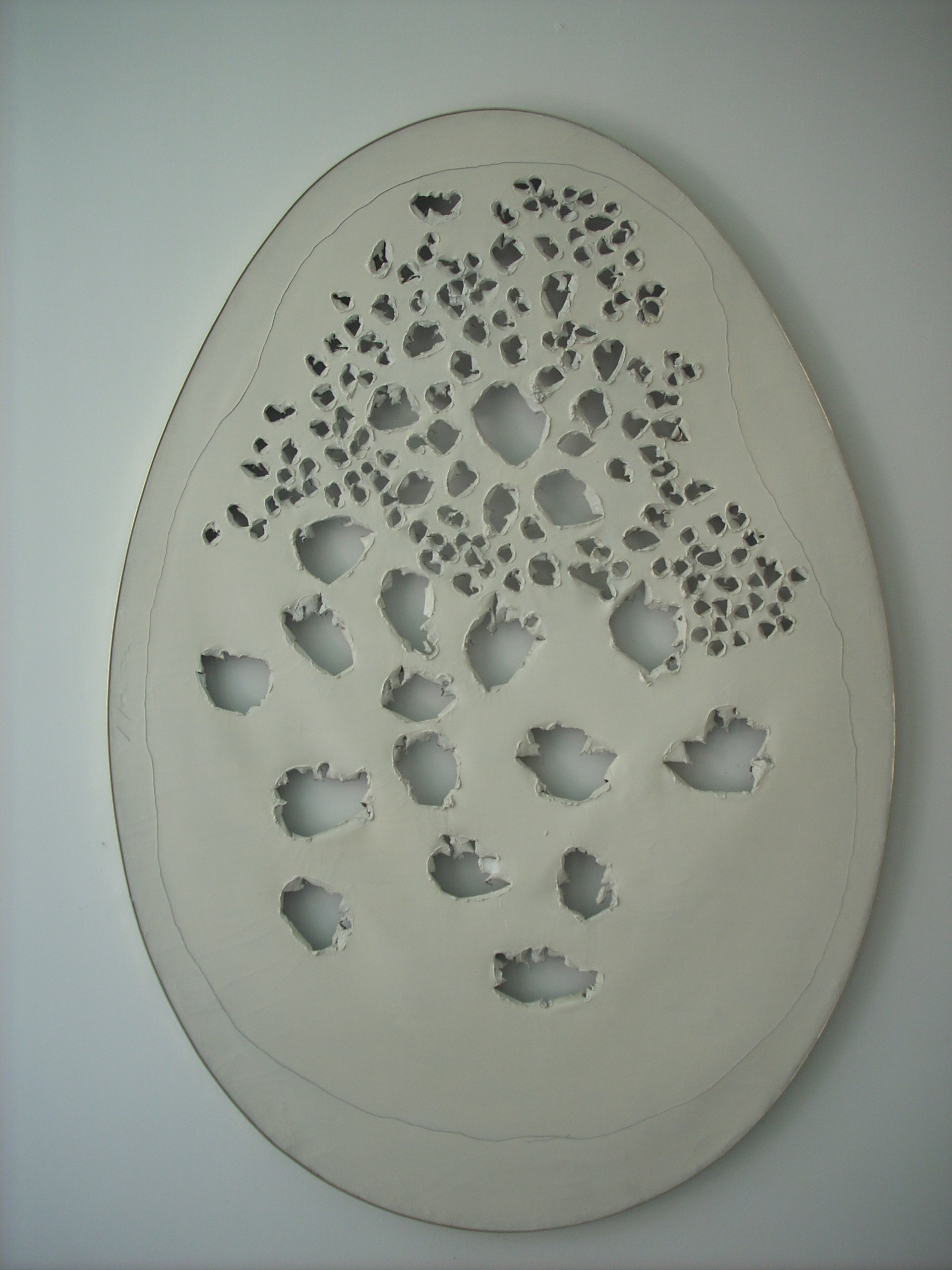
Concetto Spaziale, la Fine di Dio
1963
£10,324,500
Sotheby’s London
Feb. 27, 2008

VIDAL SASSOON  PRIVATE COLLECTION

FONTANA’S EGG

The record-setting Fontana, a golden, glittery, egg-shaped Concetto Spaziale from 1963, was bought by Philippe Segalot, according to auction reports, spurring speculation that it might be destined for François Pinault’s new museum at Punta della Dogana in Venice.

Anish Kapoor’s Sky Mirror is a breathtaking, 35-foot-diameter concave mirror made of polished stainless steel. Standing nearly three stories tall at the Fifth Avenue entrance to the Channel Gardens at Rockefeller Center, Sky Mirror offers a dazzling experience of light and architecture, presenting viewers with a vivid inversion of the skyline featuring the historic landmark building at 30 Rockefeller Plaza. Sky Mirror is on view, free and open to the public, from September 19th through October 27th, 2006. This exhibition is presented by Tumi, organized by the Public Art Fund and hosted by Rockefeller Center owner Tishman Speyer.

An urban, contemporary, and ever-changing aesthetic variation on the 18th-century landscape painting tradition, Sky Mirror literally brings the sky down to the ground. The large, 23-ton circular stainless steel sculpture is installed on a platform a few feet above street level. Its concave side, angled upward, faces 30 Rockefeller Plaza, reflecting an upside-down portrait of this elegant and iconic New York City skyscraper and the shifting sky around it. Its convex side, facing Fifth Avenue reflects a more earthly vision: viewers in the midst of the adjacent streetscape. This optical object changes through the day and night and is an example of what Kapoor describes as a “non-object,” a sculpture that, despite its monumentality, suggests a window or void and often seems to vanish into its surroundings.

Anish Kapoor is one of the foremost artists of our time. He first became known in the 1980s for his geometric or biomorphic sculptures made using simple—often elemental—materials such as granite, limestone, marble, pigment and plaster. His sculptures extend the formal precepts of minimalism into an intensely spiritual and psychological realm, drawing viewers in with their rich colors, sensuously refined surfaces, and startling optical effects of depth and dimension. Since the mid-1990s he has explored the notion of the void, creating works that seem to—and sometimes do—recede into the distance, disappear into walls or floors, or otherwise destabilize our assumptions about the physical world. They give visceral and immediate impact to abstract dualities such as presence and absence, infinity and illusion, solidity and intangibility.

Kapoor is focused on the active or transformative properties of the materials he uses. “I am really interested in the ‘non-object’ or the ‘non-material.’ I have made objects in which things are not what they at first seem to be. A stone may lose its weight or a mirrored object may so camouflage itself in its surroundings as to appear like a hole in space,” says Kapoor. From works such as Turning the World Inside Out (1995) to the massive 125-ton sculpture Cloud Gate (2004) on permanent display in Chicago’s Millennium Park, Kapoor’s reflective sculptures engage audiences directly, fusing object, viewer, and environment into one physical, constantly fluctuating form.

About the artist
Anish Kapoor was born in Bombay in 1954, and currently lives and works in London. He attended the Hornsey College of Art (1973-77) and Chelsea School of Art, London (1977-78). Kapoor is one of a generation of British sculptors, along with fellow British sculptors Tony Cragg and Richard Deacon, who gained critical recognition in the 1980s and who share an interest in materials and use of abstract, organic form. In his early series 1000 Names (1989-90), the artist focused on geometry and color, installing arrangements of semi-circles, planes and other shapes coated in particles of bright pigment. In 1990 he represented Britain at the Venice Biennale with Void Field , an installation of rough sandstone blocks topped with black holes, and over the course of the decade his sculptures ventured into more ambitious, increasingly sublime manipulations of form and space. He won the Turner Prize in 1991 and in 2002 received the prestigious Unilever Commission for the Turbine Hall at the Tate Modern in London.

Among his major permanent commissions is Cloud Gate (2004) for the Millennium Park in Chicago. Major solo exhibitions throughout his career have taken place at MAC Grand-Hornu, Belgium (2004); Museo Archeologico Nazionale, Naples (2004); Kunsthaus Bregenz (2003); BALTIC Centre for Contemporary Art, Gateshead (1999); Piazza del Plebiscito, Naples (1999); Hayward Gallery, London (1998); and Fondazione Prada, Milano (1995). Kapoor is represented by Gladstone Gallery in New York.

Description: Anish Kapoor is one of a highly inventive generation of sculptors who emerged in London in the early 1980s. Since then he has created a remarkable body of work that blends a modernist sense of pure materiality with a fascination for the manipulation of form and the perception of space. This book–the first major American publication on Kapoor’s work–surveys his work since 1979, with a focus on sculptures and installations made since the early 1990s. With more than ninety color images of these ambitious and complex works, three original essays, an extended interview with Kapoor, and selections from his sketchbooks, this book confirms Anish Kapoor’s place as one of the most remarkable sculptors working today.

Kapoor’s work has evolved into an abstract and perceptually complex elaboration of the sculptural object as at once monumental and evanescent, physical and ethereal–as in his famous Cloud Gate (2004) in Chicago’s Millennium Park. The works in Anish Kapoor include such striking works as Past, Present, Future (2006), 1000 Names (1979-1980) and When I Am Pregnant (1992). This book, which accompanies an exhibition at Boston’s Institute of Contemporary Art, offers American readers a long-overdue opportunity to consider the extraordinary clarity, subtlety, and power of Kapoor’s art.

Includes an interview with the artist by Nicholas Baume.

Exhibition:
Institute of Contemporary Art, Boston
May 30-September 7, 2008

Copublished with the Institute of Contemporary Art, Boston

  • Author: Ashish Kapoor
  • Binding: Hardcover
  • Dewey Decimal Number: 730.92
  • EAN: 9780262026598
  • ISBN: 0262026597
  • Label: The MIT Press
  • Language: English
  • Manufacturer: The MIT Press
  • Number of Items: 1
  • Number of Pages: 144
  • Product Group: Book
  • Publication Date: 2008-09-30
  • Publisher: The MIT Press
  • Studio: The MIT Press
  • Title: Anish Kapoor: Past, Present, Future