ELIZABETH OF BAVARIA
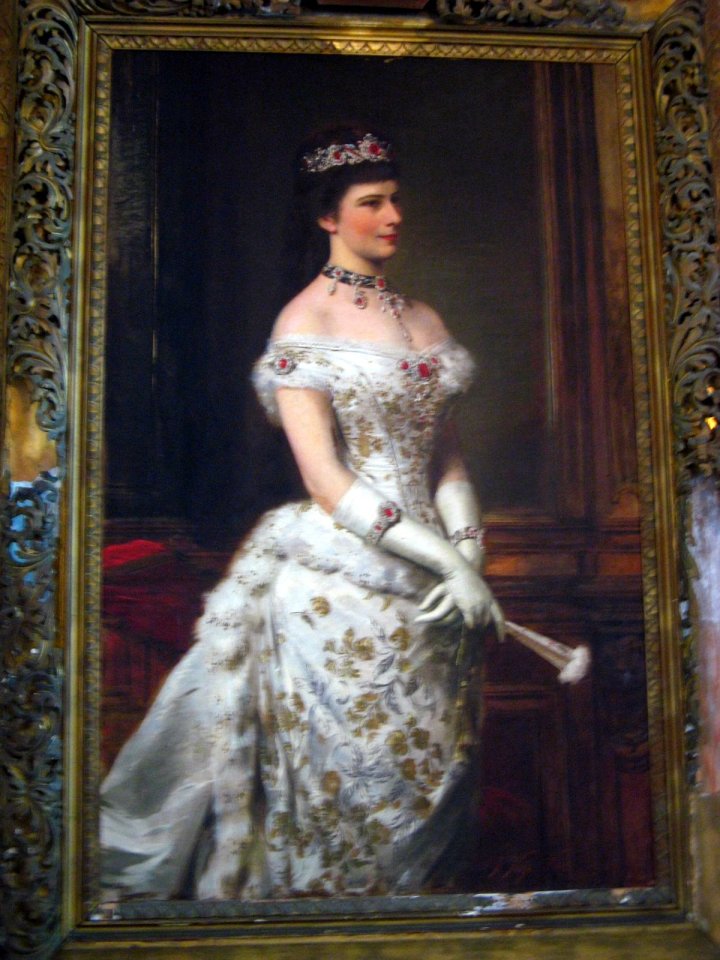

While Elisabeth’s role and influence on Austro-Hungarian politics should not be overestimated (she is only marginally mentioned in scholarly books on Austrian history), she has undoubtedly become a 20th century icon. Elisabeth was considered to be a free spirit who abhorred conventional court protocol; she has inspired filmmakers and theatrical producers alike.
BAVARIAN DUCHESS

She was born in Munich, Bavaria. She was the fourth child of Duke Maximilian Joseph in Bavaria and her mother was Princess Ludovika of Bavaria. Her family home was Possenhofen Castle.
Elisabeth accompanied her mother and her 18-year-old sister, Duchess Helene, on an 1853 trip to the resort of Bad Ischl, Upper Austria , where they hoped Helene would attract the attention of their maternal first cousin, 23-year-old Francis Joseph, then Emperor of Austria. Instead, Francis Joseph chose the 16-year old Elisabeth, and the couple were married in Vienna at St. Augustine’s Church on 24 April 1854.
QUEEN AND EMPRESS
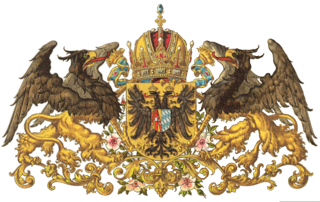
Elisabeth had difficulty adapting to the strict etiquette practiced at the Habsburg court. Nevertheless, she bore the emperor three children in quick succession: Archduchess Sophie of Austria (1855–1857), Archduchess Gisela of Austria (1856–1932), and the hoped-for crown prince, Rudolf (1858–1889). In 1860, she left Vienna after contracting a lung-disease which was presumably psychosomatic. She spent the winter in Madeira and only returned to Vienna after having visited the Ionian Islands. Soon after that she fell ill again and returned to Corfu.
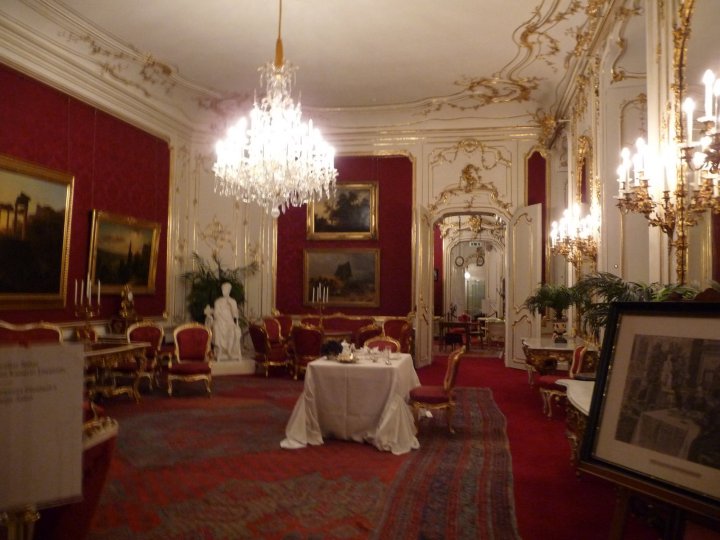
National unrest within the Habsburg monarchy caused by the rebellious Hungarians led, in 1867, to the foundation of the Austro–Hungarian double monarchy. Elisabeth had always sympathized with the Hungarian cause and, reconciled and reunited with her alienated husband, she joined Francis Joseph in Budapest, where their coronation took place. In due course, their fourth child, Archduchess Marie Valerie was born (1868–1924). Afterwards, however, she again took up her former life of restlessly travelling through Europe. Elisabeth was denied any major influence on her older children’s upbringing, however — they were raised by her mother-in-law Princess Sophie of Bavaria, who often referred to Elisabeth as their “silly young mother.”
Elisabeth embarked on a life of travel, seeing very little of her offspring, visiting places such as Madeira, Hungary, England and Corfu. At Corfu she commissioned the building of a palace which she called the Achilleion, after Homer‘s hero Achilles in The Iliad. After her death, the building was purchased by German Emperor Wilhelm II.
She became known not only for her beauty, but for her fashion sense, diet and exercise regimens, passion for riding sports, and a series of reputed lovers. She paid extreme attention to her appearance and would spend most of her time preserving her beauty. She often shopped at Antal Alter, now Alter és Kiss, which had become very popular with the fashion-crazed crowd, as described by the famous 19th-century writer Richard Rado:
“Everyone, from the most wealthy, to the upper middle class… almost every woman visited the shop. The shop’s name even extended beyond the country’s borders… Elizabeth of Bavaria (Sissi), wife of Francis Joseph I and Queen of the Austro-Hungarian monarchy, was also among its clients.
Her diet and exercise regimens were strictly enforced to maintain her 20-inch (50 cm) waistline and reduced her to near emaciation at times (symptoms of what is now recognised as anorexia).[citation needed] One of her alleged lovers was George “Bay” Middleton, a dashing Anglo–Scot who was probably the father of Clementine Ogilvy Hozier (the wife of Winston Churchill). She also tolerated, to a certain degree, Franz Joseph’s affair with actress Katharina Schratt.
The Empress also engaged in writing poetry (such as the “Nordseelieder” and “Winterlieder”, both inspirations from her favorite German poet, Heinrich Heine). Shaping her own fantasy world in poetry, she referred to herself as Titania, Shakespeare’s Fairy Queen. Most of her poetry refers to her journeys, classical Greek and romantic themes, as well as ironic mockery on the Habsburg dynasty. In these years, Elisabeth also took up with an intensive study of both ancient and modern Greek, drowning in Homer‘s Iliad and Odyssey. Numerous Greek lecturers (such as Marinaky, Christomanos, and Barker) had to accompany the Empress on her hour-long walks while reading Greek to her. According to contemporary scholars, Empress Elisabeth knew Greek better than any of the Bavarian Greek Queens in the 19th century.In 1889, Elisabeth’s life was shattered by the death of her only son: 30-year-old Crown Prince Rudolf and his young lover Baroness Mary Vetsera were found dead, apparently by suicide. The scandal is known by the name Mayerling, after the name of Rudolf’s hunting lodge in Lower Austria.
After Rudolf’s death, the Empress continued to be an icon, a sensation wherever she went: a long black gown that could be buttoned up at the bottom, a white parasol made of leather and a brown fan to hide her face from curious looks became the trademarks of the legendary Empress of Austria. Only a few snapshots of Elisabeth in her last years are left, taken by photographers who were lucky enough to catch her without her noticing. The moments Elisabeth would show up in Vienna and see her husband were rare. Interestingly, their correspondence increased during those last years and the relationship between the Empress and the Emperor of Austria had become platonic and warm. On her imperial steamer, Miramar, Empress Elisabeth travelled restlessly through the Mediterranean. Her favourite places were Cap Martin on the French Riviera, where tourism had only started in the second half of the 19th century, Lake Geneva in Switzerland, Bad Ischl in Austria, where she would spend her summers, and Corfu. More than that, the Empress had visited countries no other Northern royal went to at the time: Portugal, Spain, Morocco, Algeria, Malta, Greece, Turkey and Egypt. Travel had become the sense of her life but also an escape from herself.
LITERATURE AND DRAMA

In the German-speaking world, Elisabeth’s name is often associated with a trilogy of romantic films about her life directed by Ernst Marischka and starring a teenage Romy Schneider:
- Sissi (1955)
- Sissi — die junge Kaiserin (1956) (Sissi — The Young Empress)
- Sissi — Schicksalsjahre einer Kaiserin (1957) (Sissi — Fateful Years of an Empress)
The three films, now newly restored, are shown every Christmas on Austrian, German and French TV and have done much to create the myth surrounding Elisabeth. A condensed version dubbed in English was published in 1962 under the title Forever My Love, and in 2007 the three German films were released with English subtitles as The Sissi Collection.
Schneider loathed the role, claiming, “Sissi sticks to me like porridge (Griesbrei).” Later she was able to achieve a sort of satisfaction, appearing as a much more realistic and fascinating Elisabeth in Luchino Visconti‘s Ludwig, a 1972 movie about Elisabeth’s cousin, Ludwig II of Bavaria. A portrait of herself in this film was the only one of her roles Schneider displayed in her home.
Ava Gardner also played the Empress in the 1968 film Mayerling. (Omar Sharif and Catherine Deneuve played the doomed lovers.) She, also, had one sole film portrait of herself on display in her home: it was from this film.
She was the subject of a 1991 German movie called Sissi/Last Minute (original Sisi und der Kaiserkuß “Sissi and the kiss of the Emperor”). The movie starred Vanessa Wagner as Sissi, Nils Tavernier as Emperor Franz Joseph and Sonja Kirchberger as Nene.
In 1974, Elisabeth was portrayed in the British television series Fall of Eagles by Diane Keen (as the young Elisabeth) and Rachel Gurney (as Elisabeth at the time of Prince Rudolf’s death).
Her story also became part of a children’s book series: The Royal Diaries: Elisabeth, The Princess Bride.
In one of the episodes of the Austrian TV show, Kommissar Rex (1994), about a police dog who always solves his police-inspector owner’s cases, the myth of Sissi is shown under the influence of her story on a young woman who often sneaks into a palace where Sissi lived and starts acting like her during the night, when the museum is closed. This includes riding in the park, using hair ornaments similar to the ones Elisabeth was known for using and even sleeping in the Empress’s bed, dressed in vintage nightwear, after having brushed her hair in Sissi’s way, separating it in two parts spread over the pillow so that the strands wouldn’t be mussed by morning: all this, of course, using Sissi’s old brush. This episode, the thirteenth of Season 5 of the show (and the last from that season), is called “Sissi” and originally aired on 22 April 1999. The empress-obsessed character’s name is Marion, and she is played by actress Marion Mitterhammer.
Her younger years are portrayed in a children’s series in 1997 called Princess Sissi.
In 2007, German comedian and director Michael Herbig released a computer-animated parody film of Sissi’s character under the title Lissi und der wilde Kaiser (lit.: “Lissi and the Wild Emperor”). It is based on his Sissi parody sketches featured in his TV show Bullyparade.
DANCE AND MUSIC
Fritz Kreisler composed a comic opera ‘Sissi’, which premiered in Vienna in 1932. The libretto was written by Ernst and Hubert Marischka, with orchestrations by Robert Russell Bennett.
In 1992, the musical Elisabeth premièred at the Theater an der Wien in Vienna, Austria. Written by Michael Kunze (libretto, lyrics) and Sylvester Levay (music), with the leading role of the Empress played by Pia Douwes of the Netherlands. It has also been produced successfully in Hungary, Germany, Switzerland, the Netherlands, Sweden, Finland and in Japan, with Douwes also again performing the role of Sissi in the Netherlands, Berlin, Essen and Stuttgart.
In the film version of Andrew Lloyd Webber‘s The Phantom of the Opera, the character Christine is wearing a gown inspired by a portrait of Elisabeth of Austria-Hungary by Franz Xavier Winterhalter during her opera debut when she performs the song “Think of Me”.

French ballet dancer Sylvie Guillem appeared to great acclaim at the Paris Opera Ballet in a piece titled Sissi Imperatice , choreographed by Maurice Bejart.
Elisabeth has a featured role in Kenneth MacMillan‘s ballet, Mayerling including a pas de deux with her son Prince Rudolf, the central character in the ballet; and a notable pas de six with five male partners, Bay Middleton and four Hungarian officers, friends of her son.
Dutch singer Petra Berger’s album Eternal Woman includes “If I Had a Wish”, a song about Elisabeth.
*I have to confess one thing. In 1998, I went to Vienna; I wanted to attend to the debut of Elizabeth at the Opera House. However, my husband did not know who Sissi or Elizabeth of Bavaria was. Therefore, he did not take me to see the Elizabeth, at the Vienna Opera house. Instead, he took me to see one play of his choice witch was about a butcher’s I dress myself in a beautiful evening gown to go to the Vienna Opera House. When I arrived I found out I was about to see the butchers. I left Vienna, thinking that I would be back there to see the show that I wanted so much to see! Now you can see why I was distressed! How could I have missed such an opportunity?
 ADRIANA SASSOON
