Because we are killing it!How does it make you feel?
Please post your comments……………
RE:flection
” IF OUR OCEANS DIE WE WILL BE NEXT ! ” AKS.
California Coastal Commission in San Francisco
Chris Parry with the California Coastal Commission in San Francisco said the so-called Great Pacific Garbage Patch, has been growing a brisk rate since the 1950s, The San Francisco Chronicle reported Friday. The trash stew is 80 percent plastic and weighs more than 3.5 million tons. “At this point, cleaning it up isn’t an option,” Parry said. “It’s just going to get bigger as our reliance on plastics continues.” Parry said using canvas bags to cart groceries instead of using plastic bags is a good first step to reducing reliance on plastics, the newspaper said.
What is the state of the ocean today?
It’s actually very bad. It’s probably worse in many ways than the state of conservation on land, but we don’t think about it because we don’t live in it.
Basically it comes down to what we put into the atmosphere and ocean and what we take out of the ocean. What we put into the atmosphere is carbon dioxide, which makes the ocean hotter. And when it dissolves in the oceans themselves, it makes them more acidic. From the land, you’re getting all this runoff into the oceans—vast amounts of nutrients associated with excess fertilizer, pesticides, industrial waste, waste from cars and city streets. There’s a lot of stuff that fertilizes the ocean and causes bacteria and other slimy stuff to proliferate, plus things that actually poison the ocean.
We also have the massive scale of fisheries. We’re pulling out the tops of the food chain. Most of the big fish in the ocean are already gone. We’ve also strip-mined the bottom of the sea floor with trawls.
We’ve basically created a massive disturbance to the ocean, which is resulting in collapsing ecosystems, failing fisheries, toxic blooms.
When did scientists realize the damage we’re causing the ocean?
In the last 50 years, things have really deteriorated. People have had some impact for a long time, but the ocean can suffer a certain amount of assault from human activity and not have a major problem with it. Now everything is increasing. Carbon dioxide is increasing dramatically. Industrial fisheries, since about the 1950s, have increased dramatically.
We’re starting to really reach what people sometimes call a “tipping point,” where whole ecosystems slip into much, much less desirable states. For example, many coral reefs around the world have gone from coral reefs to a rubble bottom covered with seaweed, with very little living coral. That’s happened place after place after place.
The ocean is so big that most of the ocean bottom has never even been examined, and we’re destroying it. Even presumably well-known marine creatures are not nearly as well-known as we think they are. For example, it’s only in the last 20 years that we found out that common mussels that we used to think were one species are actually three species. Turns out there are multiple species of killer whales, not one. And there are vast numbers of species that have never been catalogued or described.
How will these changes affect the planet?
The oceans provide a lot of important things to people. In many places, seafood is the most important high-quality protein. A lot of countries, the United States included, depend on coastal activities for tourism. A big chunk of the world’s population—somewhere close to 50 percent—lives close to the oceans. So when the oceans don’t work the way they should, there are all sorts of impacts economically and also aesthetically. When beaches are closed due to toxic blooms, it has an economic impact, and it diminishes people’s quality of life.
And the idea that people could have such a devastating impact that they rival the effects of an asteroid hitting the planet, in terms of extinction and ecosystem collapse, is upsetting, even apart from the strictly dollars and cents issue.
What can people do to save the ocean?
You can reduce your ecological footprint. If everyone individually were to really take serious steps in terms of energy conservation, we wouldn’t solve the CO2 problem, but we’d make an important contribution.
It’s not just what we can do ourselves. If the United States takes CO2 seriously, we’ll pave the way for other countries to do it.
You can also support industries that are environmentally progressive.
What will happen if changes aren’t made?
A lot of the damage has already been done. Every year in the Gulf of Mexico, there’s a giant dead zone that forms. The North Atlantic cod collapse cost a fortune in lost jobs in northern New England and Canada, and it’s never really recovered. Without action, it’s all going to keep getting worse. More fisheries are going to collapse. The beaches will be unusable. It’s pretty bad. We have to do something.
What species are in the most trouble?
There’s real concern the white abalone could go extinct. The same goes for some shark species, some species of marine mammals and some corals. Once things get really rare, males and females can’t find each other to mate. So even though there a few individuals left, they don’t reproduce and eventually the population dwindles to extinction. Or, if things really get rare, other things take their place, so it’s harder for them to build back up in the ecosystem.
Are there any ocean conservation success stories?
There are lots of waterways that are being cleaned up. Also, there are more marine protected areas, which are a big tool we have to manage things effectively. One-third of the Great Barrier Reef is now a no-take marine reserve. Similarly, the Northwest Hawaiian Islands have been brought into a major reserve system. And California now has a new reserve system. So people are really starting to effectively protect marine areas, which I think is probably one of the most important things we can do for the short term.
There’s a lot to be done still. Some fisheries have started to come back, and some fisheries are much better managed than they used to be. It’s slow getting people to do things, so the first step is for people to realize the problem. The public awareness of issues associated with climate change has increased enormously in the last five years. But that’s the first step. Just being aware of the problem isn’t going to solve it.By Cate Lineberry
Em 1955, Rosa Parks, uma mulher negra, se negou a dar seu lugar em um ônibus para uma mulher branca e foi presa. Os líderes negros da cidade organizaram um boicote aos ônibus de Montgomery para protestar contra a segregação racial em vigor no transporte. Durante a campanha de 381 dias, co-liderada por King, muitas ameaças foram feitas contra a sua vida, foi preso e viu sua casa ser atacada. O boicote foi encerrado com a decisão da Suprema Corte Americana em tornar ilegal a discriminação racial em transporte público.
Depois dessa batalha, Martin Luther King participou da fundação da Conferência de Liderança Cristã do Sul (CLCS, ou em inglês, SCLC, Southern Christian Leadership Conference), em 1957. A CLCS deveria organizar o ativismo em torno da questão dos direitos civis. King manteve-se à frente da CLCS até sua morte, o que foi criticado pelo mais democrático e mais radical Comitê Não-Violento de Coordenação Estudantil (CNVCE, ou em inglês, SNCC, Student Nonviolent Coordinating Committee). O CLCS era composto principalmente por comunidades negras ligadas a igrejas Batistas. King era seguidor das idéias de desobediência civil não-violenta preconizadas por Mohandas Gandhi (líder político indiano também conhecido como Mahatma Gandhi), e aplicava essas idéias nos protestos organizados pelo CLCS. King acertadamente previu que manifestações organizadas e não-violentas contra o sistema de segregação predominante no sul dos EUA, atacadas de modo violento por autoridades racistas e com ampla cobertura da mídia, iriam criar uma opinião pública favorável ao cumprimento dos direitos civis; e essa foi a ação fundamental que fez do debate acerca dos direitos civis o principal assunto político nos EUA a partir do começo da década de 1960.
Martin Luther King Jr. profere o seu famoso discurso “Eu tenho um sonho” em março de 1963 frente ao Memorial Lincoln em Washington, durante a chamada “marcha pelo emprego e pela liberdade”.
Ele organizou e liderou marchas a fim de conseguir o direito ao voto, o fim da segregação, o fim das discriminações no trabalho e outros direitos civis básicos. A maior parte destes direitos foi, mais tarde, agregada à lei estado-unidense com a aprovação da Lei de Direitos Civis (1964), e da Lei de Direitos Eleitorais (1965).
King e o CLCS escolheram com grande acerto os princípios do protesto não-violento, ainda que como meio de provocar e irritar as autoridades racistas dos locais onde se davam os protestos – invariavelmente estes últimos retaliavam de forma violenta. O CLCS também participou dos protestos em Alabany (1961–2), que não tiveram sucesso devido a divisões no seio da comunidade negra e também pela reação prudente das autoridades locais; a seguir participou dos protestos em Birmingham (1963), e do protesto em St. Augustine (1964). King, o CLCS e o CNVCE uniram forças em dezembro de 1964, no protesto ocorrido na cidade de Selma.
Em 14 de outubro de 1964 King se tornou a pessoa mais jovem a receber o Nobel da Paz, que lhe foi outorgado em reconhecimento à sua liderança na resistência não-violenta e pelo fim do preconceito racial nos Estados Unidos.
Com colaboração parcial do CNVCE, King e o CLCS tentaram organizar uma marcha desde Selma até a capital do Alabama, Montgomery, a ter início dia 25 de março de 1965. Já haviam ocorrido duas tentativas de promover esta marcha, a primeira em 7 de março e a segunda em 9 de março.
Na primeira, marcharam 525 pessoas por apenas 6 blocos; a intervenção violenta da polícia interrompeu a marcha. As imagens da violência foram transmitidas para todo o país, e o dia ganhou o apelido de Domingo Sangrento. King não participou desta marcha: encontrava-se em negociações com o presidente estado-unidense, e não deu sua aprovação para a marcha tão precoce.
A segunda marcha foi interrompida por King nas proximidades da ponte Pettus, nos arredores de Selma, uma ação que parece ter sido negociada antecipadamente com líderes das cidades seguintes. Este ato tresloucado causou surpresa e indignação de muitos ativistas locais.
Antes, em 1963, King foi um dos organizadores da marcha em Washington, que inicialmente deveria ser uma marcha de protesto, mas depois de discussões com o então presidente John F. Kennedy, acabou se tornando quase que uma celebração das conquistas do movimento negro (e do governo) – o que irritou bastante ativistas mais radicais e menos ingênuos.
A partir de 1965 o líder negro passou a duvidar das intenções estadunidenses na Guerra do Vietnã. Em fevereiro e novamente em abril de 1967, King fez sérias críticas ao papel que os EUA desempanhavam na guerra. Em 1968 King e o SCLC organizaram uma campanha por justiça sócio-econômica, contra a pobreza (a Campanha dos Pobres), que tinha por objetivo principal garantir ajuda para as comunidades mais pobres do país.
Também deve ser destacado o impacto que King teve nos espetáculos de entretenimento popular. Ele conversou com a atriz negra do seriado Star Trek original, Nichelle Nichols, quando ela ameaçava sair do programa. Nichelle acreditava que o papel não estava ajudando em nada sua carreira e que o estúdio a tratava mal, mas King a convenceu de que era importante para o negro ter um representante num dos programas mais populares da televisão.
Martin Luther King era odiado por muitos segregacionistas do sul, o que culminou em seu assassinato no dia 4 de abril de 1968, momentos antes de uma marcha, num hotel da cidade de Memphis. James Earl Ray confessou o crime, mas anos depois repudiou sua confissão. A viúva de King, Coretta Scott King, junto com o restante da família do líder, venceu um processo civil contra Loyd Jowers, um homem que armou um escândalo ao dizer que lhe tinham oferecido 100 mil dólares pelo assassinato de King.
Em 1986 foi estabelecido um feriado nacional nos EUA para homenagear Martin Luther King, o chamado Dia de Martin Luther King – sempre na terceira segunda-feira do mês de janeiro, data próxima ao aniversário de King. Em 1993, pela primeira vez, o feriado foi cumprido em todos os estados do país.
King’s efforts led to the 1963 March on Washington, where King delivered his “I Have a Dream” speech. There, he raised public consciousness of the civil rights movement and established himself as one of the greatest orators in U.S. history.
King’s main legacy was to secure progress on civil rights in the United States, which has enabled more Americans to reach their potential. He is frequently referenced as a human rights icon today. His name and legacy have often been invoked since his death as people have debated his likely position on various modern political issues.
On the international scene, King’s legacy included influences on the Black Consciousness Movement and Civil Rights Movement in South Africa.King’s work was cited by and served as an inspiration for Albert Lutuli, another black Nobel Peace prize winner who fought for racial justice in that country. The day following King’s assassination, school teacher Jane Elliott conducted her first “Blue Eyes/Brown Eyes” exercise with her class of elementary school students in Riceville, Iowa. Her purpose was to help them understand King’s death as it related to racism, something they little understood from having lived in a predominately white community.
King’s wife, Coretta Scott King, followed her husband’s footsteps and was active in matters of social justice and civil rights until her death in 2006. The same year that Martin Luther King was assassinated, Mrs. King established the King Center in Atlanta, Georgia, dedicated to preserving his legacy and the work of championing nonviolent conflict resolution and tolerance worldwide. His son, Dexter King, currently serves as the center’s chairman.Daughter Yolanda King is a motivational speaker, author and founder of Higher Ground Productions, an organization specializing in diversity training.
There are opposing views even within the King family — regarding the slain civil rights leader’s religious and political views about homosexuals, lesbians, bisexuals and transgendered people. King’s widow Coretta said publicly that she believed her husband would have supported gay rights. His daughter Bernice believed he would have been opposed to them.
The King Center includes discrimination, and lists homophobia as one of its examples, in its list of “The Triple Evils” that should be opposed. Universally, moderate African-American civil/human rights activists and moderate gay rights activists support the middle view: gay rights is a private sexual matter between consenting adults. However, they contend gays’ social issues should be equated to more grievous social injustices such as the now defunct slave trade, past Jim Crow laws and the brutal murder of 14-year old Emmett Till.
King’s life and assassination inspired many artistic works. In 1969 Maya Angelou published her autobiography I Know Why the Caged Bird Sings. In spring of 2006, a stage play about King was produced in Beijing, China with King portrayed by Chinese actor, Cao Li. The play was written by Stanford University professor, Clayborne Carson.
Em 1967, ano em que foi lançado What a Wonderful World, vivia-se um dos períodos raciais e políticos mais conturbados nos Estados Unidos. Era o ano de Martin Luther King e de Malcom X, o ano dos happenings hippies e da contestação à Guerra do Vietname.
O artigo da Wikipédia refere-se à canção como tendo sido feita de propósito para apaziguar os ânimos raciais nos Estados Unidos, embora falhe por não especificar como ou por quem – e eu não encontrei nenhuma referência à canção como qualquer coisa “encomendada”.
Inocente ou perversa, a canção foi um fiasco nos Estados Unidos. Teve um enorme sucesso na Grã-Bretanha, onde chegou ao primeiro lugar dos tops, mas na América, numa primeira fase, não vendeu mais de 1000 discos.
Talvez o autor do artigo da Wikipédia baseie a sua ideia no facto de Louis Armstrong ter conseguido a proeza de ser uma figura aceite tanto por brancos como por negros, até mesmo pelos brancos racistas. O temperamento generoso e bonacheirão de Armstrong valeu-lhe críticas duras: chamavam-lhe Uncle Tom, ou seja, um preto subserviente em relação ao branco. E não lhe perdoavam o facto de dar concertos no Sul dos Estados Unidos, onde as audiências eram segregadas: brancos de um lado, pretos do outro.
O que Armstrong nunca quis foi comprometer-se porque, acima de tudo, tentava preservar a sua carreira. Em termos políticos, sabe-se agora, o jazzman preferia os bastidores: foi um dos que contribuiu com mais dinheiro para o movimento dos direitos civis encabeçado por Martin Luther King.
Desde então, a canção tem servido para tudo: elevar o espírito optimista (ou ingénuo?) nos homens mas, sobretudo, como contraponto irónico e sarcástico a imagens de guerra e violência. Para a história, eis a versão original de What a Wonderful World.
In economics, the term recession generally describes the reduction of a country’s gross domestic product (GDP) for at least two quarters. The usual dictionary definition is “a period of reduced economic activity”, a business cycle contraction.
The United States-based National Bureau of Economic Research (NBER) defines economic recession as: “a significant decline in [the] economic activity spread across the economy, lasting more than a few months, normally visible in realGDP growth, real personal income, employment (non-farm payrolls), industrial production, and wholesale-retail sales.”
Attributes of recessions
In macroeconomics, a recession is a decline in a country’s gross domestic product (GDP), or negative real economic growth, for two or more successive quarters of a year.
An alternative, less accepted definition of recession is a downward trend in the rate of actual GDP growth as promoted by the business-cycle dating committee of the National Bureau of Economic Research. That private organization defines a recession more ambiguously as “a significant decline in economic activity spread across the economy, lasting more than a few months.” A recession has many attributes that can occur simultaneously and can include declines in coincident measures of activity such as employment, investment, and corporate profits. A severe or prolonged recession is referred to as an economic depression.
Speculation
Speculation (in a financial context) is the assumption of the risk of loss, in return for the uncertain possibility of a reward. Only if one may safely say that a particular position involves no risk may one say, strictly speaking, that such a position represents an “investment.” Financial speculation involves the buying, holding, selling, and short-selling of stocks, bonds, commodities, currencies, collectibles, real estate, derivatives, or any valuable financial instrument to profit from fluctuations in its price as opposed to buying it for use or for income via methods such as dividends or interest. Speculation represents one of four market roles in Western financial markets, distinct from hedging, long- or short-term investing, and arbitrage.
The economic benefits of speculation
The well known speculator Victor Niederhoffer, in “The Speculator as Hero” describes the benefits of speculation:
Let’s consider some of the principles that explain the causes of shortages and surpluses and the role of speculators. When a harvest is too small to satisfy consumption at its normal rate, speculators come in, hoping to profit from the scarcity by buying. Their purchases raise the price, thereby checking consumption so that the smaller supply will last longer. Producers encouraged by the high price further lessen the shortage by growing or importing to reduce the shortage. On the other side, when the price is higher than the speculators think the facts warrant, they sell. This reduces prices, encouraging consumption and exports and helping to reduce the surplus.
Another service provided by speculators to a market is that by risking their own capital in the hope of profit, they add liquidity to the market and make it easier for others to offset risk, including those who may be classified as hedgers and arbitrageurs.
If a certain market – for example, pork bellies – had no speculators, then only producers (hog farmers) and consumers (butchers, etc.) would participate in that market. With fewer players in the market, there would be a larger spread between the current bid and ask price of pork bellies. Any new entrant in the market who wants to either buy or sell pork bellies would be forced to accept an illiquid market and market prices that have a large bid-ask spread or might even find it difficult to find a co-party to buy or sell to. A speculator (e.g. a pork dealer) may exploit the difference in the spread and, in competition with other speculators, reduce the spread, thus creating a more efficient market.
GOOD SIDE OF RECESSION
The U.S. economy has been officially in a recession since December 2007 as significant decline in economic activity, triggered by the housing downturn starting in 2006, spread across the economy, lasting more than a few months. The economy contracted at a seasonally adjusted 0.5 percent annual rate in the third quarter of 2008.
For sure the recession is bad as it drives up unemployment. It has the good side though. Here are some benefits of the recession:
Unsupportable debts are being erased.
Inefficient businesses are wiped out.
Dying industries are being cleaned up.
Workers are exiting dying industries.
Consumers are rebuilding their savings
Consumers are lowering their living standards to match reality.
Asset prices, especially houses and stocks prices, are falling to or below their fair value
Assets taken away from weak hands and given to strong ones (through distress sales, foreclosures, and bankruptcies) create the conditions for future growth.
These bags are Italian leather crafted in Brazil. They will brighten up your summer day! Great size to fit all your needs and small enough to carry around.
Designed by FIDM alumna Adriana Sassoon.
Follow Your Dreams
FIDM/The Fashion Institute of Design & Merchandising is a WASC and NASAD accredited, co-educational, specialized, private college with campuses in Los Angeles, San Francisco, San Diego and Orange County, California.
FIDM offers Associate of Arts, Professional Designation and Advanced Study Degree programs in Fashion Design, Interior Design, Merchandise Marketing, Merchandise Product Development, Jewelry Design, Textile Design, Visual Communications, Graphic Design, Beauty Industry Merchandising & Marketing, Theatre Costume Design, International Manufacturing & Product Development, Film & TV Costume Design, Digital Media, Footwear Design, and Apparel Manufacturing Management.
In addition, FIDM is now offering a four-year Bachelor of Science Degree in Business Management. The Bachelor of Science in Business Management program is accredited by the Accrediting Commission for Senior Colleges and Universities of the Western Association of Schools and Colleges.
FIDM has an enrollment of 7,500 students. Over the last 35 years, FIDM has built an alumni network in excess of 35,000 graduates around the world. The college’s alumni base and industry-wide reputation for excellence both give our students an exceptional network of contacts and resources when they enter into the marketplace
Don’t miss this spectacular evening celebrating today’s most influential new American designers.
Now, ICA Members save more than half off the ticket price!
The ICA is pleased to present NIGHT and DAY, a celebration of the newest in fashion by top American contemporary designers. Organized to honor our second anniversary, this event is coordinated by Debi Greenberg, owner of Louis Boston, the premiere Boston retailer, and Charlie Scheips, cultural historian and author of American Fashion.A fashion show featuring daytime and evening looks by some of the most inventive American designers today includes:
Ashley Olsen representing The Row
Brian Reyes
Chris Benz
Elise Overland
Jason Wu
Lyn Devon
Magda Berliner
Sari Gueron
Tuleh
Zero + Maria Cornejo
NOW! FOR ICA MEMBERS ONLY – $200 DISCOUNTED TICKETS
$425 general admission
$200 ICA Members – a savings of over $200!
Tickets are also available by phone at 617-478-3103 during regular museum hours.
Media sponsor: ELLE
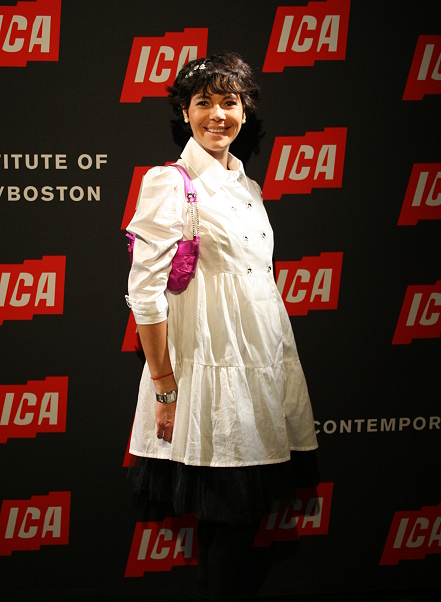
Ashley Olsen and Mario Russo at the Institute of Contemporary Art’s fashion fund-raising party last night. (bill brett for the boston globe).
FIDM Alumna Adriana Sassoon.
Wearable Art designer Adriana Sassoon & Tonn (Tonn Incorporated).
Adriana Sassoon, Wearable Art designer at the Institute of Contemporary Art’s fund -raising party last night.
By Mark Shanahan & Paysha Rhone
A bus full of cutting-edge designers rolled into Boston from NYC yesterday for the ICA 360 fashion soiree – and among them was diminu-twin Ashley Olsen, repping her line, the Row. Working the crowd at last night’s bash were designers Brian Reyes, Elise Overland, Jason Wu, Lyn Devon, Magda Berliner, Sari Gueron, Chris Benz, Maria Cornejo, and Bryan Bradley with Tuleh. But the star of the evening was actress/fashion designer Olsen. “The designers here are really inspiring,” she said in between photographs. “I’m a big fan of their work.”
In January 2007, Adriana Sassoon, was diagnosed with Hodgkin’s lymphoma. A former Elite model in her native Brazil, Adriana endured a frustrating series of biopsies in Miami, where the family was living. In search of the best care, Adriana quickly moved to Boston for treatment. Adriana recently celebrated her first cancer-free year.
SPECIAL THANKS FOR:
MY FATHER CLAUDIO & MARIA HELENA, DINDINHA & DINDINHO, ELAN, MY TWO BEAUTIFUL CHILDREN, MARY JOE, MARA & COU, ALL MY COUSINS, ALL MY UNCLES, AUNTS, ALL MY FRIENDS, MERCEDES, SONDRA, SOLEIL, MEENO, BENO, MIKE, KAY, ELISABETH, ESTHER,SIMON,VIDAL, RONNIE, BEVERLY, DR. SPIGELMAN, DR.DAVID C. FISHER, MICHELLE WALSH, SUSAN, DR.PETER MAUCH, DR. RAFAEL BUENO,THE CHILDREN AND THE VOLUNTEERS AT AMEAMOROSO, FOR ALL WHO STOOD BY MY SIDE.
DANA-FARBER EMPLOYEES: FOR ALL THE PEOPLE AROUND THE WORLD. ALL THE CARE GIVERS. NURSES, DOCTORS, VOLUNTEERS. WE NEED YOU! IN ORDER TO MAKE A DIFFERENCE IN THE WORLD OUT THERE! IF THERE ARE ANGELS …… I GUESS I HAVE MET THEM HERE ON EARTH.
EVERY YEAR, I WAS RACING FOR THE CURE! HELPING A GOOD CAUSE. WAS A GOOD WAY TO KEEP MY BODY IN GOOD SHAPE AND HELP TO SUPPORT THE RESEARCH FOR CANCER. GOD, IF I KNEW I WOULD BE NEXT…… WE NEVER KNOW. LIFE IS TO SHORT! TOO PRECIOUS.
LIVING LIFE, LOVING LIFE, LIFE PRECIOUS MOMENTS!
TIME ONLY MOVES FORWARD, DOESN’T COME BACK.
THAT’S WHY MEMORIES ARE PRECIOUS. MEMORIES LAST FOREVER!
FRIENDS AND FAMILY, MAKES WHO WE ARE!
DISEASE , NEAR DEATH EXPERIENCES MAKE US REALIZE NOTHING ELSE MATTERS. LIVE DAY BY DAY. CARPEDIEM! AKS
A look at how these fairy-tale breeds can be within reach of the everyday horse owner
For many people, owning a member of the Baroque family of horses is a far away dream. Known for their athletic ability, flowing manes and jaw-dropping beauty, they are often referred to as a “fairy-tale” breed. Despite Baroque breeds often being small in number and sometimes difficult to locate, we talked to some lucky owners and discovered that finding one of these beautiful horses to buy is a dream that could come true.
Andalusians, Lusitanos, Lipizzans, and Friesians all fall under the banner of “Baroque” breeds because they share the same ancient heritage, dating back to the Iberian Peninsula and 25,000 B.C. “Spanish” horses, as they were known, were used by the Ancient Greeks and Romans as cavalry mounts. As history progressed, the breed’s strength, agility and bravery made them favorites in warfare. Only in the last 100 years have these breeds started to reach America and now that they have, their versatility and temperaments are making them hugely popular. Despite this, breeding regulations are strict and if you are serious about owning a piece of history you have to have patience and the time to search.
Andalusians and Lusitanos
The breeds of horses known in the United States as the Andalusian and Lusitano are cousins, who trace their genetic roots back to two studbooks: one in Portugal, the other in Spain. For years, the studbooks in those two mother countries allowed cross-registry, and the horses were recognized as the same breed. When political maneuverings closed the studbooks of Spain and Portugal to each other in the late 1960s, people outside North America began to treat the two bloodlines as different breeds.
In 1967 Lusitanos were given their own studbook, and since then the number of purebred foals registered with the studbook has peaked at 1,800 in 2000.
The International Andalusian and Lusitano Horse Association believes that all purebred horses, whether of Portugese or Spanish descent, should be referred to as Andalusians and the association maintains the Purebred Andalusian Studbook, in which horses of both bloodlines continue to be eligible for registration. For the purpose of this article, the two breeds will be referred to separately.
Referred to by some as “the most versatile riding horse in the world,” Andalusians and Lusitanos made a name for themselves on the battlefield, where they were the favored mounts of war leaders and the nobility. Many paintings from the Renaissance feature generals and royalty astride their favored Andalusian and Lusitano warhorse.
As warhorses became obsolete, the breed progressed to schools of classical dressage and to the bullfighting arena, where once again their agility, intelligence, and bravery made them ideal participants.
Like Arabians and Thoroughbreds, Lusitanos are hot blooded, and according to the Lusitano Breed Society of Great Britain, were consistently used on the battlefield due to their compact body (which lent itself to being highly maneuverable). The Lusitano is a native of Portugal, and when warfare became less about precision the Lusitano progressed to the bullfighting arena, where once again their suppleness and nerve made them ideally suited. Today, the breed’s genetic disposition of maneuverability, according to one owner, means they can be “fantastic barrel racers and cowboy mounted shooting horses.” The breed is also known for its success in dressage, driving and show jumping, as highlighted by show jumping legend John Whitaker’s Lusitano stallion, Novilheiro.
Despite their steadily rising popularity and increasing numbers, Lusitanos remain quite expensive. According to Dr. Louise Turkula, owner of Lusitano breeding facility Casa Do Cavalo Real, a Lusitano may set you back between $10,000 and $25,000. However, don’t let this put you off if your heart is set on owning one of these versatile horses. They are known for their generous temperament and love for their owners; they are hardy and can weather the harshest climates and conditions. The breed is also known for their ability to remain calm and focused in stressful situations such as shows.
For Dr. Turkula, Lusitanos are well worth the money. “They are beautiful to look at, and the most comfortable horse to ride,” she says. Linda Denniston of the Eastern Region Andalusian Club says, “They are so sensitive to personal contact and they really enjoy being worked with. They are very much a rideable horse.”
Lusitanos average between 15.1 and 15.3 hands; however, they excel in high performance levels of training and have become champions in various disciplines. According to Linda, the breed is easy to train because of their intelligence. “They are easy as youngsters, and they will always remember you,” Linda adds.
Andalusians were imported from Spain, where their ancestry dates back to the 8th century Moors. Like their Lusitano cousins, Andalusians were used in wars because of their speed and agility. Due to the breed’s rarity and the Spanish wish to maintain Andalusian purity, there was an export ban until the 1960s and it wasn’t until 1965 that the first Spanish import was registered in America. Today, there are only around 2,500 Andalusians in the United States and the International Andalusian Horse Association registers around 220 new foals in America every year.
Interest in Andalusians, which range in height from 15.2 to 16.2 hands, is growing rapidly and while California and Texas own over half of the Lusitano and Andalusian population, the breeds are becoming more common in the east. Like the Lusitano, Andalusians are versatile and can be ridden English or western and have excelled in dressage, show jumping, cutting and driving. They are also known for their calm demeanor and family-friendly temperaments.
The International Andalusian and Lusitano Horse Association has recently begun an education program which aims to preserve the historical conformation and temperament of the Andalusian horse.
The IALHA is a great place to start your education on Andalusians and Lusitanos. Of course it is ideal to talk to someone locally who already owns one of the breeds, so that you can go and see them firsthand. Links to members and breeders across the country are provided on the IALHA website (www.ialha.org) to help you locate owners and breeders in your area.
Prices for Andalusians can vary greatly, from $7,000 for a purebred youngster to $55,000 depending on age, level of training and accomplishments. Unlike many common breeds, with an Andalusian you pay for their rarity.
The best advice for finding your first Lusitano or Andalusian is to buy one young and to do your research before you start making calls to set up appointments. Linda suggests you talk with your trainer and perhaps have them go with you to look at prospective youngsters. Dr. Turkula says, “Don’t just look for a color or long hair. Look at the gaits, listen to what the trainer has to say.”
Lipizzans
Lipizzans are one of Europe’s oldest domesticated horses. This breed is best known for its high-stepping gait and its ballet performances, in which specially trained horses perform classic equestrian skills known as haute êcole. The 430-year-old Spanish Riding School in Vienna is, “the only riding academy in the world where the Renaissance tradition of classical horsemanship is preserved.” The school and its classic techniques are responsible for increasing awareness of this incredibly athletic, graceful breed.
The Lipizzan Association of North America estimates that there are only around 1,500 Lipizzans in North America and a mere 2,000 throughout the rest of the world. If you look into breeding programs for Lipizzans, however, you will see that their small numbers are by design: breeders go to extreme lengths to maintain the purity of the breed, and their rarity is what attracts many prospective owners. The United States Lipizzan Registry says that “much effort has been expended to develop educational programs to foster voluntary adherence to traditional breed goals and objectives.”
Described by the United States Lipizzan Registry (USLR) as having “a rare combination of courage, strength, ability, temperament and intelligence,” it is understandable why people continue to strive to own a Lipizzan. Sandy Heaberlin, director of the Lipizzan Association of North America says, “Lipizzans possess intelligence, coupled with classic beauty and an athletic, harmonious way of moving. Lipizzans excel at several different disciplines, and possess beauty, strength and a willingness to work. Additionally, they are a long-lived breed and can still be under saddle and working into their mid-20s.”
While Lipizzans do not grow higher than 16 hands, Sandy believes that the breed’s round physique enables a taller rider to be comfortable in the saddle. Sandy also credits the breed’s ease to keep with their “sparkling personality, sensitive nature and good temperament.” The breed excels at all levels of dressage and driving. They are also ideal for pleasure riding.
As is true with Lusitanos and Andalusians, Sandy’s advice for anyone who is daunted by the thought of the cost of owning a Lipizzan is to purchase one young. “The price for weanlings and youngsters average $7,000 depending on where you look geographically,” she says. “The advantage of purchasing one young is that you get to bond with them; Lipizzans enjoy a relationship with their owners. A horse ready to go under saddle will begin at around $12,000, which compared to most Warmbloods and other European imports is a bargain.”
You can start your search by talking to other Lipizzan owners or by checking print ads and browsing the Internet. The Lipizzan Association of North America (www.lipizzan.org) gives advice on buying a Lipizzan and lists breeders. It also gives up-to-date news on events and clinics. You can also go to local shows and watch for Lipizzans in open or dressage classes. Most owners will be more than happy to talk about their horses and offer their knowledge and experience.
Lipizzans are the definitive horse people’s horse, and if you have your heart set on owning a piece of history, with enough searching it is possible to find one without breaking the bank.
Friesians
What most people notice about Friesians is their characteristic shiny black coats and their long manes. Today, the only white allowed for a Friesian to be considered pure bred is a small white star.
Friesians, originally bred as utility horses, are the only horse native to Holland and are easily recognizable by their beautiful black coats and their high step. Believed to be one of the oldest domesticated horses in the world, it is thought that Arabian and Andalusian bloodlines were introduced to Friesians to lighten the breed, giving them their characteristic gait and arching neck. This breed typically stands between 15 and 17 hands.
Andrea Harris of Pine Feather Farm in Acton, Mass., describes Friesians as “versatile, giving, forgiving and very light in their movements.” According to Andrea, no matter what discipline you enjoy most, your Friesian will be eager to please.
Friesians are known to be intelligent and very capable and the disciplines they excel in are dressage and driving, although they also compete successfully in saddle and hunt seat classes, western and dressage. While they are not widely known for it, Andrea says that some Friesians, particularly the modern ones, enjoy jumping.
“Friesians have become increasingly popular,” says Andrea. “They have been finding more support in local clubs and can be found competing in local open shows.”
As with the other Baroque breeds, costs associated with buying a Friesian vary widely. Andrea advises prospective buyers to purchase a youngster. “They’re quite easy to train,” she says, and for a Friesian with Ster status you will be looking at tens of thousands of dollars. A youngster can cost anywhere from $5,000 to $10,000 and for Andrea, a new owner has to determine what their goals are before they begin looking for their horse. “Look for something that could be the best at that discipline; your gut instinct with these horses is usually right. Once you’re a Friesian owner, you’ll understand,” she says.
A good place to start looking for your Friesian is with the Friesian Horse Association of North America, who can refer you to local clubs and associations. If you visit http://www.fhana.com you can look at the history of the horse and see how the rating system works. You will also find horses for sale and contact information for people who already own a Friesian who may be more than happy to share their knowledge and experiences with you.
Just like finding a pedigree breeder for the family dog, owning a Baroque breed takes time, dedication and research. A prospective owner must decide what they want to use their horse for and whether the breed is for them. None of the Baroque breeds are prohibitively expensive if you are willing to start with a youngster, and there are always local owners eager to share their knowledge and experience. If owning a horse is still a far-away dream, why not try to find someone who wants to lease out their Baroque horse? You could offer to help out at a breeder’s barn in exchange for riding privileges while you learn about the breed. Don’t let the small numbers put you off: Baroques are horse people’s horses, and once you own one, you won’t go back.
Thank you to the following people for helping with this article: Sandy Heaberlin, Director of the Lipizzan Association of North America; Dr. Louise Turkula, Casa Do Cavalo Real; Linda Denniston of the Eastern Region Andalusian Club; Andrea Harris of Pine Feather Farm; Courtney Tripp of Tempel Lipizzans; and members of the IALHA.
The Cadre Noir is an equestrian display team based in the city of Saumur in western France. The troop was founded in 1828, and gets its name from the black uniforms that are still used today. It is one of the most prestigious horsemanship school in the world.
In 1972, the National School of Équitation was constituted around the Cadre Noir, which form its core teaching staff. Today, there are about 50 horses and a team of elite riders, usually limited to 22. The members of the Cadre Noir are either under a civilian or a military status. Some of the riders have reached the highest level of international sport, being olympic or world champions.
The equitation on which the school is built was taught by Francois Robichon de la Gueriniere, the French riding master to King Louis XV and author of the book École de Cavalerie, which was published in 1731.
The Cadre Noir mainly uses Thoroughbreds, Anglo-Arabians, Hanoverians and Selle Français, but also keeps Lusitano horses to demonstrate the 16th and 17th century baroque style of riding. The Thoroughbreds and Anglo Arabians are used for the Grand Prix dressage, and perform individually, pas de deux (two horses), pas de trois (three horses), and dûe quantité (four or more horses). They may be either displayed in hand or ridden.
The Selle Français are used to display the ‘airs above the ground.’
A jumper of the Cadre Noir de Saumur national equestrian school performs with his horse 22 September 2006 at the Haras du Pin in Le Pin au Haras, center France, during a show “Generation Haras” directed by Mario Luraschi during celebrations for the 200th anniversary of the re-establishment of the national Haras by emperor Napoleon. The haras of France, the National Studs or breeding farms, are one of the country’s oldest administrations. They were created under Louis XIV by his financial advisor Colbert in 1665. During the French Revolution when everything that smacked of royalty was destroyed or ransacked, the haras were abolished and not re-established until 1806 by Napoleon, who favored Arabs as his mount of choice. The early role of the haras was essentially military and now has evolved to coordinate the various activities of the French horse industry. AFP PHOTO / JEAN FRANCOIS MONIER AFP PHOTO JEAN-FRANCOIS MONIER (Photo credit should read JEAN FRANCOIS MONIER/AFP/Getty Images)
” To speak with a horse, there does not need words. It is a carnal pressure which feeds our dreams.”Bartabas
The tradition, is the deformation of a message through the multiple chain links. It arrives one moment when
it is necessary to return at the origin.” Pierre Boulez














 Andalusians, Lusitanos, Lipizzans, and Friesians all fall under the banner of “Baroque” breeds because they share the same ancient heritage, dating back to the Iberian Peninsula and 25,000 B.C. “Spanish” horses, as they were known, were used by the Ancient Greeks and Romans as cavalry mounts. As history progressed, the breed’s strength, agility and bravery made them favorites in warfare. Only in the last 100 years have these breeds started to reach America and now that they have, their versatility and temperaments are making them hugely popular. Despite this, breeding regulations are strict and if you are serious about owning a piece of history you have to have patience and the time to search.

 ADRIANA SASSOON