My cousin´s work.
Digital GALLERY by Alessandra Galdeano
My cousin´s work.
My cousin´s work.

The Sessions Colour Calculator is an interactive colour wheel that helps designers select HTML, RGB, or CMYK colours and identifies colour harmonies and schemes. Our Colour Wheel works faster than any other colour wheel or html colour chart.
Designers may save HTML safe colour values, CMYK color schemes, or RGB colours to an integrated clipboard and email the colours to colleagues or clients. You can also rotate shapes on the colour wheel to identify harmonious color schemes, adjust the saturation and lightness of colours, or select a colour plan to use for a corporate identity or design project.
Colours may be selected and applied to both print and Web design – the Sessions color wheel color calculator saves hours of work. A color scheme can be further refined by choosing different designs or patterns with different complexity levels.
For a thorough examination of Colour, its systems, interactions and how to advantageously use this knowledge in art and design, please see Colour Theory.


Ecotones: Mitigating NYC’s Contentious Sites
Given the global and local challenges of climate change, the Landscape Architecture profession is at the forefront of New York City’s sustainability efforts.
Collaborating with governments, regulatory agencies, community groups, and design professionals, Landscape Architects are transforming ecological problems into opportunities for habitation and recreation.
With Mayor Michael R. Bloomberg’s sustainability plan, plaNYC, in place, the challenge is to understand the interconnectedness of the City’s green spaces.
Ecotones are transition zones between adjacent ecosystems.
In urban environments they emerge as contentious sites located between disparate or opposing forces: where industry meets the river; where community and industrial uses collide; where public and private interests merge.
These areas are often the unconsidered result of infrastructure improvements and building developments yet have the potential to be cultural and ecological mitigators.
The projects in this exhibition show us how sustainable practices, specifically, the collecting, cleansing, and reclaiming of water, can be used to mediate conflicting circumstances, integrating technical solutions with the social and cultural considerations that make for vibrant urban spaces.
more: www.aiany.org/centerforarchitectu… (28)
design directory: Center for Architecture > Architecture Galleries

http://www.leshommesfashion.com/
One thank you: Jean-Paul Lespagnard, and just one adjective:
JACQUELINE-DANCING-TRAMPOLINE-JUMPING-AVAF-NEON-PYRAMID-PRISM-SINGING-VAVA-BUBBLE-GROOVING-SILICONE-SPERMIN-ZODIAC-BUCKET-CHAMPAGNE-FLOWING-WANG-DU-ZODIAC-MYSTERY-POLE-BREAKDANCING-JOHN-KNOLLET-MARC-TURLAN-CUTTING-CRUNCHY-WEARING-I-LOVE-JP-STICKERING-ALAIN-DELON-DOOR-TRASHIN-GLASSES-BREAKIN-KOLKOZE-FRAMING-OURSLER-SMOKING-GOOD.


Ryan Gander, The Boy Who Always Looked Up, 2003. 200 children’s storybooks on a shelf, 14 1/8 x 78 3/4 x 6 3/4 in. (35.9 x 200 x 17.1 cm)
The British artist Ryan Gander weaves subtle tapestries of fact and fiction. His idea-based practice, his handling of the details of life and his own biography, art history and the artistic process, even obscure fables and puzzles—all of these he synthesizes into myriad forms, from sculpture to installation, the printed word, performance, and intervention.
He has created, for instance, an installation in which viewers are positioned on the wrong side of a cinema screen, and a book on high-rise living that is positioned above the audience’s heads. In What the Postman Brought (2007), disparate items are loosely collected, and viewers are invited to complete the space between the (missing) objects.
Gander’s cerebral but playful puzzle incorporates various visual clues: the painting of the American artist Mark Tansey (whose work is similarly allusive, often exploring abstract concepts through somewhat realistic images), a children’s adventure-mystery book whose story develops as puzzles are solved, and the Irish comedian Spike Milligan’s ironic and emotionally raw writings.
An Incomplete History of Ryan Gander
by Jens Hoffmann
The London-based artist Ryan Gander connects what appear upon first glance to be prosaic historical facts and events with a large collection of fictional and semifictional elements. His works include photographs, drawings, films, installations, sculptures, and even lectures, all of them intertwined by a fractured, opaque narrative that threads through his entire oeuvre. The finished pieces are surprisingly minimal, but they suggest a variety of points of reference, from the utopian impulses of the early twentieth century to contemporary popular culture and mundane aspects of everyday life.
The Boy Who Always Looked Up (2003) exemplifies Gander’s approach perfectly. The primary component of the piece is a children’s book that the artist wrote himself about a boy in a small house across from the infamous Trellick Tower, which was designed by the British modernist architect Ernö Goldfinger in London’s Notting Hill. The story of the building and its creation is told through the eyes of the child, and a large number of exquisite illustrations show him watching its construction. A minimalist bookshelf holding numerous copies of The Boy Who Always Looked Up is installed high on the museum or gallery wall, out of the audience’s reach. Only in the bookshop can viewers actually handle and acquire the book so that they can finally read the story after leaving the exhibition space. The fact that Goldfinger was the neighbor of Ian Fleming (author of the renowned James Bond spy novel series) in London’s Highgate neighborhood and the inspiration for the Bond character Goldfinger is something that the artist carefully notes in a separate piece as part of his ongoing lecture series Loose Associations 2.1 (begun 2002). Both works are part of a larger group that Gander calls An Incomplete History of Ideas (2002–6).
Another work from this same group, also dealing with both the legacy of modernism and the world of children, is Bauhaus Revisited (2003), a chess set designed in 1924 by Josef Hartwig, a master craftsman at the Bauhaus in Weimar, Germany. The chess set’s unique concept is that the shapes of the pieces indicate what moves can be made with them. It was originally intended to be mass produced but never went into production; Gander fabricates it as a unique piece of art using zebrawood, a rare, endangered wood found only in the rainforests of central Africa. The material’s black-and-white patterning makes it impossible to tell which side the pieces are supposed to be on, so the game cannot be played and the chess figures become, essentially, old-fashioned-looking children’s building blocks.
One of Gander’s most complex and yet most characteristic pieces is What the Postman Brought (2007), a subversion of museum display standards. It consists of four elements, three of which are missing. The fourth functions as a wall label, giving the viewer some clues about what might be going on in the absent parts. There are two nails in the wall, but the painting that is supposed to be hanging there (The Bricoleur’s Daughter [1987] by Mark Tansey) is gone. There is a bookstand, but the book (The Adventures of the Black Hand Gang [1976] by Hans Jürgen Press) has also disappeared. And the empty frame, we learn, was supposed to hold two documents from the unpublished writings of the Irish comedian Spike Milligan.
The film that Gander is presenting in his solo Passengers exhibition, Is This Guilt in You Too (Study of a Car in a Field) (2005), again employs a child as the narrator. In an enclosed space with white walls and white carpet, we watch a one-minute video loop of a car stuck in a snowy landscape near a group of trees. The camera slowly zooms in from above toward the car, and a voice-over by a young girl continues for about 15 minutes while the projection loops again and again. The girl speculates, just as we do, on how the car got there, describing carefully what we see on the screen.
Gander’s works are uncommonly hard to decipher. He sends us on a journey that is less about trying to arrive at an intellectual understanding and more about engaging in a form of detective work, which is often linked to the history of larger social structures and their relationships to the human condition. He lays out the evidence and asks us to study it carefully, connecting the different elements and forming our own personal relationship with them.

Tschumi’s Parc de la Villette in Paris.
It’s a precursor to Chicago’s Millennium Park.
The two urban parks do share a certain – object or form. At Parc de la Villette it looks like this:
” La Geode ” in the Paris park doubles as an IMAX Theater.
It shines and reflects and curves space in much the same way as a certain shiny object in a certain Chicago park that we have certainly written about – ” Cloud Gate ” – because that one is a shiny work of genius and we can’t get enough of it.
This, not purely round but in intriguing shapes, is a far superior work of art than the Geode in Paris. Theirs reflects space a la Newton, but ours bends space and light a la Einstein.
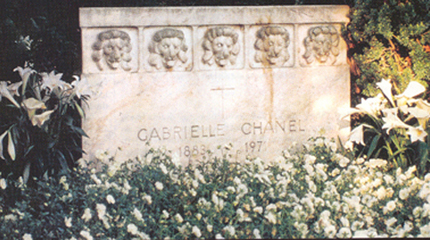
| Gabrielle Bonheur Chanel | ||||||||||||||||||||||
|
|
|||||||||||||||||||||

How Luxury Lost Its Luster
By Dana Thomas
Illustrated. 375 pages. The Penguin Press. $27.95.
With “Deluxe: How Luxury Lost Its Luster,” Ms. Thomas — who has been the cultural and fashion writer for Newsweek in Paris for 12 years — has written a crisp, witty social history that’s as entertaining as it is informative. Traveling from French perfume laboratories to Las Vegas shopping malls to assembly-line factories in China, she traces the evolving face of the luxury goods business, from design through marketing to showroom sales.
She gives us some sharply observed profiles of figures like Miuccia Prada, who was a Communist with a doctorate in political science when she took over her family’s small luxury goods business in 1978, and the business tycoon Bernard Arnault, who relentlessly built LVMH into a luxury monolith with dozens of brands (including Louis Vuitton, Givenchy and Dior) sold around the world.
Ms. Thomas peppers her narrative with lots of amusing asides about everything from how orange became Hermès’s signature color because it was the only color widely available during World War II to the money-saving benefits of raw-edge cutting, which has been marketed to the public as a cutting-edge, avant-garde innovation.
But her focus remains on how a business that once catered to the wealthy elite has gone mass-market and the effects that democratization has had on the way ordinary people shop today, as conspicuous consumption and wretched excess have spread around the world. Labels, once discreetly stitched into couture clothes, have become logos adorning everything from baseball hats to supersized gold chains. Perfumes, once dreamed up by designers with an idea about a particular scent, are now concocted from briefs written by marketing executives brandishing polls and surveys and sales figures.
With globalization, Paris and New York are no longer exclusive luxury meccas. Ms. Thomas notes that a gigantic 690,000-square-foot luxury mall called Crocus City (featuring 180 boutiques, including Armani, Pucci and Versace) is flourishing outside Moscow, and that a group of high-end boutiques will be part of a luxury complex called Legation Quarter, scheduled to open in Tiananmen Square later this year.
“Approximately 40 percent of all Japanese own a Vuitton product” today, she says, and one recent poll showed that by 2004 the average American woman was buying more than four handbags a year. With more people visiting Caesars Palace’s glitzy Forum Shops each year than Disney World, Las Vegas has made shopping synonymous with gambling and entertainment, even as outlet malls have brought designer clothing and accessories within the reach (and budget) of many suburbanites.
High-profile luxury brands like Louis Vuitton, Hermès and Cartier were founded in the 18th or 19th centuries by artisans dedicated to creating beautiful, finely made wares for the royal court in France and later, with the fall of the monarchy, for European aristocrats and prominent American families. Luxury remained, writes Ms. Thomas, “a domain of the wealthy and the famous” until “the Youthquake of the 1960s” pulled down social barriers and overthrew elitism. It would remain out of style “until a new and financially powerful demographic — the unmarried female executive — emerged in the 1980s.”
As both disposable income and credit-card debt soared in industrialized nations, the middle class became the target of luxury vendors, who poured money into provocative advertising campaigns and courted movie stars and celebrities as style icons. In order to maximize profits, many corporations looked for ways to cut corners: they began to use cheaper materials, outsource production to developing nations (while falsely claiming that their goods were made in Western Europe) and replace hand craftsmanship with assembly-line production. Classic goods meant to last for years gave way, increasingly, to trendy items with a short shelf life; cheaper lines (featuring lower-priced items like T-shirts and cosmetic cases) were introduced as well.
Although this volume quotes Anna Wintour, the editor of Vogue, saying such changes mean that “more people are going to get better fashion” and “the more people who can have fashion, the better,” the author reaches a more elitist and pessimistic conclusion. “The luxury industry has changed the way people dress,” she writes. “It has realigned our economic class system. It has changed the way we interact with others. It has become part of our social fabric. To achieve this, it has sacrificed its integrity, undermined its products, tarnished its history and hoodwinked its consumers. In order to make luxury ‘accessible,’ tycoons have stripped away all that has made it special.
“Luxury has lost its luster.”
 ADRIANA SASSOON

