Civil Court for Madrid from Zaha Hadid

by Ali Kriscenski


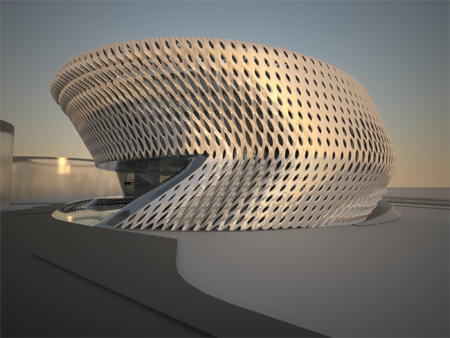
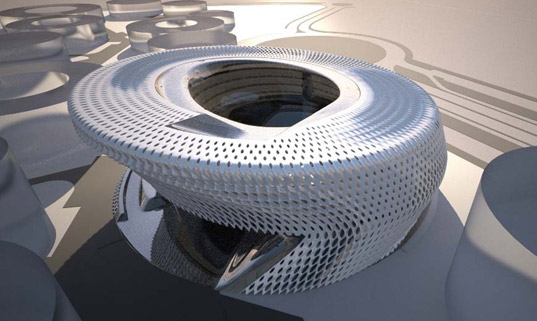
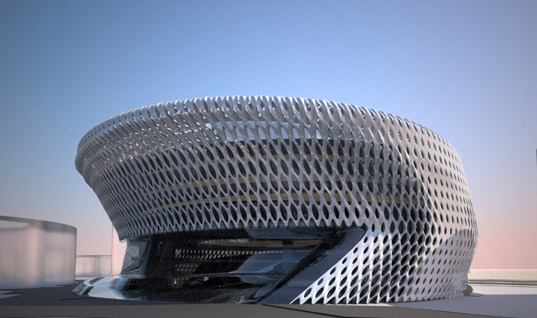
It is difficult to ignore the designs of Pritzker Prize winning architect Zaha Hadid. Bold, brave, often controversial – her ambitious experiments in form always seem to stir discourse and debate. Hadid’s design for the new civil courts building in Madrid is no exception. Planned as part of the new Campus de la Justicia at Valdebebas in the Spanish capital city, Hadid’s Civil Court is expected to become a focal point among works from Norman Foster, IM Pei and others. While we are not always big fans of Hadid’s obsession with form, we are intrigued by the “intelligent” façade of this Madrid courthouse, that in addition to being extremely eye-catching, is intended to regulate the building’s indoor environment.

It is of course the intelligent façade that caught our eye with this design. Made of metallic panels, this double-ventilated envelope is a dynamic, moving component that will respond to the environment by opening and closing. We only have an abstract understanding based on the architect’s website, but it sounds like heating, cooling and ventilation will all be moderated and control through this intelligent façade. On the roof, these metal panels will include integrated photovoltaic cells.

The proposed 74,500 square meter (~800,000 square foot) building features a spiraling semi-circular atrium that overlooks an interior public courtyard. This space is meant to draw visitors and connect the building with the surrounding campus. The atrium also brings natural light down through the building and into court rooms.

The project is slated for completion within two years and, as with all of Zaha Hadid’s extreme designs, we definitely plan to follow the progress and check it out in its final form. Always interesting and thought provoking (both good and bad), there is something about the work of this architect that just keeps her in our sights. It will be interesting to see if her latest design


PONTE AGUA ESTAIADA

PARQUE DO IBIRAPUERA

A Ponte Estaiada é o novo cartão postal de São Paulo. Nada como um dia depois de outro. A ponte da Marta era “um absurdo”, “desnecessaria”. Serra-Kassab chegaram a suspender a obra durante um ano tendo que pagar multa depois. As infâmias e ataques, também rejeitados pela justiça e, neste caso, até pela própria administração municipal, eram moeda corrente. Hoje o Jornal da Tarde a erige no novo cartão postal da cidade.

Ela destrona outra obra de Marta, a fonte de Ibirapuera. Outrora acusada de poder infectar o público e de atrapalhar o trânsito, a fonte já foi utilizada como fundo para os programas da rede Globo.

 KINETICS BY PHILIPS

Como será a sua casa em 2013? Em uma época em que a tecnologia evolui mais rápido que a vida útil de um iPod, responder a esta pergunta pode ser um tanto complicado. Mas algumas pistas do que está por vir estão espalhadas nas tendas brancas sob a recém-construída – e moderníssima – ponte estaiada da marginal do rio Pinheiros, em São Paulo. Na mostra The Simplicity Event, evento da Philips que já passou pela Holanda, Inglaterra, Estados Unidos e China, cinco ambientes exibem os protótipos e produtos-conceito que a fabricante de eletroeletrônicos holandesa espera que você use daqui a cinco anos de uma forma tão natural quanto é usar hoje um rádio de pilhas. Em comum, todos tentam aliar tecnologia a um belo design para atender de forma simples os desejos de consumidores de todo o mundo.

Cada espaço da mostra é dedicado a um tema. No Ouça o seu corpo, a idéia é prevenir o que será mais difícil e caro de remediar depois com aparelhos que promovem uma vida mais saudável. Luz e sons também ajudam nesta tarefa, como ajudam a entender as estações Cuide do seu corpo e Relaxe a Mente. Nelas, aparelhos usam freqüências de luz para despertar, relaxar e energizar seus usuários, enquanto outros tornam os ambientes da casa mais confortáveis e divertidos.

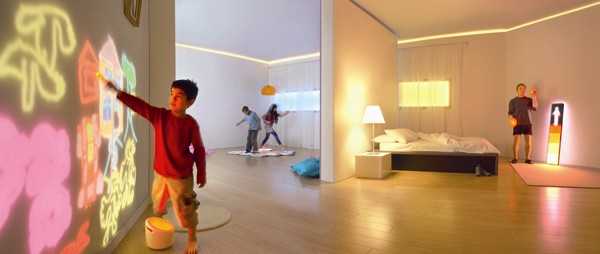
“Nada de inércia” é o lema do espaço Mexa o seu corpo, em que pisos interativos e paredes luminosas entretêm as crianças enquanto seus pais se exercitam com um personal-trainer virtual. E, na era da hiperconectividade, não poderiam faltar os aparelhos mostrados na estação Compartilhe Experiências, como o porta-retrato digital que envia e recebe fotos e uma tela sensível ao toque criada para enviar e receber mensagens de texto e vídeo. “Nem todos estes produtos irão para o mercado”, diz Stefano Marzano, diretor mundial de design. “Nossos testes mostram que alguns atendem a um público mais amplo, e são estes que levaremos à frente”.

Aparelhos com funcionamentos e formas tão diferentes têm todos um mesmo conceito por trás: usar a tecnologia para criar um estilo de vida mais harmonioso. Desde 2004, este tem sido o lema – e a estratégia de negócios – da Philips. Isso significa inverter o paradigma da tecnologia pela tecnologia em nome de uma abordagem mais humanizada com tecnologias sintonizadas com as necessidades de pessoas comuns. “Não somos mais uma empresa orientada para tecnologia, mas para o consumidor”, diz Geert van Kuyck, diretor mundial de marketing da companhia.

Esse foco diferenciado está dando certo para a empresa. Avaliada em US$ 7 bilhões, a Royal Philips Electronics já ocupa a 42ª posição no ranking internacional de marcas mais valiosas do mundo elaborado pela consultoria Interbrands. A empresa foi eleita a 38ª mais inovadora pela revista Business Week em 2007. “Nos últimos cem anos, as empresas se esforçaram para criar a próxima grande onda e todos seguiam atrás”, diz van Kuyck. “Nos próximos cem, será muito mais importante entender primeiro os problemas dos consumidores para só então trazer soluções na forma de produtos”.

Confira abaixo uma galeria com os principais destaques de cada estação da mostra:

PINTANDO O SETE: com Drag & Draw, pintar a parede é permitido. As crianças escolhem as cores no balde eletrônico, que projeta na parede os traços feitos com uma caneta especial. Depois, elas podem adicionar som e movimento aos desenhos

CONFORTO: Na sala de estar do futuro, o conforto não vem só do sofá. Luzes coloridas e sombras são projetadas para gerar sensações e complementar o clima criado com o sistema de som moderno (sobre a prateleira) que mais parece uma obra de arte

ESPELHO, ESPELHO MEU: o InForm avalia o peso, gordura e hidratação do corpo do usuário e mostra os resultados e até dá informações sobre o período fértil feminino por meio de uma tela que parece um espelho quando desligada

RELAXE: o Soft Therapy reduz a tensão muscular com uma combinação de calor, massagem vibratória e raios infravermelhos. Como o colete não tem fios, pode ser usado enquanto se anda dentro de casa. E é tão fino que dá para colocá-lo embaixo da roupa

VOCÊ TEM UMA MENSAGEM: o InTouch é a versão moderna do quadro de recados. Com a sua tela sensível ao toque, dá para escrever nele com uma caneta especial e enviar recados via internet para os amigos. Também permite gravar mensagens de vídeo

Woman works to light up Boston’s skyline

One woman is working on painting parts of the Boston skyline’s canvas with light.

Lana Nathe of Light Boston, and 30 other lighting experts, want to add modern lighting designs to structures around the city. They hope to thrust Boston further into the international spotlight.

Nathe has already made her impact felt – she re-lighted the Old North Church for former president Bill Clinton’s visit last fall.

Light Boston’s long-term goal is to light nine buildings known as the “Diamond Necklace.” Short term, they are focusing on the Convention Center.

While Phillips will donate some of the supplies, including energy-efficient lightbulbs, Nathe hopes the rest of the bill will be paid for with private donations and grants.

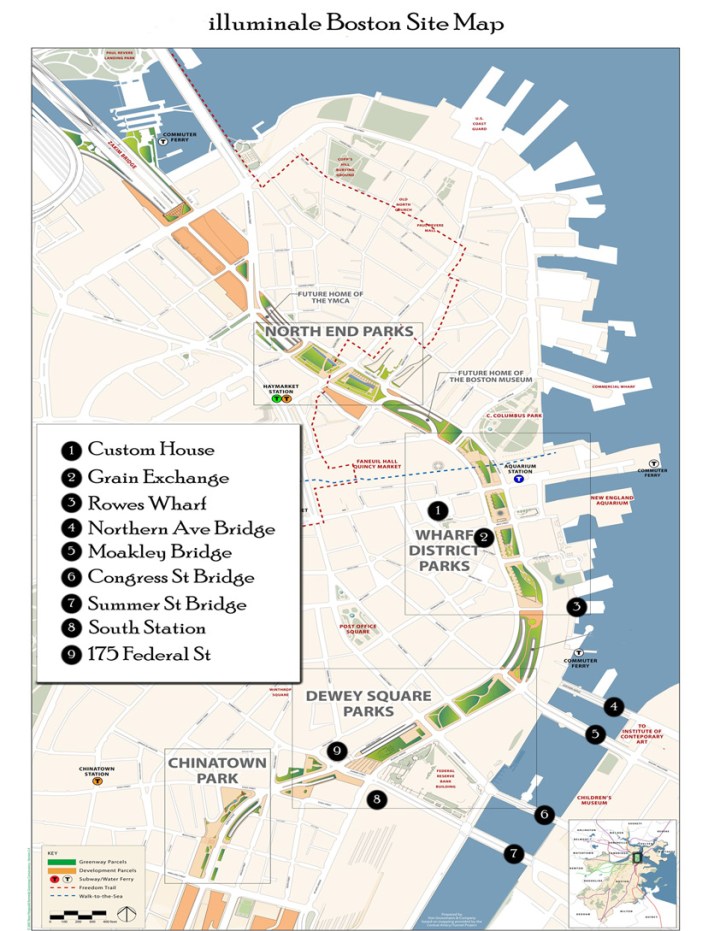
Light Boston, Inc.’s mission since 1996 ,is to illuminate 25 Historic Boston bldgs “permanently” – one of these buildings is included in the illuminate Boston’s First Festival of Light, which will temporarily illuminate 10+ bldgs & bridges along the Seaport & Fort Point Channel in Boston in mid October founded by Lana Nathe in 2007.

http://www.colorkinetics.com/

About Energy Conservation

Energy Efficient LED Lighting and Technologies

Rapid advancements in LEDs and the global need for energy efficient lighting alternatives are creating opportunities to replace conventional light sources with LED lighting for general illumination. LED lighting is gaining momentum for many reasons, and chief among them is energy efficiency.

With the landmark signing of the Energy Policy Act of 2005, and other nations similarly devoting resources to energy conservation, the potential impact of LED lighting is increasingly gaining national and global attention. A 2001 Department of Energy study estimated cumulative savings of $98 billion by 2020 once LED lighting reaches the performance crossover with conventional sources. Philips Solid-State Lighting Solutions believes this day is approaching faster than ever anticipated.

Today Philips’ energy efficient lighting systems deliver big visual impact without the big energy drains. Yet LED lighting can achieve energy savings on a much larger scale as it becomes more applicable to general illumination. With the introduction of EssentialWhite™ and IntelliWhite™, Philips now addresses specialty white light applications while developing systems that will meet the growing opportunity to cost-effectively apply LEDs for general illumination.

http://www.colorkinetics.com/lightfair/

Energy Costs
Energy consumption reduced from 8,000 watts to 600 watts total

The Ponca City Memorial Fountain has long been a community focal point, engaging residents and visitors since its construction in 1925. When the fountain was last renovated in 1980, the lighting scheme called for 250-watt incandescent fixtures with red, green and blue lenses to create colored effects. This resulted in a maintenance challenge and little ability to actually control the illumination.

Cost of Light

The opportunities to replace conventional lighting with LED lighting for general illumination are growing, fueled in part by the continual advancements in LEDs and the global need for energy-efficient lighting alternatives. Performance is an important metric for assessing the viability of replacement by LED sources. These devices that once merely lit calculators and cell phone displays can now illuminate an airport terminal or a 100 foot building façade. They increasingly match or exceed the efficacy of conventional lighting sources, particularly with the advent of today’s power LEDs. In fact, the efficacy of LED sources, measured in lumens per watt, is eclipsing that of incandescent and halogen sources.As a result, Philips Solid-State Lighting Solutions’ systems are displacing conventional lighting methods in a number of applications where LEDs were previously thought impractical. And this exciting trend continues. Performance is improving rapidly in the intensely competitive LED supplier field where current data from these manufacturers shows LED performance ahead of forecasted levels, and the cross over point for matching the efficacy of fluorescent sources outpacing the predictions made just a few years ago. Yet performance is only one metric.Matching the cost of conventional lighting is another critical element for replacement to occur. The true measure of cost goes beyond just the initial cost of the lighting system and incorporates lifetime and operational costs as well. For example, an incandescent source may only have an initial cost of fifty cents, yet its energy consumption will cost more than ten times that over its relatively short life, when a new source must be purchased and the cycle starts again. The metric that accounts for all of these factors is called the Cost of Light. This is the measure that sophisticated customers, such as those managing large buildings, use to compare the true cost of illumination. Intelligent LED lighting systems are intersecting the Cost of Light of incandescent and halogen sources and are rapidly approaching the economic cross over point for fluorescent sources. A white paper is available for more detailed information.

These are Philips estimates, and are not indicative of future performance. Decreasing operational and lifetime costs, together with improved LED performance, enable a wide spectrum of new applications.


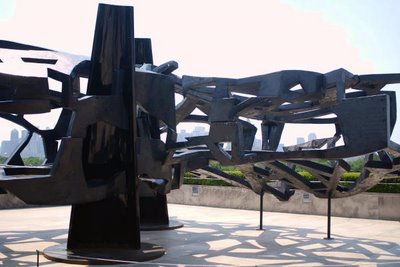
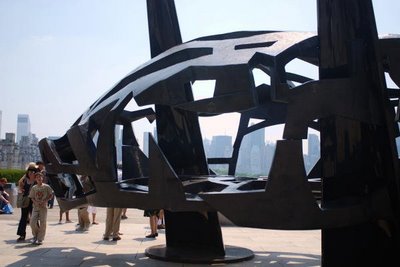
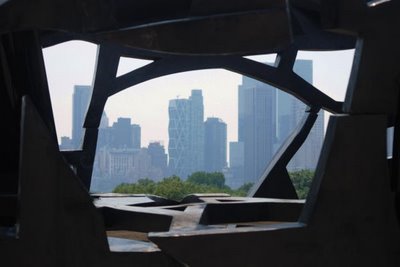
Earlier today, I visited the special exhibition at the Metropolitan Museum of Art called “FRANK STELLA ON THE ROOF,” featuring the recent works in stainless steel and carbon fiber by the prolific American artist Frank Stella (b. 1936) at the Iris and B. Gerald Cantor Roof Garden. This sculpture exhibition marks the artist’s first solo presentation at the Met, simultaneous with Frank Stella: Painting into Architecture, on view through July 29. The roof garden, aside from being an exciting outdoor space for sculpture, offers spectacular views of Central Park and the Manhattan skyline.


ALYSON SHOTZ

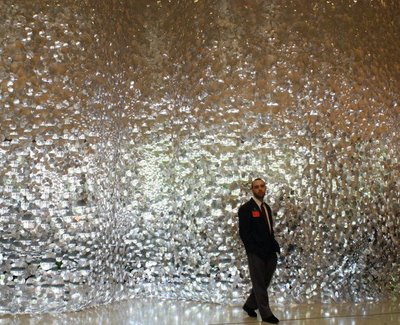
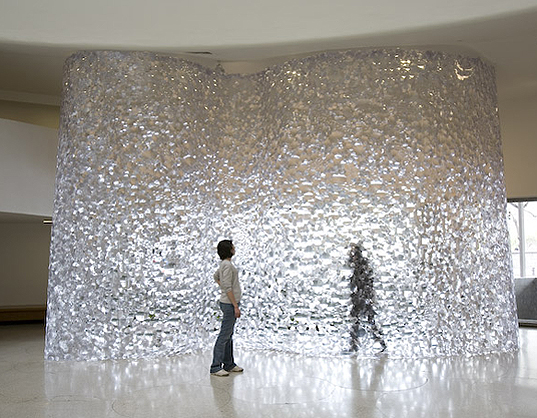
Displayed at the ground floor of the SOLOMON R. GUGGENHEIM MUSEUM is the mesmerizing panel made of cut plastic Fresnel lens sheets and staples, designed by ALYSON SHOTZ. A Fresnel lens is a type of lens invented by French physicist Augustin-Jean Fresnel, originally developed to focus the beam in lighthouse lamps. Fresnel lenses are used in the lens of traffic signals and to shape the light beam in overhead projectors as well as in molded plastic versions which are sometimes placed on the rear windows of motorhomes to broaden the drivers rearward field of view.

From http://science.howstuffworks.com: “The basic idea behind a Fresnel lens is simple. Imagine taking a plastic magnifying glass lens and slicing it into a hundred concentric rings (like the rings of a tree). Each ring is slightly thinner than the next and focuses the light toward the center. Now take each ring, modify it so that it’s flat on one side, and make it the same thickness as the others. To retain the rings’ ability to focus the light toward the center, the angle of each ring’s angled face will be different. Now if you stack all the rings back together, you have a Fresnel lens.”

SHOTZ’ work is made of thin commercial type of Fresnel lens sheet of bendable plastic cut into circular or oval pieces and stapled together cascading from the roof to the floor. This installation is part of a special exhibit called THE SHAPES OF SPACE which “makes visitors aware not only of the ways in which space is manifested within art but also the different ways in which art can engage its surroundings and reorient the viewer’s own position within space.”

Tarsila do Amaral

Tarsila do Amaral
Birth name Tarsila do Amaral
Born September 1, 1886
Capivari, São Paulo, Brazil
Died January 17, 1973
São Paulo, Brazil
Nationality Brazil
Field Painter

Tarsila do Amaral, (b. September 1, 1886 in Capivari, São Paulo,– d. São Paulo on January 17, 1973).

Tarsila do Amaral, known simply as Tarsila, is considered to be one of the leading Latin American modernist artists, described as “the Brazilian painter who best achieved Brazilian aspirations for nationalistic expression in a modern style.” She was a member of the Grupo dos Cinco (Group of Five), which included Anita Malfatti, Menotti del Picchia, Mário de Andrade, and Oswald de Andrade.

Biography Tarsila was born in the city of Capivari, part of the interior of São Paulo, Brazil, to a wealthy family who were coffee growers and landowners. Her family’s position provided her a life of privilege. Although women of privilege were not expected to seek higher education, her parents supported her educational and artistic pursuits. During her teens, Tarsila and her family traveled to Barcelona, where she attended school and first exhibited her interest in art by copying images seen in the school’s collections.

Beginning in 1916, Tarsila studied sculpture in São Paulo with Zadig and Montavani. Later she studied drawing and painting with the impressionist painter Pedro Alexandrino. These were all respected but conservative teachers. In 1920, she moved to Paris and studied at the Académie Julian and with Emile Renard. The Brazilian art world was conservative, and travels to Europe provided students with a broader education in the areas of art, culture, and society. At this time, her influences and art remained conservative.

Brazilian modernism

Portrait of Oswald de Andrade by Tarsila do Amaral, 1922.

Portrait of Oswald de Andrade by Tarsila do Amaral, 1922.

Returning to São Paulo in 1922, Tarsila was exposed to modernism after meeting Anita Malfatti, Oswald de Andrade, Mario de Andrade, and Menotti del Picchia. Prior to her arrival in São Paulo from Europe, the group had organized the Semana de Arte Moderna (“Week of Modern Art”) during the week of February 11-18, 1922. The event was pivotal in the development of modernism in Brazil. The participants were interested in changing the conservative artistic establishment in Brazil by encouraging a distinctive mode of modern art. Tarsila was asked to join the movement and together they became the Grupo dos Cinco, which sought to promote Brazilian culture, the use of styles that were not specifically European, and the inclusion of things that were indigenous to Brazil.

During a brief return to Paris in 1923, Tarsila was exposed to Cubism, Futurism, and Expressionism while studying with André Lhote, Fernand Léger, and Albert Gleizes. European artists in general had developed a great interest in African and primitive cultures for inspiration. This led Tarsila to utilize her own country’s indigenous forms while incorporating the modern styles she had studied. While in Paris at this time, she painted one of her most famous works, Le Negra (1923). The principal subject matter of the painting is a large negroid female figure with a single prominent breast. Tarsila stylized the figure and flattened the space, filling in the background with geometric forms.

Excited about her newly developed style and feeling ever more nationalistic, she wrote to her family in April 1923:

“I feel myself ever more Brazilian. I want to be the painter of my country. How grateful I am for having spent all my childhood on the farm. The memories of these times have become precious for me. I want, in art, to be the little girl from São Bernardo, playing with straw dolls, like in the last picture I am working on…. Don’t think that this tendency is viewed negatively here. On the contrary. What they want here is that each one brings the contribution of his own country. This explains the success of the Russian ballet, Japanese graphics and black music. Paris had had enough of Parisian art.”

 Pau-Brasil period

Oswalde de Andrade, who had become her traveling companion, accompanied her throughout Europe. Upon returning to Brazil at the end of 1923,Tarsila and Andrade then traveled throughout Brazil to explore the variety of indigenous culture, and to find inspiration for their nationalistic art. During this period, Tarsila made drawings of the various places they visited which became the basis for many of her upcoming paintings. She also illustrated the poetry that Andrade wrote during their travels, including his pivotal book of poems entitled Pau Prasil, published in 1924. In the manifesto of the same name, Andrade emphasized that Brazilian culture was a product of importing European culture and called artists to create works that were uniquely Brazilian in order to “export” Brazilian culture, much like the wood of the Brazil tree had become an important export to the rest of the world. In addition, he challenged artists to use a modernist approach in their art, a goal they had strived for during the Semana de Arte Moderna.

During this time, Tarsila’s colors became more vibrant. In fact, she wrote that she had found the “colors I had adored as a child. I was later taught they were ugly and unsophisticated.”  Her initial painting from this period was E.C.F.B.(Estrada de Ferro Central do Brasil), (1924). The painting represented the new railway that linked Rio de Janeiro to São Paulo, and contained many aspects of the industrial city, such as rail bridges, rail cars, telephone poles, and signals. In addition, however, she included other aspects that would make this modern scene a distinctly Brazilian one: the colorful houses, a colonial church, and palm trees and other vegetation. She combined cubism with vivid colors and tropical elements to create her own unique Brazilian style, featuring local landscapes and scenery. Furthermore, at the time, she had an interest in the industrialization and it’s impact on society.

Antropofagia period

In 1926, Tarsila married Andrade and they continued to travel throughout Europe and the Middle East. In Paris, in 1926, she had her first solo exhibition at the Galerie Percier. The paintings shown at the exhibition included São Paulo (1924), La Negra (1923), Lagoa Santa (1925), and Morro de Favela (1924). Her works were praised and called “exotic,” “original,” “naïve,” and “cerebral,” and they commented on her use of bright colors and tropical images.

While in Paris, she was exposed to surrealism and after returning to Brazil, Tarsila began a new period of painting where she departed from urban landscapes and scenery, and began incorporating surrealist style into her nationalistic art. This shift also coincided with a larger artistic movement in São Paulo and other parts of Brazil which focused on celebrating Brazil as the country of the big snake. Building on the ideas of the earlier Pau-Brasil movement, artists strove to appropriate European styles and influences in order to develop modes and techniques that were uniquely theirs and Brazilian.

Tarsila’s first painting during this period was Abaporu (1928), which had been given as an untitled painting to Andrade for his birthday. The subject is a large stylized human figure with enormous feet sitting on the ground next to a cactus with a lemon-slice sun in the background. Andrade selected the eventual title, Abaporu, which is an Indian term for “man eats,” in collaboration with the poet Raul Bopp. This was related to the then current ideas regarding the melding of European style and influences. Soon after, Andrade wrote his Anthropophagite Manifesto, which literally called Brazilians to devour European styles, ridding themselves of all direct influences, and to create their own style and culture. Instead of being devoured by Europe, they would devour Europe themselves. Andrade used Abaporu for the cover of the manifesto as a representation of his ideals. The following year the manifesto’s influence continued, Tarsila painted Antropofagia (1929), which featured the Abaporu figure together with the negroid figure from Le Negra from 1923, as well as the Brazilian banana leaf, cactus, and again the lemon-slice sun.

In 1929, Tarsila had her first solo exhibition in Brazil at the Palace Hotel in Rio de Janerio, and was followed by another at the Salon Gloria in São Paulo. In 1930, she was featured in exhibitions in New York and Paris. Unfortunately, 1930 also saw the end of Tarsila and Andrade’s marriage. This brought an end to their collaboration.

 Late Career and Social Themes

In 1931, Tarsila traveled to the Soviet Union. While there, she had exhibitions of her works in Moscow at the Museum of Occidental Art, and she traveled to various other cities and museums. The poverty and plight of the Russian people had a great effect on her. Upon her return to Brazil in 1932, she became involved in the São Paulo Constitutional Revolt against the current dictatorship of Brazil, led by Getulio Vargas. Along with others who were seen as leftist, she was imprisoned for a month because her travels made her appear to be a communist sympathizer.

The remainder of her career she focused on social themes. Representative of this period is the painting Segundo Class (1931), which has impoverished Russian men, women and children as the subject matter. She also began writing a weekly arts and culture column for the Diario de São Paulo, which continued until 1952.

In 1938,Tarsila finally settled permanently in São Paulo where she spent the remainder of her career painting Brazilian people and landscapes. In 1950, she had an exhibition at Museum of Modern Art, São Paulo where a reviewer called her “the most Brazilian of painters here, who represents the sun, birds, and youthful spirits of our developing country, as simple as the elements of our land and nature…. Tarsila’s life is a mark of the warm Brazilian character and an expression of it tropical exuberance.”

 Legacy

Besides the 230 paintings, hundreds of drawings, illustrations, prints, murals, and five sculptures, Tarsila’s legacy is her effect on the direction of Latin American art. Tarsila moved modernism forward in Latin America, and developed a style unique to Brazil. Following her example, other Latin American artists were influenced to begin utilizing indigenous Brazilian subject matter, and developing their own style.

Selected artworks

  • An Angler, 1920’s, Hermitage Museum, Saint Petersburg, Russia
  • Cuca, 1924, Museum of Grenoble, France
  • Landscape with Bull, 1925, Private Collector
  • El huevo, 1928, Gilberto Chateaubriand, Rio de Janeiro
  • Abaporu, 1928, Eduardo Constantini, Buenos Aires
  • Lake, 1928, Private Collection, Rio de Janeiro
  • Antropofagia, 1929, Paulina Nemirovsky, Nemirovsky Foundation, San Pablo
  • Sol poente, 1929, Private Collection, São Paulo
  • Segundo Class, 1933, Private Collection, São Paulo
  • Retrato de Vera Vicente Azevedo, 1937, Museu de Arte Brasileira, São Paulo
  • Purple Landscape with 3 Houses and Mountains, 1969-72, James Lisboa Escritorio de Arte, São Paulo

 Exhibitions

1922 – Salon de la Societe des Artistes Francais in Paris (group)

1926 – Galerie Percier, Paris (solo)

1928 – Galerie Percier, Paris (solo)

1929 – Palace Hotel, Rio de Janeiro (solo)

1929 – Salon Gloria, São Paulo (solo)

1930 – New York (group)

1930 – Paris (group)

1931 – Museum of Occidental Art, Moscow

1933 – I Salon Paulista de Bellas Artes, São Paulo (group)

1951 – I Bienal de São Paulo, São Paulo (group)

1963 – VII Bienal de São Paulo, São Paulo (group)

1963 – XXXII Venice Bienalle, Venice (group)

2005 – Woman: Metamorphosis of Modernity, Fundacion Joan Miró, Barcelona (group)

2005 – Brazil: Body Nostalgia, The National Museum of Modern Art, Tokyo, Japan (group)

2006 – Salao of 31: Diferencas in Process, National Museum of Beautiful Arts, Rio de Janeiro (group)

2006 – Brazilian Modern Drawing: 1917-1950, Museum of Modern Art, Rio de Janeiro (group)

2006 – Ciccillo, Museum of Art Contemporary of the University of São Paulo, São Paulo (group)

2007 – A Century of Brazilian Art: Collection of Gilbert Chateaubriand, Museum Oscar Niemeyer, Curitiba (group)

 Notes

  1. ^ Lucie-Smith, Edward. Latin American Art of the 20th Century. London: Thames & Hudson Ltd, 2004: 42.
  2. ^ Damian, Carol. Tarsila Do Amaral: Art and Environmental Concerns of a Brazilian Modernist. Woman’s Art Journal 20.1 (1999): 3-7.
  3. ^ Damian, Carol. Tarsila Do Amaral: Art and Environmental Concerns of a Brazilian Modernist. Woman’s Art Journal 20.1 (1999): 3-7.
  4. ^ Lucie-Smith, Edward. Latin American Art of the 20th Century. London: Thames & Hudson Ltd, 2004: 42.
  5. ^ Lucie-Smith, Edward. Latin American Art of the 20th Century. London: Thames & Hudson Ltd, 2004: 44.
  6. ^ Damian, Carol. Tarsila Do Amaral: Art and Environmental Concerns of a Brazilian Modernist. Woman’s Art Journal 20.1 (1999): 3-7.
  7. ^ Damian, Carol. Tarsila Do Amaral: Art and Environmental Concerns of a Brazilian Modernist. Woman’s Art Journal 20.1 (1999): 5.
  8. ^ Damian, Carol. Tarsila Do Amaral: Art and Environmental Concerns of a Brazilian Modernist. Woman’s Art Journal 20.1 (1999): 7.

[edit] Sources and further reading

  • Congdon, K. G., & Hallmark, K. K. (2002). Artists from Latin American cultures: a biographical dictionary. Westport, CT, Greenwood Press. ISBN 0313315442
  • Lucie-Smith, Edward. Latin American Art of the 20th Century. London: Thames & Hudson Ltd, 2004.
  • Damian, Carol. Tarsila Do Amaral: Art and Environmental Concerns of a Brazilian Modernist. Woman’s Art Journal 20.1 (1999): 3-7.
  • Barnitz, Jaqueline. Twentieth-Century Art of Latin America. China: University of Texas Press, 2006: 57.
  • Gotlib, Nadia Batella. Tarsila do Amaral: a Modernista. São Paulo: Editora SENAC, 2000.
  • Pontual, Roberto. Tarsila. Groves Dictionary of Art. Ed. Jane Turner. New York: Macmillan, 1996.
  • Amaral, Aracy and Kim Mrazek Hastings. Stages in the Formation of Brazil’s Cultural Profile. The Journal of Decorative and Propaganda Arts. 21 (1995): 8-25.

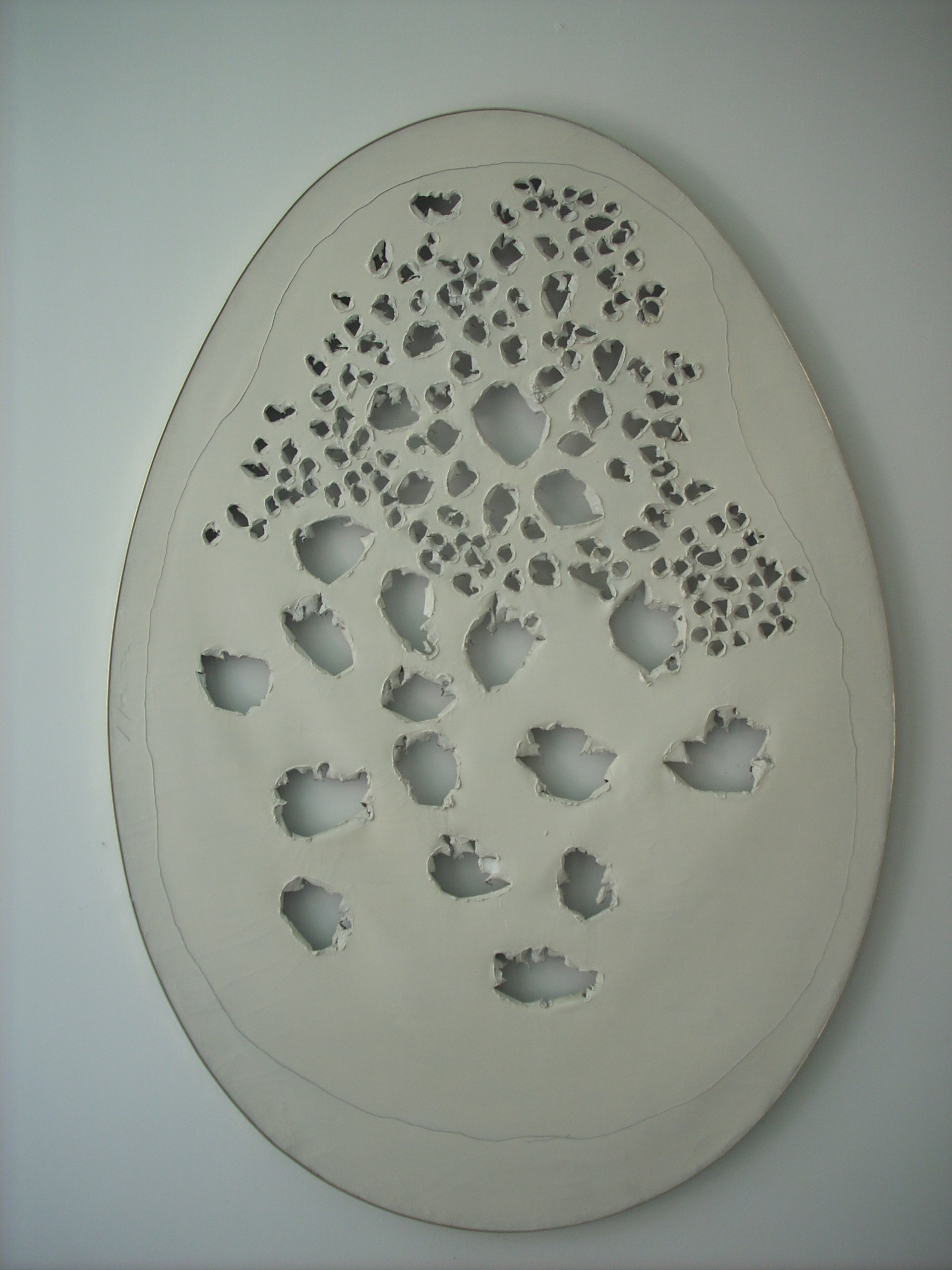
Lucio Fontana
Concetto Spaziale, la Fine di Dio
1963
£10,324,500
Sotheby’s London
Feb. 27, 2008

VIDAL SASSOON  PRIVATE COLLECTION

FONTANA’S EGG

The record-setting Fontana, a golden, glittery, egg-shaped Concetto Spaziale from 1963, was bought by Philippe Segalot, according to auction reports, spurring speculation that it might be destined for François Pinault’s new museum at Punta della Dogana in Venice.