Lucio Fontana

Lucio Fontana

Lucio Fontana

Lucio Fontana (19 February 1899 – 7 September 1968) was a painter and sculptor born in Rosario, province of Santa Fe, Argentina, the son of an Italian father and an Argentine mother. He was mostly known as the founder of Spatialism.

Fontana spent the first years of his life in Italy and came back to Argentina in 1905, where he stayed until 1922, working as a sculptor along with his father and then on his own.

In 1928 he returned to Italy, and there he presented his first exhibition in 1930, organized by the Milano art gallery Il Milione. During the following decade he journeyed Italy and France, working with abstract and expressionist painters.

In 1940 he returned to Argentina. In Buenos Aires (1946) he founded the Altamira academy together with some of his students, and made public the White Manifesto, where he states that “Matter, colour and sound in motion are the phenomena whose simultaneous development makes up the new art”. Back in Milano in 1947, he supported, along with writers and philosophers, the first manifesto of spatialism (Spazialismo)**. He also resumed his ceramics works in Albisola.

From 1958 on he started the so-called slash series, consisting in holes or slashes on the painting surface, drawing a sign of what he named “an art for the Space Age”. In 1959 he exhibited cut-off paintings with multiple combinable elements (he named the sets quanta). He participated in the Bienal de São Paulo and in numerous exhibitions in Europe (including London and Paris) and Asia, as well as New York.

Shortly before his death he was present at the “Destruction Art, Destroy to Create” demonstration at the Finch College Museum of New York. Then he left his home in Milano and went to Comabbio (in the province of Varese, Italy), his family’s mother town, where he died in 1968.

Fontana’s works can be found in the permanent collections of more than one hundred museums around the world. He was the sculptor of the bust of Ovidio Lagos, founder of the La Capital newspaper, in Carrara marble.

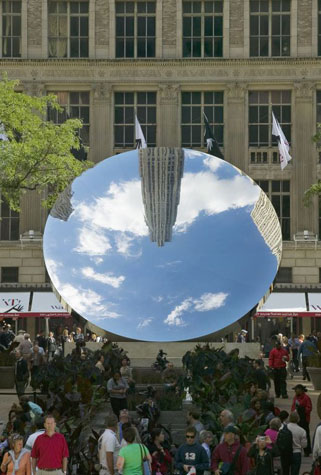
Anish Kapoor’s Sky Mirror is a breathtaking, 35-foot-diameter concave mirror made of polished stainless steel. Standing nearly three stories tall at the Fifth Avenue entrance to the Channel Gardens at Rockefeller Center, Sky Mirror offers a dazzling experience of light and architecture, presenting viewers with a vivid inversion of the skyline featuring the historic landmark building at 30 Rockefeller Plaza. Sky Mirror is on view, free and open to the public, from September 19th through October 27th, 2006. This exhibition is presented by Tumi, organized by the Public Art Fund and hosted by Rockefeller Center owner Tishman Speyer.

An urban, contemporary, and ever-changing aesthetic variation on the 18th-century landscape painting tradition, Sky Mirror literally brings the sky down to the ground. The large, 23-ton circular stainless steel sculpture is installed on a platform a few feet above street level. Its concave side, angled upward, faces 30 Rockefeller Plaza, reflecting an upside-down portrait of this elegant and iconic New York City skyscraper and the shifting sky around it. Its convex side, facing Fifth Avenue reflects a more earthly vision: viewers in the midst of the adjacent streetscape. This optical object changes through the day and night and is an example of what Kapoor describes as a “non-object,” a sculpture that, despite its monumentality, suggests a window or void and often seems to vanish into its surroundings.

Anish Kapoor is one of the foremost artists of our time. He first became known in the 1980s for his geometric or biomorphic sculptures made using simple—often elemental—materials such as granite, limestone, marble, pigment and plaster. His sculptures extend the formal precepts of minimalism into an intensely spiritual and psychological realm, drawing viewers in with their rich colors, sensuously refined surfaces, and startling optical effects of depth and dimension. Since the mid-1990s he has explored the notion of the void, creating works that seem to—and sometimes do—recede into the distance, disappear into walls or floors, or otherwise destabilize our assumptions about the physical world. They give visceral and immediate impact to abstract dualities such as presence and absence, infinity and illusion, solidity and intangibility.

Kapoor is focused on the active or transformative properties of the materials he uses. “I am really interested in the ‘non-object’ or the ‘non-material.’ I have made objects in which things are not what they at first seem to be. A stone may lose its weight or a mirrored object may so camouflage itself in its surroundings as to appear like a hole in space,” says Kapoor. From works such as Turning the World Inside Out (1995) to the massive 125-ton sculpture Cloud Gate (2004) on permanent display in Chicago’s Millennium Park, Kapoor’s reflective sculptures engage audiences directly, fusing object, viewer, and environment into one physical, constantly fluctuating form.

About the artist
Anish Kapoor was born in Bombay in 1954, and currently lives and works in London. He attended the Hornsey College of Art (1973-77) and Chelsea School of Art, London (1977-78). Kapoor is one of a generation of British sculptors, along with fellow British sculptors Tony Cragg and Richard Deacon, who gained critical recognition in the 1980s and who share an interest in materials and use of abstract, organic form. In his early series 1000 Names (1989-90), the artist focused on geometry and color, installing arrangements of semi-circles, planes and other shapes coated in particles of bright pigment. In 1990 he represented Britain at the Venice Biennale with Void Field , an installation of rough sandstone blocks topped with black holes, and over the course of the decade his sculptures ventured into more ambitious, increasingly sublime manipulations of form and space. He won the Turner Prize in 1991 and in 2002 received the prestigious Unilever Commission for the Turbine Hall at the Tate Modern in London.

Among his major permanent commissions is Cloud Gate (2004) for the Millennium Park in Chicago. Major solo exhibitions throughout his career have taken place at MAC Grand-Hornu, Belgium (2004); Museo Archeologico Nazionale, Naples (2004); Kunsthaus Bregenz (2003); BALTIC Centre for Contemporary Art, Gateshead (1999); Piazza del Plebiscito, Naples (1999); Hayward Gallery, London (1998); and Fondazione Prada, Milano (1995). Kapoor is represented by Gladstone Gallery in New York.

The sculptor’s thrilling and seductive work suggests a world beyond our grasp

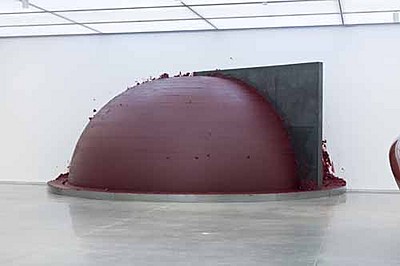
Anish Kapoor: Past, Present, Future assembles 14 works made since 1980, a period in which Kapoor’s sculptures and installations have grown increasingly ambitious and complex. The first U.S. museum survey of Kapoor’s art in more than 15 years, and the first ever to be seen on the East Coast, the exhibition premieres a new resin sculpture and features many pieces on view for the first time in this country.

In the hands of sculptor Anish Kapoor, forms become at once monumental and evanescent, present and absent, physical and ethereal. Whether using the materials of classical sculpture like stone and bronze or newly applied forms of aluminum, pigment, enamel, resin, polymer, and PVC, Kapoor’s sculpture seems to disappear, dissolve, levitate, or extend beyond a space the viewer can perceive.

The sculptor, born in Bombay and based in London, is perhaps best known in the U.S. for Cloud Gate, a permanent 110-ton sculpture of highly-polished stainless steel created for Chicago’s Millennium Park, and Sky Mirror, a breathtaking, 35-foot-diameter concave mirror that was shown in 2006 at Rockefeller Center in New York. Kapoor emerged as one of a highly inventive generation of British sculptors during the 1980s, and since then has created a body of work that has married a modernist sense of pure materiality with a fascination for the manipulation of form and the perception of space.

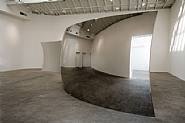
PAST , PRESENT, FUTURE

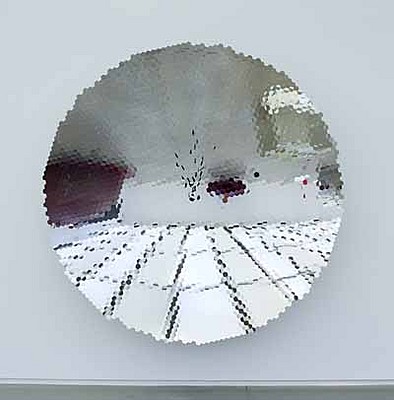
HEXAGON MIRROR

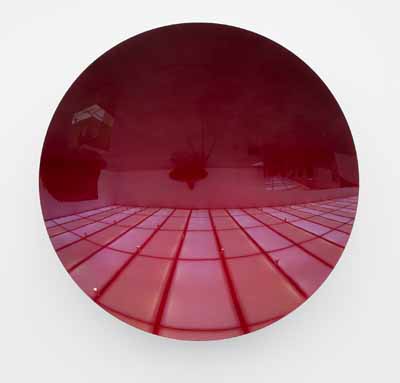
 BRANDY WINE

Description: Anish Kapoor is one of a highly inventive generation of sculptors who emerged in London in the early 1980s. Since then he has created a remarkable body of work that blends a modernist sense of pure materiality with a fascination for the manipulation of form and the perception of space. This book–the first major American publication on Kapoor’s work–surveys his work since 1979, with a focus on sculptures and installations made since the early 1990s. With more than ninety color images of these ambitious and complex works, three original essays, an extended interview with Kapoor, and selections from his sketchbooks, this book confirms Anish Kapoor’s place as one of the most remarkable sculptors working today.

Kapoor’s work has evolved into an abstract and perceptually complex elaboration of the sculptural object as at once monumental and evanescent, physical and ethereal–as in his famous Cloud Gate (2004) in Chicago’s Millennium Park. The works in Anish Kapoor include such striking works as Past, Present, Future (2006), 1000 Names (1979-1980) and When I Am Pregnant (1992). This book, which accompanies an exhibition at Boston’s Institute of Contemporary Art, offers American readers a long-overdue opportunity to consider the extraordinary clarity, subtlety, and power of Kapoor’s art.

Includes an interview with the artist by Nicholas Baume.

Exhibition:
Institute of Contemporary Art, Boston
May 30-September 7, 2008

Copublished with the Institute of Contemporary Art, Boston

  • Author: Ashish Kapoor
  • Binding: Hardcover
  • Dewey Decimal Number: 730.92
  • EAN: 9780262026598
  • ISBN: 0262026597
  • Label: The MIT Press
  • Language: English
  • Manufacturer: The MIT Press
  • Number of Items: 1
  • Number of Pages: 144
  • Product Group: Book
  • Publication Date: 2008-09-30
  • Publisher: The MIT Press
  • Studio: The MIT Press
  • Title: Anish Kapoor: Past, Present, Future
                                                   

Nike’s Radical New Olympic Riding Boot

It’s not yet clear how tradition-bound equestrians—or Olympic judges—will view the iconoclastic footwear

The Olympics & Innovation

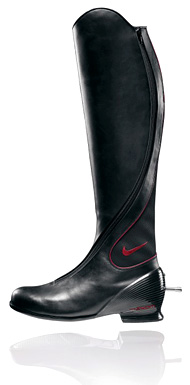
Instead of a vertical zipper on the back of the boot, Nike designed one that wraps around the calf Nike.The century-old spur system was replaced with a titanium screw-in model that was easier to install and adjust Nike

 
U.S. Olympian Amy Tryon will wear Nike’s Ippeas boots at the Games Carolyn Djanogly.When Nike (NKE) unveiled new footwear for athletes in all 28 sports at the Olympic Games, one of its offerings prompted skepticism: an equestrian boot. One rider opined on a Web site that it looks like “the stripper boot of the horse world.” U.S. Olympic rider Gina Miles wonders if wearing a swoosh might lead to lower scores in a sport that prides itself on centuries-old traditions. And Nike archrival Adidas, which is also creating new shoes for the Games, said no to riding boots. “We didn’t feel we could come in with some meaningful innovation,” says James Carnes, Adidas’ creative director.

Nike insists its offering, dubbed the Ippeas (Greek for “rider”), allows for better performance than hand-cobbled leather boots. It used its Air Zoom cushioning—a staple in its sneakers—in the sole to make the boot more comfortable. The century-old spur system was replaced with a titanium screw-in model that was easier to install and adjust. Instead of a vertical zipper on the back of the boot, Nike designed one that wraps around the calf. There’s also grippy rubber on the part of the boot that touches the saddle to improve handling, as well as red piping and a shiny heel for flourish.

The world will get to see the Ippeas on the feet of U.S. rider Amy Tryon, a bronze medal winner at the 2004 Athens Games, as well as on the 14 members of the Chinese equestrian team. Tryon says the snug fit gives her greater control over her horse than any other boot she has worn. “If nobody tries to push the envelope, nothing changes,” she says.


www.intermarine.com.br

Ao longo de sua história a Intermarine percorreu uma trajetória de grande sucesso, marcada por produtos que revolucionaram o mercado náutico brasileiro.


A Intermarine sagrou-se como uma marca de respeito, qualidade e prestígio. Acompanhando a evolução dos seus produtos, renovou o espírito da sua marca com a introdução de novos logotipos.

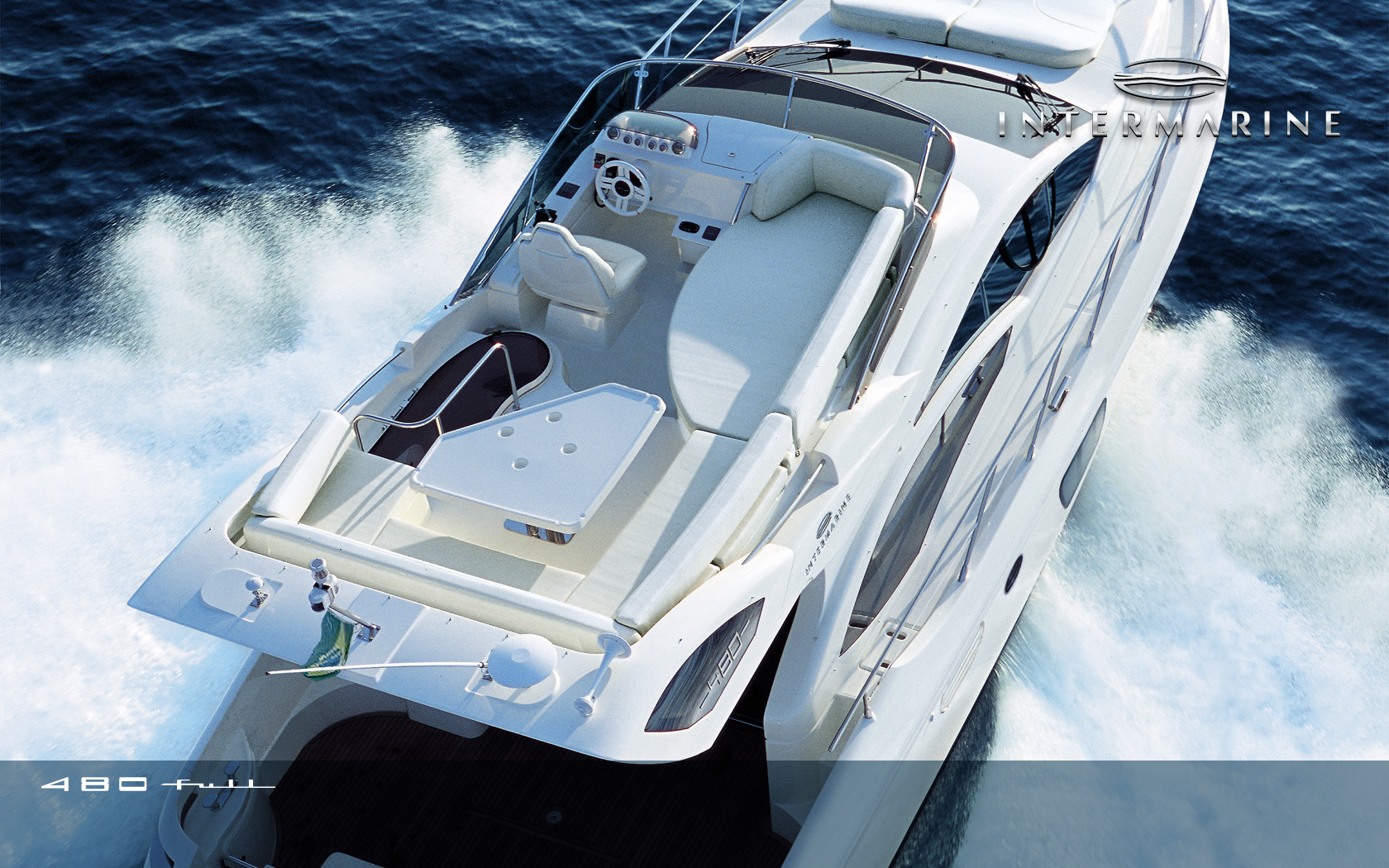
A Intermarine é o estaleiro líder em lanchas de alta performance no Brasil. Fundada em 1973, já produziu e comercializou mais de 5000 embarcações, consolidando-se como a marca de maior prestígio dos mares brasileiros.

Somos o único estaleiro no mundo a obter a Licença de Fabricação de Barcos do renomado estaleiro italiano Azimut Yachts , uma parceria que permite construir no Brasil embarcações homologadas e perfeitamente adaptadas as nossas condições de clima e mar. A Intermarine constrói a mais ampla linha de embarcações do mercado náutico brasileiro, de 38 a 98 pés. Estabelece, a cada lançamento, novos padrões de estética, engenharia e tecnologia, em sintonia com o que existe de mais moderno no mercado náutico mundial.

MISSAO & VISAO

Muitas qualidades definem uma embarcação Intermarine – design inconfundível, performance excepcional, sofisticação, alta qualidade de construção, assistência técnica eficaz e uma vibrante experiência ao navegar. E é a combinação de todas essas características que torna a marca Intermarine tão única.

Proporcionar aos nossos clientes momentos inesquecíveis, a bordo de um dos melhores barcos do mundo. A experiência única de desfrutar de uma Intermarine é resultado de produtos criados com paixão, qualidade, talento e criatividade. Superar-se constantemente e ser reconhecido como o melhor e mais distinto estaleiro de embarcações de lazer da indústria náutica brasileira

Excelência – Buscamos incansavelmente a qualidade máxima em produtos e serviços.

Garra – Superamos os desafios com determinação e comprometimento.

Evolução – Aperfeiçoamos constantemente nossa empresa, produtos, serviços e colaboradores.

Capital Humano – Os nossos colaboradores são os elementos mais importantes para a construção de uma empresa de sucesso.

Responsabilidade – Agimos com consciência social e ambiental.

Jato de US$ 28 milhões

Executivos e empresários que utilizam os serviços da aviação executiva já começaram a voar em um Falcon 2000EX Easy, que chegou recentemente ao Brasil.
Adquirido pela Alliance Jet Táxi Aéreo por cc.

É o primeiro jato desse modelo a ser usado como táxi aéreo no país.
Com capacidade para oito passageiros, que poderão usufruir de uma cabine mais larga do que a dos jatos convencionais, o Falcon também é intercontinental, com autonomia de 3,8 mil milhas (permite vôo ininterrupto de oito horas). A aeronave possui tecnologia avançada, com painel desenvolvido pela Agência Aeroespacial Americana (Nasa), telas de cristal líquido e controle por mouses, sem botões.

“A aquisição do Falcon 2000EX Easy consolida a Alliance como uma das empresas de táxi aéreo que possui uma das frotas mais modernas do país. Por esse motivo, investimos em equipamentos e buscamos os melhores profissionais do mercado”, explica o gerente administrativo da Alliance Jet Táxi Aéreo, Wesley Chagas.
A empresa atua no setor de aviação executiva desde 2005 e, a partir de outubro de 2006, começou a operar como táxi aéreo. O faturamento mensal da companhia é de cerca de R$ 500 mil e a previsão para maio já é de aumentar para R$ 1 milhão.

O novo modelo, fabricado na França e montado nos Estados Unidos, se juntou à frota de três aeronaves da Alliance Jet, empresa sediada em Sorocaba, interior de São Paulo. Além do Falcon 2000EX Easy, ela já conta com os jatos Citation CJ2 e Citation X e um helicóptero Bell 430.
A empresa estuda a aquisição de mais duas aeronaves.

THIS HOUSE IS LIKE NO OTHER. ONE PERSON OUT OF 100 WILL APPRECIATE TRUE VALUE.

Neutra’s Singleton Residence Still Up For Grabs (For Only $19M…)

By my favorite MCM architect. Neutra had several houses I’d call masterpieces, and this is definitely one of them. It is a perfect blending of nature with the built environment.

There has been a reduction in the price. It originally listed at $25M!

Sotheby’s description:

“RICHARD NEUTRA, ARCHITECT. THE SINGLETON RESIDENCE, 1959. This is one of the most famous architectural sites in America, comprising five plus acres on top of Bel Air, with exceptional views. Neutra designed this residence to sit in perfect harmony with nature. Renovated and expanded with respect, integrity and no expense spared. A new master bedroom wing has been seamlessly added, the kitchen expanded, and a gallery now blends the approach to the earlier Neutra addition into the overall floorplan with élan.”

Links:

November 18, 2007Posted by mcarch | Neutra, Real Estate | , , , | 4 Comments

On the Market: A Neutra in Bel Air


2007.06.lautner.jpg

“The Singleton House Is For Sale! The Singleton House Is For Sale!” writes an excited Curbed reader. And so it is. Listed at $19.955 million, the Richard Neutra-designed 1959 home sits on 5.2 acres in Bel Air. “Two potential extra building pads on site,” notes the listing. And there’s a “long, imposing private drive.

2007_06_vidal.jpg

When we announced yesterday that the Neutra-designed Singleton House was for sale for $19.5 million, there was debate in the comments. Is it or is it not currently owned by Vidal Sassoon? Turns out, it is. Vidal bought the place in 2004 and according to Radar, oversaw a “meticulous renovation,” including “an art gallery in the joint, as well as a massive kitchen and a sprawling swimming pool—all stunning. Because if Vidal Sassoon’s place doesn’t look good, he doesn’t look good.”

15000 MULHOLLAND DR $19,995,000
Active
4 Beds 5.00 Baths
View larger image
Additional PhotosMLS Number
07-197547
15000 MULHOLLAND DR, LOS ANGELES, CA 90077

Bel Air – Holmby Hills
RICHARD NEUTRA, ARCHITECT. THE SINGLETON HOUSE, 1959 One of the most famous architectural sites in America. 5+ acres on top of Bel Air. Designed to sit in perfect harmony w nature. Hypnotic views. Renovated/expanded w integrity. No expense spared. Orig legendary LR & DRs, stunning lge kit, sitting rm/media rm, art gallery. Master wing w sitting room, BR, sumptuous bthrm, + add’l suite/office/gym. Perfectly sited swimming pool. 2 potential extra building pads on site. Long, imposing private drive
Rooms:
Bonus, Dining, Living, Media
Equipment:
Built-Ins