

Copyright © 2008 ADRIANA SASSOON .All Rights Reserved.
Polka dots for baby room.

Copyright © 2008 ADRIANA SASSOON .All Rights Reserved.

Copyright © 2008 ADRIANA SASSOON .All Rights Reserved.

Copyright © 2008 ADRIANA SASSOON .All Rights Reserved.
Copyright © 2008 ADRIANA SASSOON .All Rights Reserved.
Polka dots for baby room.
Copyright © 2008 ADRIANA SASSOON .All Rights Reserved.
Copyright © 2008 ADRIANA SASSOON .All Rights Reserved.
Copyright © 2008 ADRIANA SASSOON .All Rights Reserved.
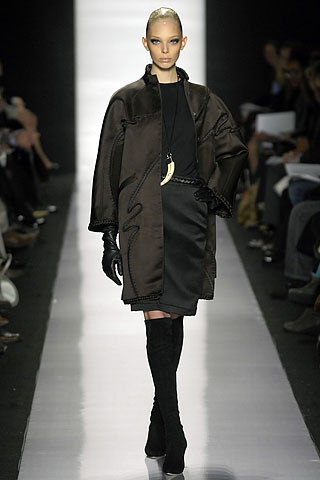
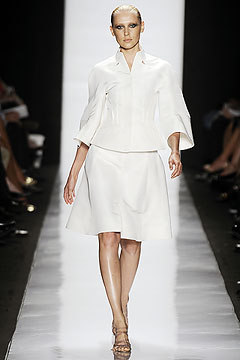
Chado Ralph Rucci – One of a kind!
 |
Chado Ralph Rucci’s architecturally-influenced clothing is created by designer Ralph Rucci, the only American currently officially invited to show haute couture in Paris. (He shows ready-to-wear on our shores.) Since beginning in 1994, Chado (the name of a traditional Japanese tea ceremony symbolizing respect, tranquility and integrity) has been about impeccable craftsmanship. Rucci himself creates new textiles with his European mills, culling inspiration from his personal archives and those of historical cloths; his prints are derived from his own watercolor and acrylic artwork. The result is a clothing collection that is sophisticated and sculptural, created in luxurious fabrics and a neutral palette. Chado’s small staff includes Rucci’s sister, who works in tandem with him at his Seventh Avenue atelier.
Sculptural, architectural and clean. Hammered-satin suits, short, laser-cut jackets, narrow pants with sixties-style tunics, slouchy fur tops.
The son of a Philadelphia butcher, Ralph Rucci graduated from Temple University, where he majored in literature and philosophy. After moving to New York, he studied design at the Fashion Institute of Technology before starting Chado Ralph Rucci in 1994. In 2002, Rucci became the first American designer since Mainbocher to be invited by Paris’ Chambre Syndicale to show as part of the haute couture fashion calendar. He’s been twice nominated for CFDA Designer of the Year, but has yet to take home the honor.



| ERA | |
|---|---|
| Origin | France |
| Genre(s) | New Age, Gregorian chant, Opera |
| Years active | 1996–present |
| Members | |
| Eric Levi Guy Protheroe Lena Jinnegren Eric Geisen Florence Dedam Murielle Lefebvre Chester Thompson Lee Sklar |
|
Era is a music project by Eric Levi that is often based on chants in an imaginary language close to Latin. The music could be described as New Age[1]. Their music mixes classical music, opera, and Gregorian chants with other contemporary styles. Their music was used in the soundtrack for the French film Les Visiteurs and in Sylvester Stallone‘s “Driven“. Eric Levi uses English choirs to record the songs.
The song “Ameno” was used in Australia within “The Power of Yes” advertisements for Optus Communications. The band has sold more than 10 million albums. Era is also famous among mixed martial arts fans due to their song “Enae Volare Mezzo” being the theme song of Fedor Emelianenko.
Era’s live shows often feature vocalists dressed in medieval clothes and armour.
http://www.amethystium.com/music.php
Amethystium is a music project aiming to create and explore emotive imaginary worlds in sound. Primarily electronic-based, the compositions traverse a span of moods that includes both light and darkness, bliss and melancholy. They range from the purely relaxing to the subtly intense, creating dreamlike and evocative musical journeys.
Formed by Norwegian composer/producer Oystein Ramfjord, Amethystium started out independently with a demo release in late 1999. After quickly becoming something of an underground phenomenon through word of mouth, the project was signed to then EMI/Capitol subsidiary Neurodisc Records and released a string of three Top 10 Billboard charting albums in the US.
In 2006 a retrospective compilation titled “Emblem (Selected Pieces)” was released, and a fourth full-length album is scheduled to be released in June ’08.
Lesiëm is a German musical project created in 1999 by the producers Sven Meisel and Alex Wende. The project’s music combines elements of rock, pop, electronica, new age, enigmatic and ambient music, as well as Gregorian chant and other choral music. It is frequently compared to French project Era and the Norwegian artist Amethystium.[citation needed] Lesiëm’s web site makes extensive reference to the group’s mystical/spiritual influences.
Lesiëm released its debut album, Mystic, Spirit, Voices, in 2000. When the album was released in the United States in 2002, it climbed to no. 7 on the U.S. Billboard charts. Lesiëm’s second album, Chapter 2, was released in 2001 in Europe, and in the U.S.A. in 2003 under the title Illumination.
The first two albums were some sort of prelude for the pop-opera Times, which was Lesiëm’s 3rd album (released as Auracle in U.S.A. in 2004). The musicians started their work in March of 2002 and finished it in the end of July. The single Caritas (feat. Maggie Reilly and Chor der Deutschen Oper Berlin) was presented in December 2002 on the philanthropic TV-show of Jose Carreras “Carreras Gala”.

Paris Fashion Week Fall-Winter 2008-2009 Chanel Runway. Straight from the runway the looks and fashions for Fall and Winter 2008 -2009 featuring Chanel designs. Rhianna was even present at the event and looked stunning as always. You can view all of the fashions below.

Katie Holmes, a senhora Tom Cruise, exibiu um novo visual em Berlin, numa cerimônia onde seu marido foi homenageado. Antes, Katie estava usando um look Chanel, com franja longa, inspirada e motivada por sua amiga Victoria Beckham.
Agora, Katie está com um Chanel moderno, com franjinha e pontas desfiadas. Com certeza, muitas irão adotar o look, já que a franja está de volta, é só ver por aí, várias famosas já adotaram, como a atriz Aline Morais.

The Spanish clothing company Zara thrives by shipping new products to its stores every few days.
By JOHN TAGLIABUE
 A CORUÑA, Spain — This is the town that invented retailing’s secret sauce.
Zara, the big clothing chain based here, created a novel formula in apparel retailing by shipping new products to its 600 or so stores around the world every few days, not once a season, and by manufacturing more than 11,000 products a year, instead of several hundred.
Zara is opening new stores at a rate of one a week, and shows no signs of slowing. But its business model, developed by a publicity-shy entrepreneur who began his career here more than 50 years ago delivering hand-sewn shirts for a local tailor, is facing increased challenges as it expands.
As the dollar melts, the price gap is widening between Zara’s products, the bulk of them made at factories here in Spain, and competitors that import from low-wage countries and pay for goods in dollars. Zara still has plenty of room to grow in Europe before the market is saturated. But to reach its ambitions of becoming a global brand, it will have to replicate on other continents its finely tuned European distribution system, which is more akin to Dell Computer and Wal-Mart than to Gucci or Louis Vuitton.
Moreover, Zara’s parent, the big Spanish group Industria de Diseño Textil, known as Inditex, is moving in several directions at once. It is expanding its other retail chains, including brands like Massimo Dutti and Bershka; introducing new store concepts like Zara Home, a home furnishings outlet; and adding lines of larger-size garments for older women at Zara itself that some industry experts say may dilute Zara’s brand image.
“The question going forward is: how durable is the model as it gets bigger and goes international?” said David Oliver, a principal at Kurt Salmon Associates, a retailing-industry consulting firm.
Though not well known in the United States, where Zara has just 10 stores, six of them in New York, Zara has so far kept the challenges it faces from crimping its robust performance. Two important rivals, Gap and Hennes & Mauritz, are only beginning to show signs of rejuvenation after passing through rough patches, but Zara has been flourishing all along. With 250 million euros ($294.2 million) in net cash at the end of 2002, Zara is awash in liquidity. “We certainly don’t need cash,” said José Maria Castellano Rios, Inditex’s chief executive.
The company’s chairman, Amancio Ortega Gaona, may be one of the world’s wealthiest people, with assets estimated by Fortune magazine at $10.3 billion, but he is also one of the most retiring. Inditex’s ultramodern headquarters, a blend of Scandinavian glass and steel and Mediterranean stucco, is located outside La Coruña, a small city of 250,000 in Spain’s far northwest corner where his father, a railroad employee, moved the family when Amancio was 12. Now 67, he has turned over day-to-day operations to managers like Mr. Castellano while keeping a hand in strategic decisions.
Mr. Ortega never grants interviews, and until recently there were hardly any photographs of him in circulation.
Mr. Ortega took Inditex public in 2001, selling 32 percent of the company to investors on the Madrid Stock Exchange. He and other family members, including his three children, control the rest.
Now that management of the company is largely in the hands of professionals, has the flame diminished for Mr. Ortega? “There’s the same passion,” said Mr. Castellano, 55, who has worked with Mr. Ortega since 1976. “Maybe even more.”
Mr. Ortega opened the first Zara in La Coruña in 1974 to sell the apparel he was making in a factory he had opened a few years earlier with his own savings. Conventional wisdom called for retailers to franchise their stores and outsource their goods, but Mr. Ortega chose vertical integration, owning the factory, the stores and the distribution network in between. While Gap and Hennes & Mauritz contracted out manufacturing largely to plants in low-wage countries, notably in Asia, Mr. Ortega stocked his stores from his own factories in Spain.
The advantage was speed to market, achieving the kind of delivery and restocking frequency usually associated with grocery stores, not apparel merchants.
To be sure, Zara does produce seasonal clothing collections. The company is known for stylish designs, many resembling those of the big-name Italian fashion houses, sold at moderate prices. Yet if it finds that customers are coming in asking for, say, a rounded neck on a vest rather than the V neck on display, a new version with a rounded neck can be in the store within about 10 days. If Jennifer Lopez appears in a ravishing new item, Zara can get a version of it into its stores in a matter of weeks, not months.
To do that, Mr. Ortega built up an elaborate distribution structure over the years. Zara’s huge warehouse features customized sorting machines built in Denmark and patterned on the equipment used by overnight parcel services; they can now handle 40,000 items an hour, and the company’s capacity will roughly double in July when a big new center in Zaragoza in northeastern Spain comes on line.
Trucks deliver goods to Zara stores that are within 24 hours’ driving time; stores farther away are supplied by air. Twice a week, for instance, trucks make the three-hour trip to the airport in Porto in northern Portugal, where KLM 747 cargo jets pick up goods to fly to New York by way of Amsterdam.
Zara’s fashions appeal to dressier European tastes. Laetitia Sernet, 20, a stylist in Paris, contrasted Zara with Gap, saying Zara’s “things are more fashionable, more diversified. They follow fashion.” Ms. Sernet just bought two cotton tops, one for 35 euros ($41.19) and one for 40 euros.
Yet for all its technical prowess, quick delivery has its limits. “One interesting question is: are they locked in?” said John Gallaugher, a professor of information systems at Boston College who admires the company and teaches its model in his graduate business courses. Professor Gallaugher said that for Zara to penetrate the United States on a large scale, it would probably have to duplicate its manufacturing and distribution system in North America, perhaps in Mexico.
Mr. Castellano acknowledged that Zara had been purposely slow to expand in the United States, where in 1989 it first opened a store on Lexington Avenue in Manhattan. That is because there is still so much it can do in Europe, he said. Zara has only begun to crack the British market, and recently set aside its distaste for franchising to form joint ventures in two more difficult countries, Germany and Italy.
Still, he said, Zara does plan to open “two to three stores” in the United States, including one in Washington, in the fall. “In the American market, we have 10 stores, and they are all profitable,” he said.
The two planes to America each week could supply as many as 40 or 50 stores, Mr. Castellano said, “but there is no service that can replicate the model here.”
Mr. Castellano also knows that European competitors that manufacture in East Asia are reaping windfall profits that Zara cannot match. Hennes & Mauritz, for instance, gets roughly half its products from Asia, measured by value. Adidas of Germany and Aigle of France, two sportswear retailers, have both recently said that their profits are growing rapidly because they pay depreciating dollars for goods made in Asia and get strengthening euros when they sell them in Europe.
Zara has not completely resisted Asia’s temptation. Some basic items like T-shirts and jeans, which now account for 20 percent of the selection, are bought from manufacturers there.
But in the main, Zara looks to other aspects of its business for profit advantages. It spends much less on advertising than its rivals, for example, and its distribution system helps keep inventories low. “Price is important,” Mr. Castellano said, “but so is fashion.”
For all Zara’s success, though, Inditex is directing much of its new investment into a gaggle of other retail chains, some that it created and others that it bought, like Massimo Dutti, whose stores offer moderately priced apparel for men and women, and Oysho, a lingerie chain. Moreover, Inditex is expanding Kiddy’s Class, a competitor to Gap Kids, and the Zara Home chain.
But the initiative that raises the most eyebrows is the experimental line of plus sizes that Zara is adding.
Reiner Triltsch, chief international investment officer at WestAM, a Dallas asset management company, wondered about the strategy. “More mature plus sizes have got to be difficult to reconcile,” Mr. Triltsch said. “It changes the image” of Zara, he said, adding that it may alienate teenage customers who will not shop where their mothers do. “I don’t think it’s going to be easy,” he said.
Mr. Castellano says Zara is only testing the idea and has not committed itself. “There are people in the company who say, `Customers who were buying with us when they were 20, well, now they’re 50 or 45 and they want to stay with us,’ ” he said. “We are testing. A decision will come later.”
The diversification into other brands and store types will continue, Mr. Castellano said, with Zara’s share of Inditex’s total revenue falling to 62 percent over the next five years, from 72 percent now.
Essentially, he said, Zara’s strategy is hostage to its abundant cash flow. “We have to do something with the money,” he said.
 ADRIANA SASSOON