320519084_4652da6c331

VIDAL  SASSOON  STYLE  HAIR

Early life

Vidal Sassoon é um cabeleireiro inglês, nascido em Londres, em 1928. Nos Estados Unidos estudou na universidade de Nova Iorque. Como cabeleireiro, notablizou-se por ter criado uma forma de penteado baseada na Bauhaus e nas formas geométricas.Vencedor de vário prémios, foi presidente da Multinacional Vidal Sassoon, presidente da Fundação Vidal Sassoon .

sassoon_picbeauty_5172_0_sl

Influence in hairstyling

Sassoon’s works include the geometric, the wash-and-wear perm, and the “Nancy Kwan.” They were all modern and low-maintenance. The hairstyles created by Sassoon relied on dark, straight, and shiny hair cut into geometric yet organic shapes. In 1963, Sassoon created a short, angular hairstyle cut on a horizontal plane that was the recreation of the classic “bob cut.” His geometric haircuts seemed to be severely cut, but were entirely lacquer-free, relying on the natural shine of the hair for effect. Sassoon is a father of modernist style and has also been a key force in the commercial direction of hair styling, turning its craft in to a multi-million dollar industry.

He was a very influential person to people all over the world; especially those who have become cosmetologists. By the early 1980s, after moving to the United States, Sassoon had sold his name to manufacturers of haircare products and the multinational Procter & Gamble was applying his name to shampoos and conditioners sold worldwide. Former salon colleagues also bought Sassoon’s salons and acquired the right to use his name, extending the brand in salons into the United Kingdom and United States. However, in 2003, it was reported that Sassoon was suing Procter & Gamble for destroying his brand by skimping on marketing in favor of the company’s other hair product lines, notably Pantene. Also in 2002, the chain of Vidal Sassoon salons was sold to Regis Corporation. By 2004, it was reported that he was no longer associated with the brand that bears his name.[citation needed] Vidal Sassoon has authored several books, including A Year of Beauty and Health co-written with his former wife, Beverly Sassoon. He also had a short-lived TV series called Your New Day with Vidal Sassoon in the late 1970s.

Family

In 1967, Vidal Sassoon married Beverly Adams. They had four children,CATYA, ELAN, EDEN  including an adopted son DAVID. One daughter, actress Catya Sassoon, died of a drug overdose on January 1, 2002. The couple divorced in 1980.

 sassoon-trend-51172

 Quote

Hair is nature’s biggest compliment and the treatment of this compliment is in our hands. As in couture, the cut is the most important element … haircutting simply means design and this feeling for design must come from within. ”VS
The only place where success comes before work is in the dictionary. ”VSsassoon-trend-51202

SASSOON STYLING PRODUCTS

vs-logo-11

Vidal Sassoon stands for Very Simple and Very Stylish! Vidal Sassoon is the consumer brand that experts use when it comes to delivering fabulous haircare. The best of technology is used by Vidal Sassoon to deliver the ultimate in hair styling product expertise. Vidal Sassoon’s products are for the modern individual with the know-how and expectation of living in the 21st century.

Vidal Sassoon’s hair styling products are renowned in the world of fashion for bringing style and confidence to today’s image conscious consumer. Innovation, experience and value are all top of the agenda with Vidal Sassoon, the world leading authority on haircare.

Vidal Sassoon brings the vital hair styling tools for the modern sophisticate enabling you to create those elegant, silky and shiny looks.

sassoon_pichover_5747_0_sl

www.sassoon.com

WOMEN’S FASHION 1930

1930 paris

WOMEN’S FASHION 1930

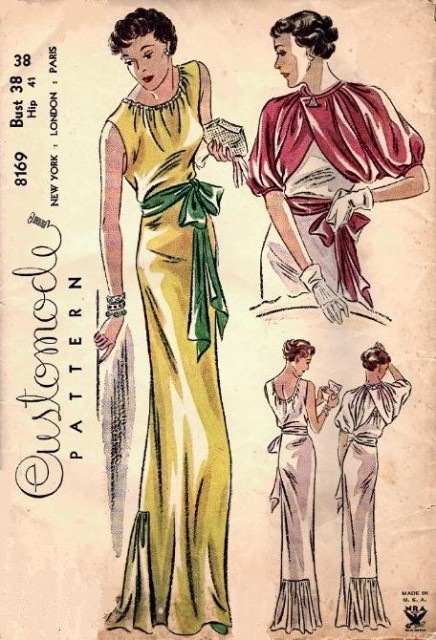
In the 1930s there was a return to a more genteel, ladylike appearance. Budding rounded busts and waistline curves were seen and hair became softer and prettier as hair perms improved. Foreheads which had been hidden by cloche hats were revealed and adorned with small plate shaped hats. Clothes were feminine, sweet and tidy by day with a return to real glamour at night.

The French designer Madeleine Vionnet opened her own fashion house in 1912. She devised methods of bias cross cutting during the 1920s using a miniature model. She made popular the halter neck and the cowl neck.

1930

The bias method has often been used to add a flirtatious and elegant quality to clothes. To make a piece of fabric hang and drape in sinuous folds and stretch over the round contours of the body, fabric pattern pieces can be cut not on the straight grain, but at an angle of 45 degrees. 

It is sometimes said that Vionnet invented bias cutting, but historical evidence suggests that close fitting gowns and veils of the medieval period were made with cross cut fabrics. The Edwardians also made skirts that swayed to the back by joining a bias edge to a straight grain edge and the result was a pull to the back that formed the trained skirt. She did really popularise it and the resulting clothes are styles we forever associate with movie goddesses and dancers like Ginger Rogers. 

fallgold-704452

Using her technique designers were able to produce magnificent gowns in satins, crepe-de-chines, silks, crepes and chiffons by cross cutting the fabric, creating a flare and fluidity of drapery that other methods could not achieve. Many of the gowns could be slipped over the head and came alive when put on the human form. Some evening garments made women look like Grecian goddesses whilst others made them look like half naked sexy vamps. Certain of her gowns still look quite contemporary.


141


There was a passion for sunbathing. Women tried to get tans and then show them off under full length backless evening dresses cut on the true cross or bias and which moulded to the body. To show off the styles a slim figure was essential and that was getting easier for women who were educated and aware as many now used contraception and did not have to bear baby after baby unless desired. 

goldie-hawn-vogue-photo-300x300

The new improved fabrics like rayon had several finishes and gave various effects exploited by designers eager to work with new materials. Cotton was also used by Chanel and suddenly it was considered more than a cheap fabric for work clothes. But nothing cut and looked like pure silk and it was still the best fabric to capture the folds and drapes of thirties couture. Fine wool crepes also moulded to the body and fell into beautiful godets and pleats.

Schiaparelli liked new things as well as new ideas. In 1933 she promoted the fastener we call the zip or zipper. The metal zip had been invented in 1893 and by 1917 it was somewhat timidly used for shoes, tobacco pouches and U.S. Navy windcheater jackets. Her use of the new plastic coloured zip in fashion clothes was both decorative, functional and highly novel. They soon became universally used and are now a very reliable form of fastening. 

glam2-709181


Health and fitness was an important aspect of thirties lifestyle. As sun worshipping became a common leisure pursuit fashion answered the needs of sun seekers by making chic outfits for the beach and its surrounds. Beach wraps, hold alls, soft hats and knitted bathing suits were all given the designer touch.

Swimwear was getting briefer and the back was scooped out so that women could develop tanned backs to show off at night in the backless and low backed dresses. The colours of the beach holiday were  navy, white, cream, grey, black and buff with touches of red.

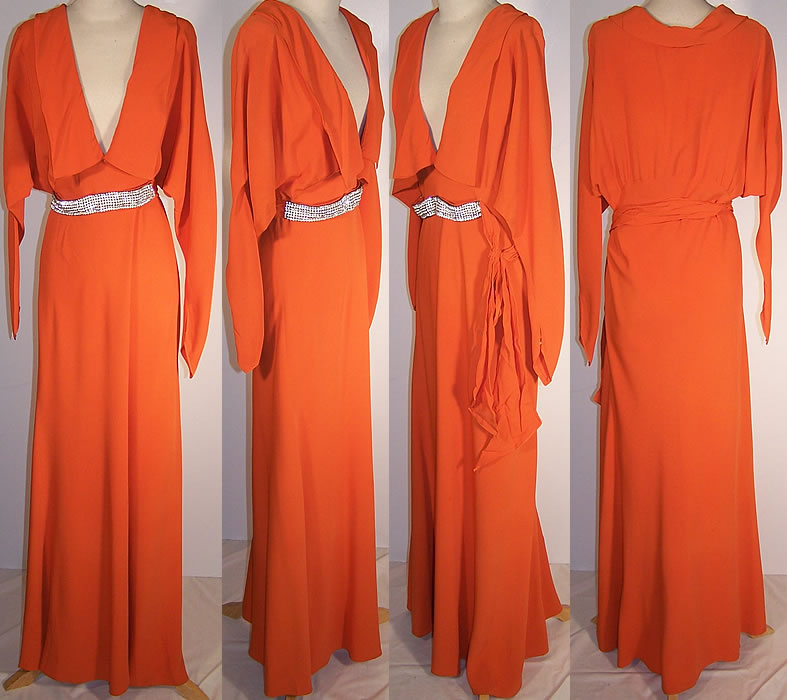
1930s-orange-silk-crepe-floor-length-dress

Pyjamas introduced as informal dinner dress or nightwear for sleeping died quickly as fashions. However the third use of them as a practical beach outfit caught on and every woman made them an essential garment to pack. They were soon regarded as correct seaside wear. The trousers were sailor style, widely flared and flat fronted with buttons. They were made up in draping heavy crepe-de-chine. Blue and white tops or short jackets finished the holiday look.


 MEN’S FASHION 1930

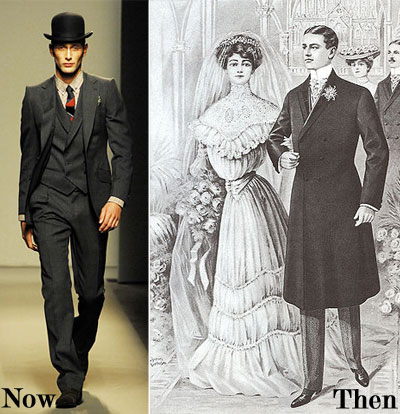
grooms_attire_1900's

 The decade of the 1930s saw dramatic changes in men’s fashion.  It began with the great Wall Street Crash of October 24, 1929.  By 1931, eight million people were out of work in the United States.  Less or no work meant little or no money to spend on clothing.  The garment industry witnessed shrinking budgets, and going-out-of-business sales were prevalent.  The Edwardian tradition of successive clothing changes throughout the day finally died. Tailors responded to the change in consumer circumstances by offering more moderately priced styles.

In the early part of the decade, men’s suits were modified to create the image of a large torso.  Shoulders were squared using wadding or shoulder pads and sleeves were tapered to the wrist.  Peaked lapels framed the v-shaped chest and added additional breadth to the wide shoulders.

This period also was a rise in the popularity of the double-breasted suit, the precursor of the modern business suit.  Masculine elegance demanded jackets with long, broad lapels, two, four, six or even eight buttons, square shoulders and ventless tails.  Generous-cut, long trousers completed the look. These suits appeared in charcoal, steel or speckled gray, slate, navy and midnight blue.

Dark fabrics were enhanced by herringbone and stippled vertical and diagonal stripes.  In winter, brown cheviot was popular.  In spring, accents of white, red or blue silk fibers were woven into soft wool.  The striped suit became a standard element in a man’s wardrobe at this time.  Single, double, chalk, wide and narrow stripes were all in demand.

grooms_attire_1920's

Plaids of various kinds became popular around this time as well.  Glen plaid checks, originally known as Glen Urquhart checks from their Scottish origin, were one of the more stylish plaids.  Glen plaid designs are sometimes referred to as “Prince of Wales” checks.  Initially the design was woven in saxony wool and later was found in tweed, cheviot, plied and worsted cloth. (See glossary for definitions of these terms.)

In 1935, as a result of President Roosevelt’s New Deal, signs of prosperity returned.  The rebounding economy demanded a redesign of the business suit, to signal the successful status of the man who wore it.  This new look was designed by the London tailor, Frederick Scholte and was known as the “London cut”.  It featured sleeves tapering slightly from shoulder to wrist, high pockets and buttons, wide, pointed lapels flaring from the top rather than the middle buttons and roll, rather than flat lapels.  Shoulder pads brought the tip of the shoulder in line with the triceps and additional fabric filled out the armhole, creating drape in the shoulder area.  As a result of this last detail, the suit was also known as the “London drape” or “drape cut” suit.

grooms_attire_1930's

Other versions of the new suit included four instead of six buttons, lapels sloping down to the bottom buttons, and a longer hem.  This version was known as the Windsor double-breasted (D.B.) and the Kent double-breasted (D.B.), named after the Prince of Wales and the Duke of Kent respectively.  Clark Gable, Jimmy Stewart, Fred Astaire and Cary Grant were a few of the Hollywood stars who lent their endorsement to this style by wearing the suits in their movies.  From there it became popular in mainstream America.

The famous “Palm Beach” suit was designed during the 1930s.  It was styled with a Kent double or single-breasted jacket, and was made from cotton seersucker, silk shantung or linen.  (See glossary for definitions.) Gabardine was also used to make this suit.  It quickly became the American summer suit par excellence and was touted as the Wall Street businessman’s uniform for hot days.

During this time, blazers became popular for summer wear.  Blazers are descendants of the jackets worn by English university students on cricket, tennis and rowing teams during the late nineteenth century.  The name may derive from the “blazing” colors the original jackets were made in, which distinguished the different sports teams.  The American versions were popular in blue, bottle green, tobacco brown, cream and buff.  Metallic buttons traditionally adorned the center front of the jackets, and they were worn with cotton or linen slacks and shorts

A discussion of men’s fashion during the thirties would be incomplete without recognizing the gangster influence.  Gangsters, while despised as thieves, paradoxically projected an image of “businessman” because of the suits they wore.  However, they didn’t choose typical business colors and styles, but took every detail to the extreme.  Their suits featured  wider stripes, bolder glen plaids, more colorful ties, pronounced shoulders, narrower waists, and wider trouser bottoms.  In France, mobsters actually had their initials embroidered on the breast of their shirts, towards the waist.  They topped their extreme look with felt hats in a wide variety of colors:  almond green, dove, lilac, petrol blue, brown and dark gray.  High-fashion New York designers were mortified by demands to imitate the gangster style, but obliged by creating the “Broadway” suit.

In 1931, “Apparel Arts” was founded as a men’s fashion magazine for the trade. Its purpose was to bring an awareness of men’s fashion to middle-class male consumers by educating sales people in men’s stores, who in turn would make recommendations to the consumers.  It became the fashion bible for middle- class American men.

Over the next three decades, American garment makers rose to a new level of sophistication, successfully competing with the long-established English and French tailors.  However, the eruption of war at the end of the decade brought an abrupt halt to the development of fashion all over the world.
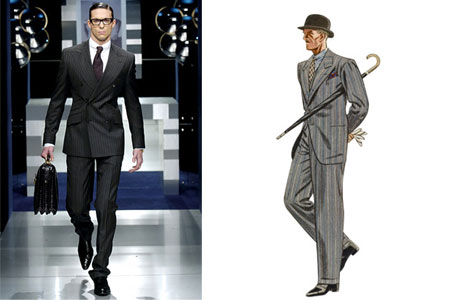
1930s-mens-fashion

On September 3, 1939, England and France declared war on Germany for invading Poland, and refusing to withdraw troops.  Once again, men’s fashion would change as a result of historic events.

1930 GLOSSARY OF TERMS

 Cheviot:  A British breed of sheep known for its heavy fleece.  Cloth produced from this wool is a heavy twill weave.

Gabardine:  A firm, tightly woven fabric of worsted, cotton, wool or other fiber with a twill weave.

Glen plaid:  Vertical and horizontal stripes intersecting at regular intervals to form a houndstooth check.

Herringbone:  A pattern consisting of adjoining vertical rows of slanting lines suggesting a “V” or an inverted “V”.  Also known as chevron.

Houndstooth check:  A pattern of broken or jagged checks.

Saxony:  A fine three-ply yarn.  Cloth produced from the yarn is a soft-finish compact fabric.

Seersucker:  Originally from India and named after a Persian expression, “shirushakar”, meaning milk and sugar.  It is a rippled or puckered cloth resulting from the vertical alternation of two layers of yarn, one taut and one slack, which also creates the characteristic stripe.

Shantung:  A plain weave silk cloth made from yarns with irregular or uneven texture.

Tweed:  A coarse wool cloth in a variety of weaves and colors originally from Scotland.  (Many tweeds are multi-color and textured.)

Twill weave:  One of three basic weave structures in which the filling threads (woof threads) are woven over and under two or more warp yarns producing a characteristic diagonal pattern.

Worsted:  Firmly twisted yarn or thread spun from combed, stapled wool fibers of the same length.  Cloth produced from this yarn has a hard, smooth surface and no nap (like corduroy or velvet).

Written by  Carol Nolan-Edited by  Julie Williams

 Possibilities Emerge …

Possibilities emerge when we earnestly search for what is hindering our destiny to flow naturally.
There are times when it seems that we are going round and round in circles about the same situation and our horizon shows no perspective whatsoever.
Many times, we fail to perceive that we have become wearied of some situations and it is time for us to open up to new things.

We have a habit of creating standards and routines hindering new possibilities to appear… because standards and routines imprison us in an endless repetition of the same things.
There are countless things chaining us to the past, never allowing the present to happen, things that manifest themselves as soon as we open the door.
We are imprisoned by pain and fear… when they prevent us from even getting close to setting them free and achieve what is beyond.

We tie ourselves to what was good… but now it is in the past… this also keeps us from allowing new things to enter our lives…
Actually, if we would remember that we are only present when we are whole at those moments, then we would allow life to flow without tying ourselves to the concepts of “good” and “bad”…

Many times we are imprisoned even in the Light… to some special experience, from this or other lives that gratified, and that we keep trying to repeat now, without remembering that the Light is available when we are in the present time accessing all the possibilities as we sink into creative emptiness.
Trying to live the situations you had in the past, for the best that they may have been… only keeps us from other possibilities that can reveal even more precious experiences than those we have in our memory.
Haven’t you noticed how we repeat our daily routines and almost never remember that the day can be filled with different things… different experiences… different ways to practice things…

So many people say they want new things in their lives…but only accept what comes in old colors… because it gives an illusion of safety.
To really access what the Universe has for us… we must be willing to give up many things… and that may happen in a much gentler way than we think it could, when our choices are made in the present.
Be the Light… Be the shadow… let go … if this is holding you in some way, and open yourself to the countless possibilities that are present in the moments in which when we are whole… here and now
Then… a magic field opens up with ever more… and more… to be explored, leading us to discover that the Universe is unlimited in possibilities…


COMMUNITY BOATING

5

Copyright © 2009 ADRIANA SASSOON .All Rights Reserved.

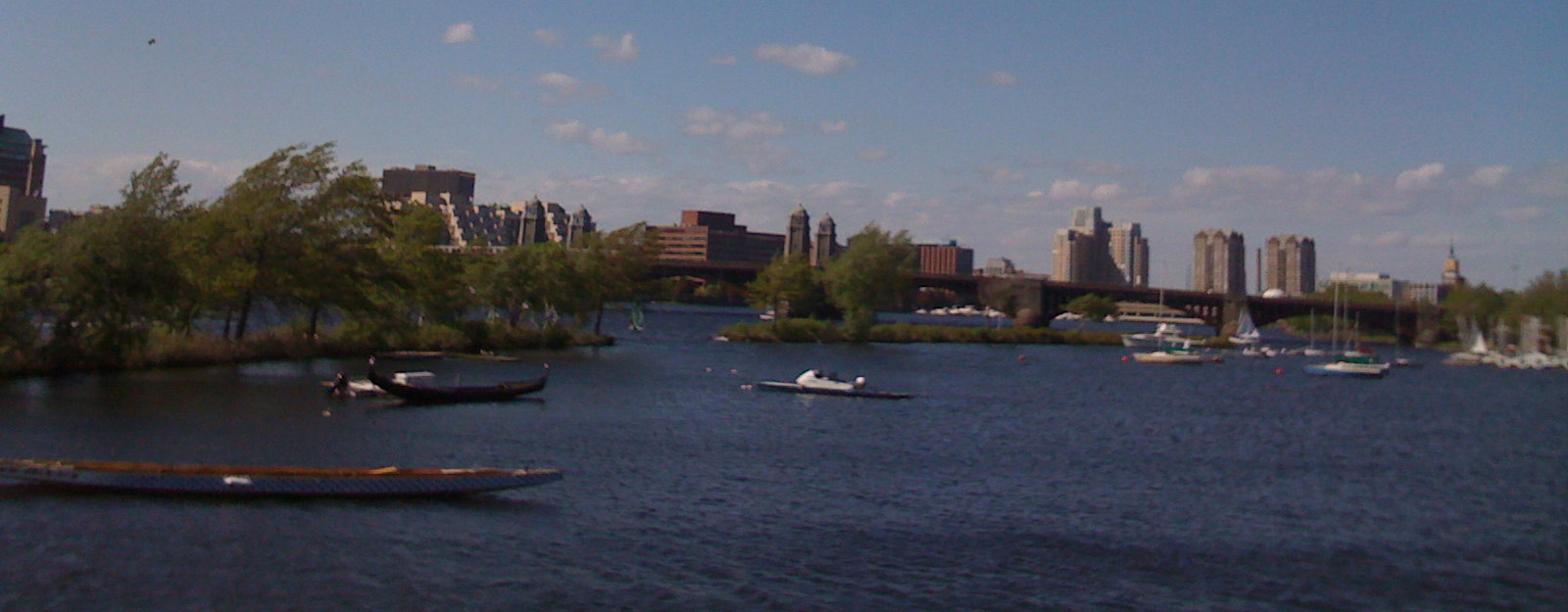
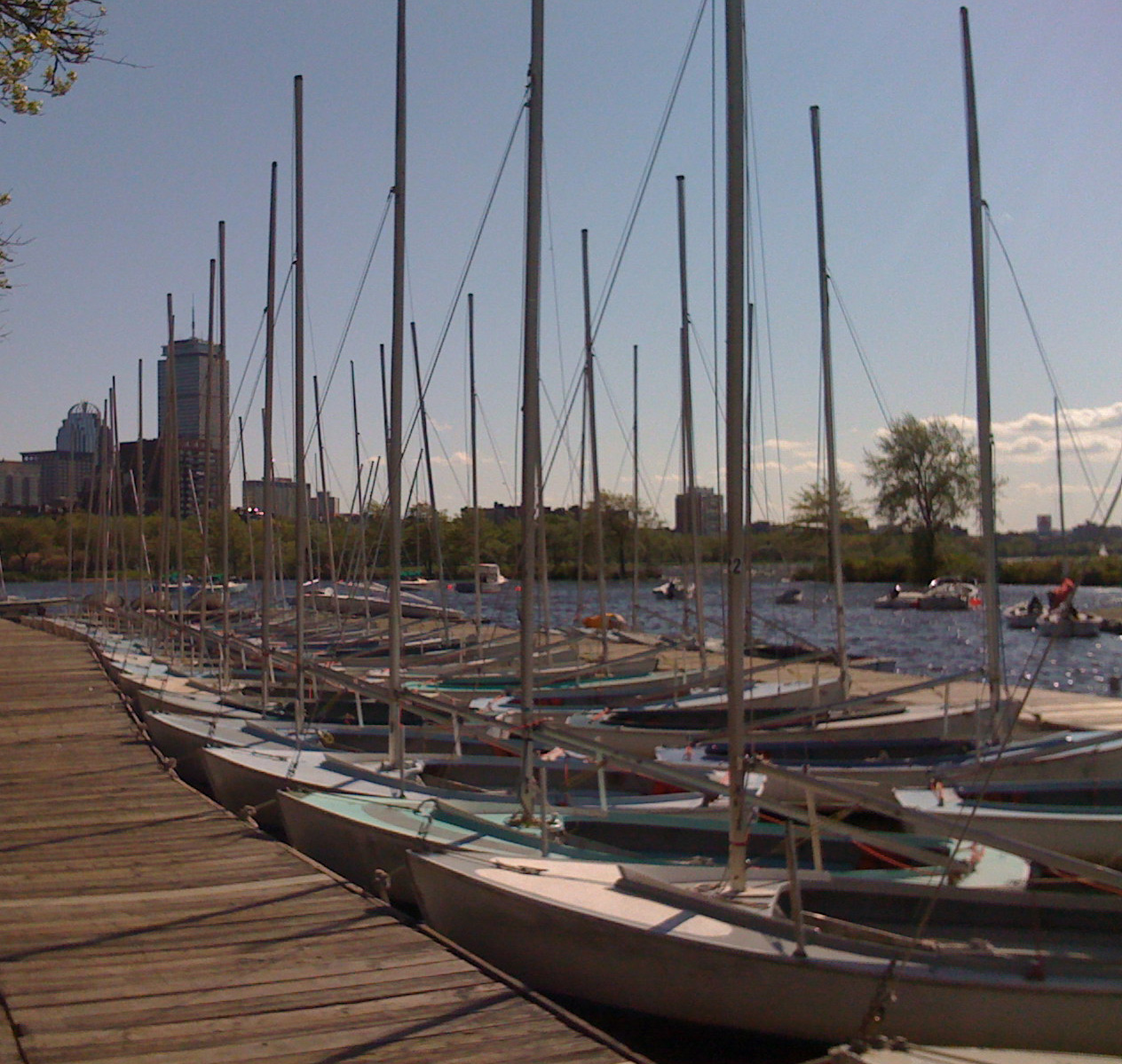
LEARN ABOUT SAILING ON THE CHARLES RIVER AT COMMUNITY BOATING INC. (CBI). Sailing on the Charles River is without a doubt one of those iconic Boston experiences and it has never been easier to get started. Join CBI . Open House to learn more about Boston’s greatest resource for sailing, windsurfing, and kayaking.

Complimentary Orientations, Rigging classes, or Shore School, and meet the staff and some of the dedicated volunteer instructors.CBI serve light refreshments. The adult full year membership cost only $240 and includes use of boats, equipment and all classes.

For the experienced dinghy sailor they have a great fleet of 420s, Lasers, and windsurfers and a full summer schedule of racing and advanced clinics.

 Copyright © 2009 ADRIANA SASSOON .All Rights Reserved.


WWW.COMMUNITY-BOATING.ORG


BOSTON BY BICYCLE

Boston area transit advocates are livid over the state’s attempts to weasel its way out of commitments made two decades ago to expand public transit as a requirement for building the $15 billion dollar central artery highway. Fred Salvucci, the former state transportation chief who championed the Big Dig, recently told the Boston Globe, “We always knew that this thing would create a very brief improvement and things would recongest if we did not improve public transportation.” Bicycling and pedestrian advocates, too, are disappointed that little money and attention has been allocated to their modes.

Advocates for safer road conditions for cyclists and the creation of off-road bicycle paths in Boston feel they have had limited success over the past several decades. “Bicyclists are a tiny minority of transportation mode users. We cannot rely on our numbers alone, rather on having the public and decision-makers realize that the entire community benefits when other modes of transportation receive necessary funding,” says Doug Mink, long time Boston bicycle advocate and MassBike Board member. In rethinking a strategy toward making Boston a more bicycle-friendly city, Mink believes that, “success requires proven coalitions with other groups, such as health and parks advocates, and acting opportunistically on as broad a field of issues as possible.”

Contemporary bicycle advocacy was born with the oil crisis and surge of environmentalist activity in the 1970s. Concerns were over the reliance on oil from governments we would rather not support, automobile pollution, and urban sprawl. Also touted were the positive benefits bicycling brings to health and community noting that a significant number of trips in Boston are under 5 miles. Early on, cyclists were simply fighting for their right to share the road. In 1990, an average of only $2 million out of an approximate $400 billion in Federal transportation funds were spent each year nationwide on bicycle and pedestrian projects, and only a handful of states and cities had bicycle coordinators.

Today, cycling has entered the mainstream of transportation planning concepts, at least as far as words and potential funding are concerned. After decades of highway-only federal spending, in 1990 the Federal Highway Administrator described bicycling and walking as “the forgotten modes” of transportation. For the first time, U.S. Department of Transportation adopted a national transportation policy to “increase use of bicycling, and encourage planners and engineers to accommodate bicycle and pedestrian needs in designing transportation facilities for urban and suburban areas.” 1998’s Transportation Equity Act for the 21st Century (TEA-21) allows states to apply for federal transportation dollars for a variety of modes, including biking, public transit and pedestrian facilities. By 2003, Federal spending on bicycle and pedestrian improvements reached over 400 million dollars per year. Tim Blumenthal, Executive Director of Bikes Belong, a bicycle industry group, is optimistic. “The past two years of strategic advocacy may result in the next Federal Transportation Authorization bill including twice the funding for bicycle facilities and programs,” he asserts.

At the local level, several cities such as London, Bogotá, and Chicago have emerged as visionary leaders in integrating bicycling into transportation policy, in partnership with hard-working bike advocate organizations. Chicago’s ambitious, multi-million dollar program with a staff of six has established 100 miles of new bike lanes, installed 10,000 bike racks, and will be installing 100 miles of signed bike routes in 2005. “My goal is to make the City of Chicago the most bicycle-friendly city in the U.S.” asserts Richard Daley, Mayor of Chicago. Their new Millennium Park Bicycle Station offers free indoor secure bike parking, showers, lockers, bike rentals, tours, snack bar, and repair shop. “We’re not telling people to get out of the car, but we’re trying to provide incentives and encouragement to make the city more bicycle-friendly,” says Ben Gomberg, the city’s bicycle program coordinator.

Bostonians want more opportunities to bicycle. According to a January 2005 report, part of MetroFuture: Making a Greater Boston Region, a project of the Metropolitan Area Planning Council (MAPC), support for bicycle commuting was identified in a list of most critical issue facing Metropolitan Boston today. “We found that in nearly every community, people see a need for more sidewalks and bike paths to get around safely without a car,” says Tim Reardon, a Regional Planner at MAPC. “And when people talk about dealing with the region’s transportation problems, they don’t talk about new highways and wider roads–they talk about transit, bike paths, and walkable communities.” And with its compact nature and existing greenway bike paths, Boston is ripe for increased bicycling for transportation and recreation.

Founded in 1977, the Boston Area Bicycle Coalition became a statewide advocacy group in 1993 and changed its name to MassBike in 1998. Dorie Clark, MassBike’s executive director, says they are working on state-wide issues that have an impact on local bicycling advocacy. “We are actively involved in the State Highway Manual redesign which will bring modern standards into the document, last updated in the 1960s, that guides every new and reconstructed roadway in the Commonwealth,” Clark says.

“However,” says Jeffrey Ferris, Boston bicycle shop owner and activist, “MassBike’s focus on statewide bicycle issues has left a noticeable void in organized local Boston-area bicycle advocacy.” In 2001, the Boston Transportation Department, in collaboration with the Mayor-appointed Boston Bicycle Advisory Committee, published the “Boston Bicycle Plan” as part of the city 2000-2010 transportation plan. Sadly, four years later, few of the plan’s key recommendations have been implemented. There is currently no Bicycle Program Manager and no Interdepartmental Bicycle Task Force. To its credit, the City has adopted a bicycle parking ordinance to ensure adequate bicycle parking facilities in new buildings, but without adequate enforcement provisions.

In late January, Mayor Thomas Menino convened a high-level meeting to announce his support for the upcoming Boston Bicycle Festival, planned for Sunday October 2, 2005. This suggests a “renewed effort in giving bicycling legitimacy within City government,” says Steve Miller, Festival Director. Boston City Councilor Hennigan held a public hearing in November 2004 on the importance of reinstituting a Bicycle Program Manager. A newly formed organization called the Boston Bicycle Planning Initiative (BBPI) gave a coordinated formal testimony to a packed audience at the hearing, and is spearheading follow-up advocacy in collaboration with MassBike, Bikes Not Bombs, and WalkBoston.

But what can this new bike advocacy attempt do differently to get city officials to take bicycling seriously? New York’s advocacy group Transportation Alternatives appeals to a wider car-alternative audience by working toward “better bicycling, walking and public transit, and fewer cars; safer, calmer neighborhood streets and car-free parks.” “But Bike advocates don’t win by themselves,” says Noah Budnick, Projects Director of Transportation Alternatives and Board Member of Thunderhead Alliance, a national coalition of bicycle and pedestrian advocacy organizations. “Bike advocates and parents and health professionals and park users and businesses and block associations win when they work together.”

Bikes Not Bombs helped create and is on the steering committee of “On the Move: Greater Boston Transportation Justice Coalition,” a two-year old group consisting of 50 community organizations focusing on improved transportation services in low-income neighborhoods and communities of color. The advocacy group BBPI has been pushing the message of “Complete Streets,” arguing that all road users must accommodated, including handicapped, transit users, pedestrians, bicyclists, and automobiles. “The incremental costs of bike, pedestrian, and traffic calming measures are very low when considered during routine road redesign,” says Larry Slotnick, BBPI board member.

Groundwork Somerville, a group working toward healthier, greener neighborhoods, leads the Somerville Active Living by Design Partnership. With a grant from the Robert Wood Johnson Foundation, the Partnership supports the completion of the Somerville Community Path to Boston and sponsors urban cycling skills workshops in collaboration with MassBike. “People are more likely to be physically active if the exercise happens naturally in daily routines, for example walking up stairs or bicycling to work,” says their Executive Director Jennifer Hill. “That’s why the Partnership includes bike advocates, City planning agencies, and social service and public health agencies, to bring together the people who can make those changes happen.” With funding from the Center for Disease Control, Boston Public Health Commission’s new “Boston STEPS” program aims to reduce the burden of diabetes, asthma, and obesity for residents in seven Boston neighborhoods, and “bike advocates are urging them to develop programs to increase bicycling among their target populations,” says Mink.

BNB’s former Transportation Organizer, Mira Brown, says the challenges before bike advocates are formidable, but exciting. “We cyclists, have to get the entire community to realize that everyone benefits from improved cycling facilities, in combination with more walkable streets and better public transportation. To do this, cyclists have to listen a lot more to our natural allies – transit users and people stuck in cars they really can’t afford or don’t want. Then we have to work together in a diverse movement to force the city, state and federal governments to allocate transportation dollars wisely.”

6

7 

REFERENCED LINKS

MassBike
http://www.massbike.org

History of Boston Area Bicycle Coalition
http://www.massbike.org/groups/massbike/babchist.htm

City of Boston Bicycle Plan
http://www.cityofboston.gov/accessBoston/bicycle.asp

Boston Phoenix Article (May 2004) on loss of Boston’s Bicycle Program Manager
http://www.bostonphoenix.com/boston/
news%5Ffeatures/top/features/documents/03806097.asp

Boston Bicycle Festival
http://www.bostonbikefestival.org

Boston Bicycle Planning Initiative (BBPI)
http://www.bikethehub.org

BALLET RUSSES

“Ballet Russes” by August Macke, 1912

The Ballets Russes (French for The Russian Ballets) was an itinerant ballet company which performed under the directorship of Sergei Diaghilev between 1909 and 1929. Some of their places of residence included the Théâtre Mogador and the Théâtre du Châtelet, though they worked in many countries, including England, the U.S.A., and Spain. Many of its dancers originated from the Imperial Ballet of St. Petersburg. Younger dancers were trained in Paris, within the community of exiles after the Russian Revolution of 1917. The company featured and premiered now-famous (and sometimes infamous) works by the great choreographers Marius Petipa, Michel Fokine, Bronislava Nijinska, Leonide Massine, Vaslav Nijinsky, and a young George Balanchine at the start of his career.

Ballet Russes poster, 1911

It created a huge sensation around the world, altering the course of musical history, bringing many significant visual artists into the public eye, and completely reinvigorating the art of performative dance. The Ballets Russes was one of the most influential theatre companies of the twentieth century, in part because of its ground-breaking artistic collaboration among contemporary choreographers, composers, artists, and dancers. Its ballets have been variously intepreted as Classical, Neo-Classical, Romantic, Neo-Romantic, Avant-Garde, Expressionist, Abstract, and Orientalist. The influence of the Ballets Russes lasts to this day in one form or another.

After Diaghilev’s early death in 1929, the dancers were scattered, and the company’s property was claimed by creditors. Colonel Wassily de Basil and his associate René Blum revived the company under the name Ballets Russes de Monte Carlo. George Balanchine and Leonide Massine worked with them as choreographers, and Tamara Toumanova as a principal dancer. De Basil and Blum argued constantly, so Blum founded another company under the name Original Ballet Russe.

During World War II the Ballets Russes de Monte Carlo toured extensively in the United States. When dancers retired and left the company, they often founded dance studios in the United States or South America, or taught at other dancers’ studios. With Balanchine’s founding of the New York City Ballet, many former Ballet Russes de Monte Carlo dancers went to New York to teach.

The Original Ballet Russe toured mostly in Europe. Its alumni were influential in teaching classical Russian ballet technique in European and British schools.

The Serge Lifar collection of Ballets Russes costumes and other memorabilia is on display at the Wadsworth Atheneum in Hartford, Connecticut.

Two of the male stars of Diaghilev’s Ballets Russes in 1909 were Adolph Bolm (1884-1951) and Mikhail Mordkin (1880-1944). Bolm was a student at the Imperial School in St. Petersburg and Mordkin was trained at the Bolshoi, in Moscow. They both joined Diaghilev for his Paris season as leading dancers although they ranked above Nijinsky. Diaghilev made sure that the press wrote more about his young favorite.

mordkin_mikhail

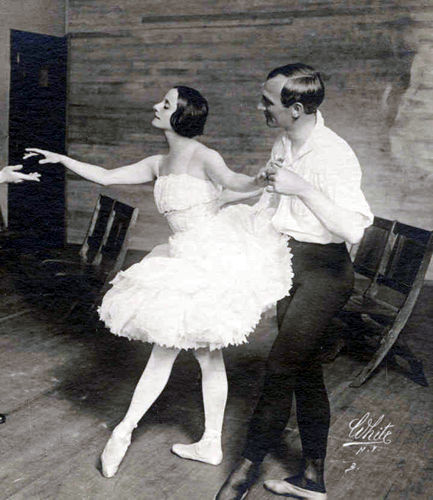
Mikhail Mordkin graduated from the Bolshoi Ballet School in 1899, and in the same year was appointed ballet master. He joined Diaghilev’s ballet in 1909 as a leading dancer. After the first season he remained in Paris to dance with Pavlova. He then formed his own company, All Star Imperial Russian Ballet, which toured America in 1911 and 1912. Mikhail returned to the Bolshoi and was appointed its director in 1917. He left Russia after the October Revolution, first working in Lithuania, and finally settling in the United States in 1924. He founded the Mordkin Ballet in1926, for which he choreographed a complete Swan Lake and many other ballets. His company included such distinguished artists as Hilda Butsova, Felia Doubrovska, Pierre Vladimiroff, and Nicholas Zvereff. After a European tour the company disbanded in 1926. Mordkin continued to be a freelance artist and teacher. From among his students in America he formed a new Mordkin Ballet in 1937, the forerunner of Ballet Theatre (now American Ballet Theatre). His student Lucia Chase helped finance his company and after the first season of Ballet Theatre, she and Richard Pleasant took over the management from Mordkin because they thought his plans lacked ambition. Although he had been pushed into the background, Mordkin, like Bolm, helped build the foundation for ballet in America.

massine-leonide-laleggendadi-giuseppe

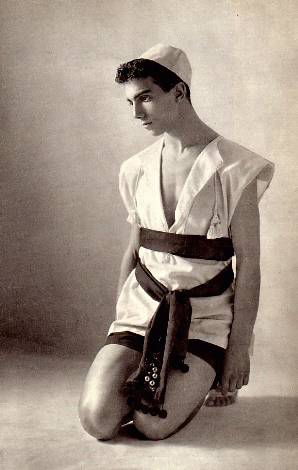
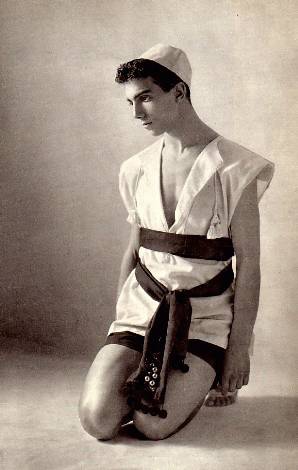
You may remember one of Diaghilev’s most famous dancers, Leonide Massine (1895-1979), because of his portrayal of the ballet master and shoemaker in the 1948 film The Red Shoes . Massine studied at the Moscow Bolshoi School, graduated in 1912 and joined the Bolshoi Ballet.

When Diaghilev fired Nijinsky after his marriage a void was left both in the ballet company, and Diaghilev’s life. Mikhail Fokine was working on a new ballet, The Legend of Joseph. While visiting in Moscow Diaghilev saw the Bolshoi Ballet, and noticed in Don Quixote and Swan Lake a handsome young man with big dark eyes who reminded him of St. George in an ikon. This was Leonide Massine not a particularly good dancer (with poorly shaped legs), but who had stage presence that would make him into a great star. Diaghilev became infatuated with Massine and persuaded him to leave the Bolshoi and join his company. It was understood that he would replace Nijinsky on and off the stage. Massine immediately began to work with the Ballets Russes’ teacher Enrico Cecchetti and was soon ready to star in Fokine’s new ballet.

Massine became an outstanding-actor dancer. Before joining the Ballets Russes, Massine had considered giving up dance and becoming an actor. He had even been offered the role of Romeo in Shakespeare’s play at the Maly Theatre in Moscow.

Massine joined the company in 1914 and by 1915 he had choreographed his first ballet for the Ballets Russes. To Diaghilev’s dismay Massine followed the same path as his predecessor and got married to the first of four wives in 1921. Diaghilev called him an ingrate, saying, “Nothing but a good-looking face and poor legs.” Massine continued to choreograph for every major company including three years as lead dancer and choreographer for the Roxy Theatre in New York City. In 1945 and 46 he formed his own company called Ballet Russe Highlights.

He was a prolific choreographer  he created 50 ballets. His greatest achievement is considered by many to be the development of the symphonic ballet as a separate art form.

To list all his ballets would take a whole page. A few are: The Good-Humored Ladies, La Boutique Fantasque, The Three Cornered Hat, Les Presages, Jeux d’enfants, and Gaîte Parisienne.

Massine was for twenty years considered the Western world’s greatest choreographer, but in later life he was overshadowed by George Balanchine .

http://ballets-russes.com
* The Ballet Rousses at Wang Theater Boston.Oh my god! I am speechless.Centenial Anniversary of Diaglev’s Ballet Company. Mikko, great job. What a surprise at the end Fire red costumes and real fire created a sensuous scenery. The illusion of 3D. A true CLASSIC.

AYRTON SENNA


“Meu principal objetivo é ser reconhecido no mundo do automobilismo como um bom profissional, ser visto como alguém que conquistou algo. Também quero que valorizem o esforço que aplico no meu trabalho” (1983)

“Eu quero ser um piloto de Fórmula 1 vencedor. Não quero competir por competir, vencer vai ser parte da minha filosofia” (1983)

“A Fórmula 1 é um salto muito grande para quem vem da F3 e preciso de tempo para me adaptar. Devo ter uma base sólida antes de uma possível mudança de categoria. Até agora tenho apenas três anos de experiência (na F3), porém conto com grande experiência nos karts. Tudo bem que tenho 23 anos, mas tenho tanta experiência como alguns pilotos de 30” (1983)

“Quando eu me tornar campeão não vou deixar de ser eu mesmo” (1984)


“Eu vi Deus, foi ele quem me guiou. Tive sinais que indicaram seus desejos e poder. Acima de tudo, seu poder de controlar o que está a sua volta, tudo. Algumas pessoas nunca têm a experiência que eu vivi, e não acreditam no que eu digo. Eu rezava, agradecendo a Deus que eu seria campeão mundial. Quando, concentrado ao máximo, eu fazia uma curva a 180 graus, eu vi uma foto dele, grande, ali, suspensa, subindo para o céu. Tudo isso ao mesmo tempo em que me concentrava, conduzindo o carro. Este contato com Deus foi uma experiência maravilhosa” (1988)

“A Xuxa gostava muito de sua profissão e não tínhamos tempo para estarmos juntos, por isso tivemos que nos separar” (1989)

“Antes de me aposentar, eu vou pilotar para a Ferrari” (1989)

“Tem provas que terminam faltando seis voltas e outras na primeira curva…” (sobre o acidente com Alain Prost no GP do Japão de 1990)

“Meu maior erro? acho que ainda não o cometi…” (1991)

“Deixar de correr porque é perigoso? Também posso ser atropelado” (1991)

“Nós corremos mais riscos que as pessoas de outras profissões e, por isso, sabemos lidar melhor com o medo” (1991)

“O sentimento de chegar quase ao seu limite é fascinante” (1991)

“Quando Deus quer algo, nada pode-se contra” (a alguns jornalistas depois da vitória em Interlagos, em 1991)

“Eu corro para disputar, não para ganhar dinheiro…” (diante da oferta da Ferrari para ter o piloto brasileiro, em 1992)

“Para a Williams, eu até correria de graça” (1992)

“Superstições? Não acredito nelas, só creio no trabalho” (1993)

“O que eu quero, acima de tudo, é voltar a pilotar um carro competitivo, que tenha possibilidade de ganhar e lutar pelo título. Não quero uma temporada como a de 1992. Quero ser competitivo” (1993)

“Ele não é um piloto, é um idiota” (em referência a Eddie Irvine por um incidente em Suzuka, em 1993)

“É o sonho da minha vida. Frank (Williams) foi o primeiro a me dar uma oportunidade na F1, em 1983, e agora, finalmente, estaremos juntos” (1993)

“Quero sair deste buraco em que me encontro. Creio que posso correr até o ano de 2000. Posso chegar, inclusive, ao pentacampeonato mundial, como Fangio” (1994)

“Ganhar uma corrida é um desafio muito maior do que ganhar US$ 1 milhão” (1994)

“Ceccoto, De Angelis, Dumfries, Nakajima, Berger, Andretti, Hakkinen: nunca tive nenhum problema com eles. Só tive problemas com um piloto (Prost)” (1994)

“Campeão mundial antecipado? É fácil dizer, mas esse ano está muito difícil” (1994)

BIOGRAPHY

Ayrton Senna da Silva, (pronounced [aˈiɾtõ ˈsenɐ da ˈsiwvɐ] (help·info), March 21, 1960 – May 1, 1994) was a Brazilian race car driver and three-time Formula One world champion. He died while leading the 1994 San Marino Grand Prix and is the most recent Grand Prix driver to die at the wheel of a Formula One car.

Senna began his motorsport career in karting and moved up the ranks to win the British Formula 3 championship in 1983. Making his Formula One debut with Toleman in 1984, he moved to Lotus-Renault the following year, and won six Grands Prix over the next three seasons. In 1988 he joined Frenchman Alain Prost at McLarenHonda. Between them, Senna and Prost won fifteen out of the sixteen Grands Prix which took place that season, with Senna winning his first World Championship, a title he would go on to win again in 1990 and 1991. McLaren’s performance declined in 1992, as the WilliamsRenault combination began to dominate the sport, although Senna finished runner-up in 1993. He moved to Williams in 1994, but suffered a fatal accident at the third race of the season at the Autodromo Enzo e Dino Ferrari in Italy.

Senna is regarded as one of the greatest drivers in the history of Formula One. He was recognised for his qualifying speed over one lap and held the record for most pole positions from 1989 to 2006. He was among the most talented drivers in extremely rain-affected conditions, as show by his performances in the 1984 Monaco Grand Prix, the 1985 Portuguese Grand Prix, and the 1993 European Grand Prix. He also holds the record for most victories at the prestigious Monaco Grand Prix (6) and is the third most successful driver of all time in terms of race wins.

Senna courted controversy throughout his career, particularly during his turbulent rivalry with Alain Prost, which was marked by two championship-deciding collisions at the 1989 and 1990 Japanese Grands Prix. Being competitive and unwilling to settle for second, Senna’s style consisted of pushing the car to its limits and going flat out, a stark contrast to the relaxed intellectual style of his nemesis Prost.  Senna’s aggression had inspired Michael Schumacher, another F1 great who idolized Senna and had who also courted similar controversy through his career.