wet-ltt-thumb.jpg

Decorating with LED is easy. After learning about many LED enabled home fixtures, we’ve understood that the most of them if not all can be installed by regular contractors or plumbers, with no special skills required. Really, all it takes is to plug in a LED powering connection via low voltage adapter that comes with the product (some can even run on batteries). LED is definitely in the trend. Already today you can decorate your home with LED. Be the first to surprise your guests. But before we’ll show you a few great products that will set this new trend in your home, let us comfort you with a few important facts about LED…


Bathroom: Chromatheraphy – set your mood with the right color

hansgrohe-wellspring.jpg


WellSpring Steam Shower by Hansgrohe … Light up your steam shower with the LED color, change it based on your mood. The WellSpring’s LED chromotheraphy in 4 colors is only one of many features to enjoy you bathing with in this high-end system.


HansaColourShower by Hansa … take a shower with the LED colored rain. Let it light on when water on automaticaly or manualy change between 8 colors including white from the lit control panel, as you desire. LEDs installed right in the showerhead, combined with multiple spray options help to create a very relaxing showering experience.

hansacanyon-colors.jpg

Whole House: Practical LED

brighthandle-handle.jpg

Brighthandle LED lit door handle … it changes its color from Green to Red when you lock the door. What a practical way to show others that the room is occupied. Brighthandle also brings colors to home interior. We find the Brighthandle to be one of the most practical LED application in home decor.


Bathroom: Changing Colors with TemperatureAnother LED’s fascinating feature that brings art and unexpected to modern home decor – the ability to change color with changing temperature. In the case of Nephopia basin, the glass color is changing, and with Hansacanyon the color of the water is changing.

Hansacanyon LED lit faucet from Hansa … is a high-tech water and light control system – with water temperature changing from cold to hot, the water color is changing from Blue to Red. Along with the faucet, also available is the illuminated waterfall spout that can be either a tub filler or an overhead shower. Even the temperature control buttons are illuminated.

hansacanyon-colors-all.jpg

Bathroom: LED Lighted Faucet, Lavatory and Tub – practical and beautiful


Take a clear or translucent material and make faucets, sinks and tubs out of it, then light them up with LED… how thoughtful and how aesthetic. These fixtures don’t just set a nice atmosphere and make a very modern statement, they create a friendly glow by night so you won’t trip over when looking for your loo. You can leave the LED light on – it won’t cost you more than leaving your computer on.

The Neve Brick Faucet by Neve Rubinetterrie… more like art in your bathroom that mixes water and light. The two versions Brick Glas (transparent) and Brick Ice (opal) are available with a choice of white, red, orange, blue or green LED light.


neve-brick-faucets.jpg

wet-ltt-sink-tub-blue.jpg

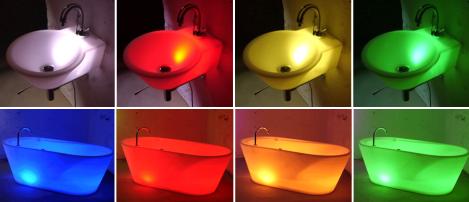
The LTT tubs and LTB lavatories from Wet, and Italian company … these objects are some of the most impressive LED driven designs. You see them and you want them, and they are priced on a budget. And not just for adults – would it be much easier to convince your child to take a bath in a lighted tub? Both the bathtub and the sink are made from polyethylene and are illuminated with a built-in multicolored, low-voltage electronic LED device that can be programmed for time, color and color intensity. A transformer is included. Buy them at Giant.


wet-ltt-sinks-tubs.jpg

“Why LED?”, people ask. Because… LEDs, or light-emitting diodes, bring FUN, FUNCTION and BEAUTY to home decor.
On a more technical note…
LED is virtually maintenance free – it rarely burns out; it lasts for 100,000 hours on average. No filament to burn out, unlike in ordinary incandescent bulbs. By some sources, LEDs can last for as long as 40 years.
LED is a low cost light source – in LED bulbs, 90% of energy is converted into light, while in incandescent bulbs 90% of energy goes to heat and only 10% to visible light.
led-diods.jpg LED is safe – it requires low voltage DC electric current and can run on batteries, and it’s safe to the touch – it doesn’t get hot.
LED light is easy to see even in bright sunlight.
LED can be illuminated in many colors including a very recent addition of White and Blue. Other are Green, Cyan, Red, Red Orange and Amber.
LED can change its light color.
LEDs are very inexpensive – some priced at .50 cents.
LEDs are easy to implement – they are just tiny bulbs that fit easily into modern electric circuits.
LEDS are durable – they aren’t glass but small plastic bulbs.
Do you need more LED advantages…?! And there’s more… Incidentally, just when we were writing this article, the news came up about the LED discovery made accidentally… The news basically say the LEDs will replace the common incandescent bulbs.. See how LED works in more details.

LED will lead and light up the future.
LED will play a major role in contemporary decor. If today’s contemporary style means decorating with colors … tomorrow’s contemporary style will be decorating with colors of LIGHT… The LED revolution in the interior design has already began…

Now that we know why LED is in, let’s see some examples of how it transforms the home decor of today, room by room…

Dining: Add Magic with LED

The LED table by Ingo Maurer … Thinking about a romantic candlelight dinner under the stars? Instead, spend a ‘starry’ night at this LED lighted table, and you’ll fill your romance… ‘above’ the stars. Designed by Ingo Maurer in 2003(!), this magic table lights up with 278 white LEDs per leaf and is available in 2-leaf ($14,850) and 3-leaf ($22,421) version at Unica.

Kitchen: Lighted Water

kwc-eve-led-ring.jpg

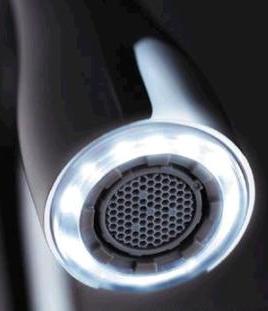
The KWC Eve Kitchen Faucet … Illuminating water is not new but when your kitchen faucet does it, is. Imaging yourself entertaining your guests in a darken kitchen… and suddenly they see the blue lighted water… this will set the party trend. Eve has only became available since August of 2005, from Swiss KWC. It’s fascinating how this small and elegant faucet is made so innovative and practical. It has a pull-out that you don’t see right away. The LED-lighting ring is integrated into the pull-out. You press a button on the pull-out, and Eve will not only illuminate water flow but provide effective lighting of the workplace as well. The LED application is supported by the Luminaqua light technology that uses a low voltage of 6.75V and is absolutely safe. It will automatically switch itself off after 45 minutes, and will use up very little electricity thanks to the LED efficiency. The pull-out extends up to 2 feet and the swivel rotates 270 degree. Available with no LED as well.

Kitchen: Cooking with Fun

faber-imago-hood-led.jpg

Imago LED Illuminated Hood from Faber … a mood setter in the Kitchen. Add some fun to your boring kitchen appliances. Besides LED lights, it comes with a built-in TV.

ANIMALE

Once upon a time people used to hunt animals for their meat and skin. The meat used to keep them well fed and the skin well protected from the vagaries of nature. As they progressed in evolution, the animal skins found a place in their homes first used as sleeping rugs and later for beautification.

The rugs, no matter what type you would choose, would instantly make the room look prettier and interesting looking.  Try putting one as the fist thing that your feet touch on the floor in the morning or in the drawing in front of your favorite arm chair and so on, and see the difference.You will find that wherever you put the animal print rugs, there would be an instant and very beautiful change to the room and overall to the house. A word of warning in case you use it on freshly polished wooden floors, you might need some anti skid tape under it, or you would risk injury by falling as soon as you put your foot on it. 

karastan-exotics-rugs.jpg

 Bordelet fireplace Eva Tiger

 The History Of The Animal Print Rugs

That was once upon a time when human beings were primitive; then came an era when human beings developed a peculiar thirst for animal blood giving hunting the name of royal game where royalty and other people of influence chose to animals not for their meat (to eat) or skin (to cover) but for greed and relaxation.

At that time it was considered chic to have the hide of the animal you slew tanned and displayed on your wall in the drawing room, or as a rug on the floor in a prominent place. Almost all the kings would have some type or other animal rugs in their palaces along with huge stuffed animals that they hunted, or their heads as trophies.

The Animal Print Rugs Today

Thankfully, hunting is no more considered a great “sport” everywhere in the world as people realize that there is nothing glorious in killing an animal with the latest gun while hiding in a machan. However, the trend of having animal print rugs in your home has not yet died. Of course, today animal print rugs do not mean animal skin. In fact, if you would be careful, the very name indicates that this is not supposed to be the real skin but only their prints.

In this way you have plenty to choose from you could choose from the following animal print rugs – lion, tiger, zebra, goat, wild cat, leopard, panther, grizzly bear, polar bear, wolf and many more.

animal-print-decor-trends.jpg

Animal Print on Wall Coverings

animal-print-tile.jpg

steuler-fliesen-wild-thing-daktari-tile.jpg

steuler-fliesen-daktari-tile-wall.jpg

bisazza-mosaic-leopardo-new.jpg

Animal Print Architecture

featherstone-orchid-house.jpg

Modern Homes

Demonstrating the pervasive influence of animal prints – there is now even a stunning luxury home with a nature inspired camouflage exterior! Even modern homes can get in on the animal print trend – as shown by the eco-friendly Orchid House designed by Featherstone Associates. The outer shell of the fascinating UK home is of laminated veneer lumber and covered in timber shingles, sporting a pattern they will help it to fit into its 450-acre nature reserve habitat! 


settecento-animal-tiles.jpg

settecento-animal-tile.jpg

 Tiles are a practical and decorative way to add animal prints anywhere. The Animalier tiles from Settecento combine great looks and a fun tactile element. Leo, Zebra and Cobra patterns can be combined or used individually on walls or around key features in the bathroom for emphasis. Wild Thing Daktari also favours a surrealistic twist for high impact. These animal printed tiles are a playful option – the patterns appear abstract – copied from an animated jungle inhabitant rather than a real one! A timeless, sophisticated interpretation of the animal print trend, the Leopardo is from the 2008 Mosaic Tiles collection by Bisazza. Formed by an intricate pattern of tiny mosaic tiles, the Leopardo is truly precious. Mosaic tiles, by nature of their small size, are fantastically versatile too.

Animal Print Accessories

vivarini-lamp-giraffe-1.jpg

vivarini-lamp-zebra-1.jpg

Lamps
Whether you are looking for an accent for a neutral decor, or seeking to pick up your chosen animal print themes, accessories are the perfect solution. The Vivarini Giraffe and Zebra collections of Murano glass lamps from Formia are bold yet refined. Their abstract animal print patterns allow the light to shine out from within, to emphasise their pretty, delicate glass forms. The lamps come in a variety of different shapes, appropriate for wall, ceiling, table or floor.

Vessels
With the exciting Ethnic collection of
animal print vessels from Vitruvit you can choose your favourite pattern from a wide range including snake, leopard, giraffe, and crocodile. Not only that, you can also choose from a range of distinctively shaped sinks. Focusing on the great prints and forms of the sinks, Vitruvit designers Manuela Busetti and Andrea Garuti have chosen the most minimal of slits for the water to escape, keeping your focus firmly on the shape and print of each vessel.

vitruvit-vessel-ethnic-41.jpg

vitruvit-vessel-ethnic-8.jpg

 Vanities


Vanities can be used as a showcase for animal prints too… the AdattoCasa Couture vanities show their true stripes in the best possible way! Topped with a modern basin, the body of the vanity is wrapped in a terrific animal print, adding a new dimension of interest to a functional piece. Whether finished with a glossy black snakeskin or an impressive tiled zebra or giraffe print, these simple Couture
vanities are totally contemporary.

legnox-couture-bath-furniture-adattocasa.jpg


3110494709_bdc1a3c3ce3110498755_603aa54cf3


 3095698037_083a866f081


3096539236_5a66b882bc3109745455_69986a221c1

Headband

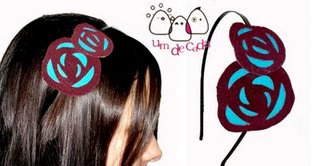
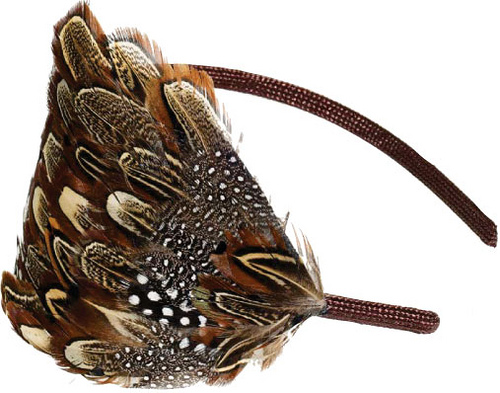
A headband is a clothing accessory worn in the hair or around the forehead, usually to hold hair away from the face or eyes. Headbands generally consist of a loop of elastic material or a horseshoe-shaped piece of flexible plastic or metal. They come in assorted shapes and sizes and are used for both practical and fashion purposes.

Horseshoe-shaped headbands are sometimes called Alice bands after the headbands that Alice is often depicted wearing in Through the Looking Glass.

Tiara

 Traditionally the Tiara is a form of headgear that is similar to a crown. The Tiara is usually worn by female members of a royal family. The literal translation of the world tiara means high crown. However unlike a crown the tiara is not a completely circular. Although circular in shape it does not meet at the back of the head. In ye olden times they were made out of leather or other fabric and were decorated with fine jewels and made to look beautiful. They were worn by the most dignified and prestigious members of the society such as the kings or emperors.

There were a wide variety of different variations on the theme and many different societies found innovative ways of decorating the tiara to show how prestigious it was. It is noted that the Assyrian people around the 15th to 20th century BC used bull horns as a symbol of authority and these were also decorated with feathers. The tiara was also popular in Persian times but differed slightly in that they featured more jewels and less feathers. The Persian version was also a little more like a crown as it had a tall cone like peak at the top and was more like a closed hat than the more modern open version.

Another common place where you might see a Tiara is in the Roman Catholic Church. The Papal tiara is a hat that is worn by the Pope. It is a ceremonial piece of headwear that comprises of three crowns that bear a globe and it is seen as an indicator of authority. This has not been worn for a while and it has been removed from the Pope’s Holy See coat of arms but it still plays a large symbolic role.

The modern tiara is a semi circle design that sits on the top of the head. It is usually a metal band that is more often than not decorated with jewels. Nowadays it is not used as much as a mark of rank or authority but more so as a form of adornment. Women usually wear them at very formal occasions to supplement a beautiful dress. They are often seen in events such as beauty pageants and are used to show which of the contestants have won and it is seen as a regal symbol. It is synonymous with head wear that would be worn by a princess and is as a result a very feminine item. Many women choose to wear them at their wedding. It is an extremely prestigious adornment.

The queen owns the most valuable collection of them in the world and people travel for miles to see her collection. They are property of the royal family and the queen is regularly seen wearing them at large occasions. It is said that the tiaras that she owns personally are priceless. She received the majority of these priceless items as heir looms but she has also received a number as gifts from foreign dignitaries. She was given a beautiful aquamarine tiara as a present from Brazil and Queen Alexandra has given her many of these gifts.

 http://www.umdecada.com.br/

TIME FOR CHANGE  & REFLECTION

money1


Recession

In economics, the term recession generally describes the reduction of a country’s gross domestic product (GDP) for at least two quarters.  The usual dictionary definition is “a period of reduced economic activity”, a business cycle contraction.

The United States-based National Bureau of Economic Research (NBER) defines economic recession as: “a significant decline in [the] economic activity spread across the economy, lasting more than a few months, normally visible in real GDP growth, real personal income, employment (non-farm payrolls), industrial production, and wholesale-retail sales.”

Attributes of recessions

In macroeconomics, a recession is a decline in a country’s gross domestic product (GDP), or negative real economic growth, for two or more successive quarters of a year.

An alternative, less accepted definition of recession is a downward trend in the rate of actual GDP growth as promoted by the business-cycle dating committee of the National Bureau of Economic Research. That private organization defines a recession more ambiguously as “a significant decline in economic activity spread across the economy, lasting more than a few months.” A recession has many attributes that can occur simultaneously and can include declines in coincident measures of activity such as employment, investment, and corporate profits. A severe or prolonged recession is referred to as an economic depression.

Speculation

Speculation (in a financial context) is the assumption of the risk of loss, in return for the uncertain possibility of a reward. Only if one may safely say that a particular position involves no risk may one say, strictly speaking, that such a position represents an “investment.” Financial speculation involves the buying, holding, selling, and short-selling of stocks, bonds, commodities, currencies, collectibles, real estate, derivatives, or any valuable financial instrument to profit from fluctuations in its price as opposed to buying it for use or for income via methods such as dividends or interest. Speculation represents one of four market roles in Western financial markets, distinct from hedging, long- or short-term investing, and arbitrage.

The economic benefits of speculation

The well known speculator Victor Niederhoffer, in “The Speculator as Hero” describes the benefits of speculation:

Let’s consider some of the principles that explain the causes of shortages and surpluses and the role of speculators. When a harvest is too small to satisfy consumption at its normal rate, speculators come in, hoping to profit from the scarcity by buying. Their purchases raise the price, thereby checking consumption so that the smaller supply will last longer. Producers encouraged by the high price further lessen the shortage by growing or importing to reduce the shortage. On the other side, when the price is higher than the speculators think the facts warrant, they sell. This reduces prices, encouraging consumption and exports and helping to reduce the surplus.

Another service provided by speculators to a market is that by risking their own capital in the hope of profit, they add liquidity to the market and make it easier for others to offset risk, including those who may be classified as hedgers and arbitrageurs.

If a certain market – for example, pork bellies – had no speculators, then only producers (hog farmers) and consumers (butchers, etc.) would participate in that market. With fewer players in the market, there would be a larger spread between the current bid and ask price of pork bellies. Any new entrant in the market who wants to either buy or sell pork bellies would be forced to accept an illiquid market and market prices that have a large bid-ask spread or might even find it difficult to find a co-party to buy or sell to. A speculator (e.g. a pork dealer) may exploit the difference in the spread and, in competition with other speculators, reduce the spread, thus creating a more efficient market.

GOOD SIDE OF RECESSION

The U.S. economy has been officially in a recession since December 2007 as significant decline in economic activity, triggered by the housing downturn starting in 2006, spread across the economy, lasting more than a few months. The economy contracted at a seasonally adjusted 0.5 percent annual rate in the third quarter of 2008.


For sure the recession is bad as it drives up unemployment. It has the good side though. Here are some benefits of the recession:


  • Unsupportable debts are being erased.
  • Inefficient businesses are wiped out.
  • Dying industries are being cleaned up.
  • Workers are exiting dying industries.
  • Consumers are rebuilding their savings
  • Consumers are lowering their living standards to match reality.
  • Asset prices, especially houses and stocks prices, are falling to or below their fair value
  • Assets taken away from weak hands and given to strong ones (through distress sales, foreclosures, and bankruptcies) create the conditions for future growth.

5

8972


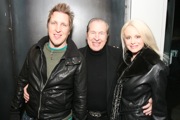
Soffer Ari

Adriana & Ari

Adriana  &  Ari
About Soffer Ari :
In 1995 Ari founded S.A. Leather when he created his first piece, a pair of handmade leather pants, which quickly became a necessity among the Hollywood Elite. Soon after he created his leather pants customers wanted belt straps and buckles to match. Ari quickly became the go-to person for custom pieces for movies and rock tours. Today, Ari houses a complete lifestyle collection and has earned a reputation for distinction, beauty, and quality craftsmanship.
The Soffer Ari collection is a very large and extensive collection. Ari has chosen some of his favorite pieces to offer in this online store. If you do not see what you are looking for in this store, you can send an email and order almost any piece that is shown on Ari’s online catalog which is viewable under “online catalog” at http://www.saleather.com


IMG_6575.JPG

IMG_6583.JPG

http://media.saleather.com/

SKULL

19

111

29

28

Skull symbolism is the attachment of symbolic meaning to the human skull. The most common symbolic use of the skull is as a representation of death and mortality, but such a reading varies with changing cultural contexts.

Humans can often recognize the buried fragments of an only partially revealed cranium even when other bones may look like shards of stone. The human brain has a specific region for recognizing faces [1], and is so attuned to finding them that it can see faces in a few dots and lines or punctuation marks; the human brain cannot separate the image of the human skull from the familiar human face. Because of this, both the death of, and the now past life of the skull are symbolized.

Moreover, a human skull with its large eye sockets displays a degree of neoteny, which humans often find visually appealing—yet a skull is also obviously dead. As such, human skulls often have a greater visual appeal than the other bones of the human skeleton, and can fascinate even as they repel. Our present society predominantly associates skulls with death and evil. However, to some ancient societies it is believed to have had the opposite association, where objects like crystal skulls represent “life”: the honoring of humanity in the flesh and the embodiment of consciousness.

The skull is a bony structure found in the head of many animals. The skull supports the structures of the face and protects the head against injury.

The skull can be divided into two parts: the cranium and the mandible. A skull that is missing a mandible is only a cranium; this is the source of a very commonly made error in terminology. Those animals having skulls are called craniates.

Functions of the skull include protection of the brain, fixing the distance between the eyes to allow stereoscopic vision, and fixing the position of the ears to help the brain use auditory cues to judge direction and distance of sounds. In some animals, the skull also has a defensive function (e.g. horned ungulates); the frontal bone is where horns are mounted.

 ELIE SAAB

Elie Saab (Arabic: إيلي صعب) (born July 4, 1964), sometimes known simply as ‘ES’, is a Lebanese fashion designer.

In 1982, Saab launched his own Beirut-based fashion label when he was 18 years old. His main workshop is in Lebanon, a country to which he remains deeply attached. He also has workshops in Milan and Paris.

Saab is self-trained. He started sewing as a child and knew that one day he would make a living out of it. In 1981 he moved to Paris to study fashion, but ended up returning and opening his workshop in 1982. In 1997 Saab was the first non-Italian designer to become a member of the Italian Camera Nazionale della Moda, and in 1997, showed his first collection outside Lebanon in Rome. In 1998, he started ready-to-wear in Milan, and in the same year, he held a fashion show in Monaco which was attended by Princess Stéphanie of Monaco. He became an overnight success after he became the first Lebanese designer to dress an Oscar winner, Halle Berry, in 2002. Berry wore a burgundy gown by Saab to the 2002 Academy Awards when she won for Best Actress. Berry later wore another dress by Saab, this time a gold dress, to the 2003 Oscars.

In May 2003, the Chambre Syndicale de la Haute Couture invited him to become a member, and he showed his first haute couture collection in Paris in July 2003. His first ready-to-wear collection in Paris was the Spring-Summer 2006 collection, and Paris is now his permanent ready-to-wear runway.

His creations can be found all over the world, with boutiques located in Beirut and Paris.

Elie Saab

De origem árabe, Elie Saab faz sucesso com seus vestidos de noite vendidos para as mais variadas festas em ambientes formais ou a rigor; de coquetéis a recepções, bailes e casamentos. Com um estilo que faz sucesso tanto entre as mulheres ricas da sociedade quanto no tapete vermelho do Oscar (Halle Berry é uma das estrelas que prestigiam Saab na cerimônia), o estilista mostrou sua coleção para o Inverno 2008-09 com sala cheia para cerca de mil pessoas, incluindo o escritor Paulo Coelho.

Rosas enfeitavam a cintura alta no mesmo tecido dos vestidos, que eram também ganhavam babados, drapeados e outros trabalhos de modelagem em musselines, tafetás amassados, organzas e crepes . Os bordados com brilhos, tão apreciados pelas conterrâneas de Saab (sentadas na primeira fila) ficaram em segundo plano aparecendo em dois ou três vestidos tas inteiros cobertos por pequenos cristais.

O modelo hit da passarela era o clássico tomara-que-caia. Mas Elie Saab também se saiu bem em outros momentos, principalmente da metade do desfile para frente, quando os longos de festa começaram a aparecer (o início, com looks mais formais, em preto, foram menos feliz). Na cartela de cores, os azuis e os verdes mais vibrantes perderam em refinamento para o bonito azul clarinho, com toque de cinza e o rosa quase fúcsia. Na única estampa da coleção a citação ao tema de Elie Saab, numa versão livre da geometria de Mondrian.

Criador de moda para um público feminino que tem dinheiro e gosta de se vestir à maneira dos ricos “de antigamente”, Saab é sucesso de vendas neste setor, com bom corte e caimento de seus vestidos. Os negócios vão tão bem que, recentemente, ele abriu uma loja na Champs-Elysées, em Paris.

RED & BLUE SHADES

00100m1 


00080m1


00050m


00060m1 


00090m1