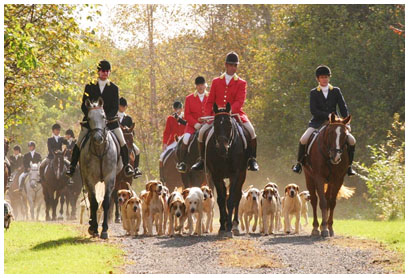
Fox Hunting in America
Riding to hounds has been as much of a sport among well-to-do Americans as among the British gentry
By CAROLINE JONES
Ask anyone where fox hunting originated and odds are he will respond promptly, “Why, the British Isles, of course.” Indeed, the cry of “Tallyho!” conjures up visions of Lord or Lady Poddlesmere galloping across the English countryside, leaping mammoth hedges for hours on end, and sipping strong waters around the fireside at the end of the day. As it turns out, though, we Americans can lay just as much claim to pioneering the sport as our cousins across the Atlantic, and probably no one will ever know for sure who is entitled to the honors.
What we do know, however, is that fox hunting today still adheres to strict rules of protocol established two hundred years ago. It caters primarily to the wealthy because usually only they can afford the cost of a good hunter and the means of keeping him, not to mention the expense of properly outfitting themselves. Good hunters are customarily thoroughbreds, though not the smaller, rather slight thoroughbreds found at the racetrack. And unlike the quarter horses that are bred for speed in short stretches and are commonly seen out West, hunting thoroughbreds are often crossed with heavier breeds for endurance and solidity, are taller and more muscular, and are trained to run long distances (most hunts last all day) and jump a variety of fences and ditches.

The organized hunting club, whose season runs from September to March, has been fairly well standardized. Its hierarchy consists of the Master of Foxhounds (MFH), the huntsman, the whippers-in, the hunt secretary, and the members of the hunt, or field. Today there are about 140 such hunts throughout the United States and Canada registered with and thus recognized by the Masters of Foxhounds Association of America. The association has jurisdiction over all hunting matters, and its constitution and bylaws set forth its function: “The Corporation is formed for the purposes of improving the breeds of Foxhounds … registering Packs of Foxhounds, Packs of Harriers [hounds used for chasing hares] and Hunts, keeping for reference maps of the Fox and Drag Hunting Countries of America, and settling disputes in regard to the same, with authority to hold real estate and other property in furtherance of such purposes, and with such other powers as may be naturally incident to such purposes.” A drag hunt, incidentally, usually takes place when there is a lack of foxes. Instead of chasing a live animal, the pursuers and hounds follow a scented trail laid out by touching the ground with a fox’s brush or litter from the fox’s den.
as if reviewing troops. The Squire of Mount Vernon should be leaning forward.
First Gentleman of Virginia BYJOHN WARD DUNSMORE, 1909; CXHJRITSY
The Master of Foxhounds is in direct command of the field. He dedecides if weather conditions permit the hunt, and where it will take place; he arranges with farmers for access to hunt on their land and makes peace with and recompense (through the hunt secretary) to any angry landowner whose gate has been left open or fence knocked down. He may also maintain the pack and kennels and be responsible for controlling the hounds in the field, but usually he turns over these last duties to his huntsman.
The Master of Foxhounds generates a rather mystical aura and is held in great esteem. Said one British lord: “No one is too good to be a Master of Fox-hounds. If he be gifted with the average endowment of tact, administrative talent, power of penetrating character, and all other attributes that form the essential equipment of a successful public man, so much the better. … He should [be the] … possessor of a remarkably thick skin.” One former Master offers this advice: “As a general rule [the MFH] can enjoy your conversation and society more when not in the field, with the hounds, riders, foxes and damages on his mind. N.B., the proffer of a flask is not conversation, within the meaning of the above.”
The huntsman, who originally was an employee, is not only responsible for the hounds in the field. He is also the blower of the horn, his way of calling various signals to the dogs. This horn can produce only one note, but in several variations. The huntsman is assisted by the whippers-in, or whips, as they are more commonly known. The whips go to the covert (a thicket or section of woods where the fox is supposed to be) and watch for the fox to “go away,” and then they signal (“Holloa”) the fox’s escape from the covert.
The beginning of the hunt, once the field has been assembled in the location of the covert to be drawn, is the actual “draw,” or flushing of the fox out of the woods. The Master presumably has had word that a fox is there, or has a good idea that he is. The huntsman then blows a sharp, brief note to warn the fox of their approach, giving the fox a chance to escape and thereby preventing a chop. (A chop occurs when the hounds catch the fox immediately in the covert and kill him, thus defeating the purpose of the chase—an immensely undesirable event.) The hounds fan out in a line and advance into the covert as the fox, in theory anyway, emerges from the other side. If no fox is found, the hunt proceeds to another covert until one is produced or at least until the hounds pick up the scent of a fox recently in the area. Sometimes a fox may be spotted in the open, as foxes often choose to sun themselves in the fields if it is a particularly cold day.

Once the chase begins, the hounds are in front, baying loudly if they have a scent, and the Master and held follow at a respectable distance. When a fox has been viewed up ahead, a view halloo (such as “Tallyho”) is called by the rider who spots the animal, and this person is supposed to point his horse in the direction of the fox and hold out his hat. The huntsman sounds “gone away,” a series of long and short notes in rapid sequence. Most times the fox will temporarily be able to lose the hounds, in which case the hunt must stop. The huntsman then blows a few long mournful notes to tell the field of the missing quarry, and everyone waits till the hounds have picked up the scent once more, or “made a hit.”
After this has gone on for anywhere from a half-hour to an entire dav, the hunt sometimes losing one fox entirely and having to start all over again, the chase ends when the hounds either catch the fox or, more commonly, the fox “goes to earth,” disappearing down his hole where he cannot be reached. The hounds then “mark to ground,” or stand and bay in frustration. The huntsman dismounts and calls off the dogs.
Contrary to popular belief, the purpose of the hunt is not necessarily to kill the fox, although in colonial days this was often the case. It is now the exception rather than the rule. If the fox is caught, the dogs soon make short work of the hapless creature, and the huntsman sounds the “whoohoop” to announce the death of the fox—a series of long and short notes with a tremolo at the end. Those members of the hunt who have never seen a fox killed will then be blooded, that is, their foreheads will be marked with the blood of the dead quarry. But foxes are so scarce in the United States today that it is more desirable not to kill one if at all possible; besides, the chase is much more enjoyable if the quarry is a veteran of two or three seasons and is thus able to make more of a sport of it.
Another misconception is that the fox is a terrified and confused creature—somewhat like a deer—frantically trying to escape from the pack of baying hounds. Not so. He is an extremely clever, calculating animal who knows exactly how good or bad the scenting conditions are and who frequently controls the entire chase by various ruses and deceptions. He seemingly enjoys the sport of it, then goes home when finally tired. An exMaster reports that on one hunting day in 1926, during a four-and-a-half hour period, a fox deliberately led the pack over “every bad scenting spot he could pick out; he walked on rocks for a half mile; he traversed over three miles of stone walls, and in one place walked a rail fence for three hundred yards, retracing his own steps to add to the fun.”
In colonial days there was no problem as far as fences were concerned, as the use of wire was unknown. Now, however, it is often necessary to obtain a farmer’s permission to employ “panelling,” since it is unwise to attempt to jump a horse over a wire fence, which he cannot see. Panelling entails the erection of jumpable posts or boards over the wire; one such structure is the chicken-coop jump, which forms a sort of pyramid of boards over the wire fence.
What about the hounds? The pack, of course, is an integral part of a successful chase, and many hunting clubs hold an annual ceremony at which the hounds are blessed by a clergyman. If the hounds are unable to scent the fox or if they pick up the scent and then lose it, there will be no run. A good pack of hounds has always been an asset and a valuable piece of property to any man, and hounds are carefully bred to incorporate certain qualities. Two of the most important are the cry and the nose. The cry must be loud and clear in order to be heard over and across the rolling woodlands. The nose must be very keen indeed, for the fox is tracked solely by the scent he leaves behind, and scenting conditions can vary greatly. The fox’s scent comes from a gland just under his brush and from others in the pads of his feet; a fine, oily substance is left behind on anything he touches.
Costume has also assumed importance for a proper hunt. A “rat-
catcher”—someone who is informally dressed—would be frowned upon in most good hunting circles.
The fox-hunting costume is designed to be practical as well as handsome. The leaders of the hunt, that is, the MFH and the huntsman, wear scarlet coats so that they will be easily visible at all times, even in the midst of a deep forest. These scarlet coats are called pinks, not because of their hue, but because the original hunting coat was designed long ago by an English tailor named Pink. Sometimes an exceptionally good rider who has demonstrated skill, loyalty, and experience will be allowed to wear the scarlet coat, thus making it an object of prestige. Women (although this may soon change) are not allowed to wear scarlet coats unless they happen to be Masters of Foxhounds. They, as well as the rest of the field, customarily wear black, gray, or tweed jackets and tan breeches flared at the thigh and very tight at the calf, so as to be easily tucked into the high black or brown boots. The outfit is set off by a white stock, a sort of ascot that can be pressed into service as a bandage or sling in case of emergency; it is held in place by a simple gold stock pin placed horizontally, never vertically, to avoid injury to the chin. Hard headgear, either a derby or a black velvet hat, is always worn and is constructed to protect the wearer from low tree branches or a nasty tumble on the head; the crown is lined with cork or some other durable material. Finally, leather gloves are worn to save the hands from chafing reins, or string gloves in rainy weather.
The exact origins of fox hunting, both here and abroad, are clouded by incomplete and often contradictory facts and by fictions as well. But as Dixon Wecter points out in his Saga oj American Society, “Society has always adored both horses and dogs.” Thus it was only logical that when the fox—an animal who proved to be much cleverer than the stag or hare- turned out to be catchable by use of the combination, fox hunting became firmly entrenched in the aristocratic way of life. Hounds have always been kept for hunting purposes in Europe; for many centuries the stag, boar, and hare were pursued in one fashion or another, as witness the countless tapestries and paintings with this theme. And it appears that hounds were first used to hunt various and sundry pests, such as opossums, wolves, raccoons, and foxes, in the Colonies sometime in the second half of the seventeenth century.
The history of American fox hunting seems to fall quite naturally into several distinct time periods. The first encompasses the colonial days up until the Revolution. The sport at first consisted of the colonials and their untrained dogs chasing a fox now and then “in between Indian vigils.” By 1775 fox hunting was firmly entrenched as a somewhat organized sport. The next period ranges from 1781 to 1861, when foxes were hunted quite regularly by wealthy landowners in Pennsylvania, Maryland, and Virginia. A pack of hounds became as integral a part of a gentleman’s assets as his “horses, slaves and guns.”
From 1865 to 1906 many organized hunts sprang up, with seventy-six known in North America as of 1904, and the sport spread into the North and westward toward the Mississippi. With the establishment of the Masters of Foxhounds Association of America in 1907, fox hunting became increasingly regulated. Since then the sport has grown steadily in popularity.
On record, the first gentleman to have a pack of hunting dogs in the Colonies was a well-to-do Londoner named Robert Brooke, who arrived in Prince Georges County, Maryland, on June 3o, 1650, the recipient of a two-thousand-acre plot from Lord Baltimore to be developed into a successful plantation. Brooke settled in with wife, ten children, twenty-eight servants, and hounds. It is unlikely that the dogs were brought over for the express purpose of chasing foxes. Back in England they had probably served as harriers or all-purpose hunting dogs. In fact the first known packs of foxhounds were not recorded in England until 1666; they belonged to a Viscount Lowther. Others were reported belonging to Lord Arundell of Wardour in 1690 and to Thomas Boothby of Leicestershire in 1698. However, at this stage fox hunting was no more formalized a sport than was the shooting of squirrels. To understand this, we should take a look at Reynard himself.
The fox has always been the farmer’s enemy, and in those early days he was despised as vermin in the class of the rat or weasel, a thief of the worst sort whose wiles made it well-nigh impossible to keep him out of any chicken coop. The fox populations in both England and America were overrunning the countryside, so hunting was less a sport than a necessity.
There has always been some argument as to which kind of fox was hunted here and, in fact, was even native to the North American continent. Although some experts have it that only the gray fox was found here by the colonists and that red foxes were imported from England in the eighteenth century, this is contradicted by evidence supplied by naturalists at the Smithsonian Institution. They insist that the red fox is indeed indigenous to North America and can be found everywhere today except in the south Atlantic coastal region and Florida, the Pacific coast, the desert areas, and the midwestern plains. Although some English red foxes were imported, they were soon incorporated into our larger-sized strain. In any case the red fox, reputed to be more clever and more speedy than his gray relative, has always predominated in the mid-Atlantic and northern regions, whereas the gray prefers the warmer climes of the South. The gray fox is a better treeclimber than runner; thus he is a less desirable quarry because he doesn’t give his pursuers much of a chase.
Prior to the eighteenth century fox hunting was probably conducted on foot for the most part. At this time many families kept three or four dogs to destroy such marauders as wolves and foxes. The wolf was the first of these animals hunted with hounds and horses in Virginia and Maryland, probably because it was easier for a person on horseback to keep up with the hounds. When the wolf population became depleted in the eighteenth century, the fox was a natural replacement. One fox-hunting authority, J. Blan Van Urk, notes that a bounty on the red fox was recorded “as early as 1714 in New Jersey and 1723 in New York.” In the i73o’s a rising prosperity in Virginia and Maryland led many of the well-to-do to breed fine racehorses as well as hunting horses for sportive riding to hounds. People also began breeding hounds specifically for fox hunting; thus they became foxhounds. Hounds originally fell into four categories, all English strains: the staghound, the southern hound or bloodhound, the fox beagle, and the harrier. As these breeds were crossed and mixed, a good foxhound was eventually developed.
One of the early private hunting packs of pre-Revolutionary days employed strictly for hunting foxes belonged to Dr. Thomas Walker of Albemarle County, Virginia, later a member of the House of Burgesses. He founded the Castle Hill Hounds in 1742, having imported his dogs from England. Othei prominent colonials who maintained foxhound packs included Maryland’s Charles Carroll and George Calvert and Virginia’s Charles Lee and George Washington. Washington, not even excepting Jacqueline Kennedy Onassis, must be the best-known fox hunter of all time, and his diaries indicate a great enthusiasm for the sport. He was first introduced to it while in his teens by Lord Thomas Fairfax, who settled in Virginia in 1746. Fairfax was a devoted fox hunter who brought his horses and hounds with him from England. Between 1759 and 1774 Washington spent a great deal of time and effort breeding his own hounds, giving them such romantic names as Musick, Countess, and Truelove. He inspected his kennels twice daily and hunted the dogs several days a week from September until May. Often he would hunt with his neighbors’ packs as well. Mount Vernon was frequently aswarm with guests from near and far—mostly Maryland and Virginia- who rode with him to the hounds. They would take the field at dawn after a candlelight breakfast of corncakes and milk. A typical Washington diary entry of the time is one of January i, 1768: “Fox Hunting in my own Neck with Mr. Robt. Alexander and Mr. Colvill. Catched nothing.” And February 12 of the same year: “Went fox-hunting with Colonel Fair-fax, Capn. McCarty, Mr. Chichester, Posey, Ellzey and Manley, who dined here with Mrs. Fairfax and Miss Nicholas—catched two foxes.”
Washington cut a dashing figure in the field astride his favorite hunter, Blueskin. He possessed a wardrobe, as described by social historian Foster R. Dulles, of “riding frocks, waistcoats of superfine scarlet cloth and gold lace … elegant buckskin breeches … all specially made in England.” Martha, when she occasionally joined him, also wore scarlet.
Washington gave up the sport at the onset of the Revolution, of course. Afterward he tried to pick it up again; Lafayette even sent him a pack of French staghounds in 1785, although these proved unsatisfactory for fox hunting. But more urgent matters forced him to break up his kennels and give away all his dogs in 1787.
There were, however, other prominent Virginians who hunted foxes. Charles Lee was reputed to be so fond of his pack that he allowed the hounds to follow him everywhere, even to his host’s dining table when visiting (just as to his own). Little is recorded about Thomas Jefferson’s taste for the sport, although Van Urk says that while in his teens (1757), “attending the Reverend Mr. Maury’s School in Virginia,” Jefferson fox-hunted on foot with his classmates. “A little later, however, he rode to hounds and was both enthusiastic and capable.” But being more scholarly and serious than Washington, Jefferson did not become a lifelong devotee.

There were other fox hunters, however, who lacked the time or wherewithal to own a pack of dogs and so settled on the next best solution: the organized hunting club. The first such club, by all accounts, was established near Philadelphia on October 29, 1766: the Gloucester Foxhunting Club. Its initial meet was held on December 13 of that year, all twentyseven members gathering at the Philadelphia Coffee House on the corner of Front and Market streets. From then on, hunts were held regularly on Tuesdays and Fridays. The elite of Philadelphia hastened to join: Benjamin Chew, one-time chief justice of the Pennsylvania supreme court; James Wharton and John Cadwallader, scions of distinguished Philadelphia families; Thomas Mifflin, later a Revolutionary general and member of the First Continental Congress; and Robert Morris, financier and later United States senator from Pennsylvania, among others. Articles were drawn up including a call for dues of five pounds “current money” to be paid for the upkeep of the pack. When a fox was killed, the members took up a collection in a hat to give to the huntsman. In 1774 the members decided to add an air of elegance to their sport, adopting a uniform that consisted of a dark-brown coat with “lapelled dragoon pockets, white buttons and frock sleeves, buff waistcoat and breeches, and a black velvet cap.”
After 1780 dues rose to a rather steep thirty pounds annually. Although interrupted temporarily by the Revolution (during which twentytwo members formed the First Troop of the Philadelphia City Cavalry), the members continued to hunt thereafter for nearly a half century, and the present-day Rose Tree Foxhunting Club claims to be a direct descendant.
The opening of the hunt season in Washington, D.C., in 1828 prompted this poetic stanza in the American Farmer:
At the sound of the horn
We rise in the morn,
And waken the woods as we thunder along,
Yoix, yoix, tally ho!
After Reynard we go,
While echo on echo redoubles the song;
We waken the woods as we thunder along,
Tally ho, tally ho,
After Reynard we go,
While echo on echo redoubles the song.
On Long Island fox hunting was introduced shortly after the Gloucester Hunt began when an Englishman named John Evers began to hunt his own hounds near Hempstead in 1768. He imported dogs, horses, and huntsmen from the British Isles. The descendants of his hounds were used in the nineteenth century to form the Meadow Brook Hounds, one of whose chief backers was August Belmont, the New York banker and diplomat.
Hunting was enjoyed in Brooklyn as early as 1781, although no formally organized hunt existed there until 1856. A notice appeared in the Royal Gazette on November 14, 1781, reading: “Hounds will throw off at Denyse’s Ferry, on the estate of Denyse Denyse, Esq., at the Narrows [now Fort Hamilton] at 9 o’clock, Thursday morning, and a guinea will be given for a good, strong, bag fox.” (A bag fox is one brought to the hunt in a sack and turned loose. This practice is thought by many to be unsportsmanlike.)
In 1783 a subscription hunt (one where the members subscribe by paying dues), the St. George, was formed on Long Island. It listed such prestigious active members as Henry Astor, Alexander Hamilton, John Jay, Charles Lee, and George Washington. Most of the other older fox-hunting clubs were established in the 1800’s.
Fox hunting was slower to catch on in Puritan New England, although certainly individuals had maintained hounds for hunting on foot since the founding of the Massachusetts colony. (One resident, a Concord man, wasn’t so enthusiastic about the sport; he is quoted as saying that he considered hunting “a godless custom” and that he regretted the “bringing back of the red coats, which were driven out of Concord in 1775.”) The first organized hunt club in New England did not appear until 1866; it is the Millwood Hunt in Framingham, Massachusetts. A little later (1879) the Myopia Hunt Club grew out of Winchester, Massachusetts, and is now more famous, perhaps, for its polo matches. Tradition has it that its peculiar sobriquet was derived from the fact that nearly all the original members were nearsighted and bespectacled.
Even New York City, on the island of Manhattan, produced a hunting club, the Belvidere, shortly after the War of 1812. Edward Prime was the founder, and he called the meets in front of Cato’s Inn, situated at what is now Sixty-seventh Street and Third Avenue. Cato’s took its name from the owner, Cato Alexander, a popular black man who catered to the foxhunter trade.
The first American military hunting club originated far from the East—in Oklahoma, at Fort Gibson, in 1835. A number of ex-cavalrymen there found fox hunting an excellent diversion from daily routine. They did not, apparently, chase only foxes but pursued any animal that could run.
The decade of the 1870*5 saw a great burst of new hunting clubs. The year 1877 was the birth date of the Richmond County Hounds on Staten Island. Foxes were abundant there, and the island was said to be ideal for the sport. It consisted largely of farms and dairies with lots of fences, and scenting conditions were excellent. Not one farmer denied the hunt permission to ride over his land. In turn, the Master held a Farmers’ Ball and supper each year to be sure to stay on the good side of the landowners.
In Maryland, a state still renowned for its beautiful horses and horse country, the Elkridge Hunt was formed in 1878. It soon had a rival in the Harford Hunt (with which it has since merged), but the oldest Baltimore families at first refused to patronize the latter because it was started by one Foxhall Keene and some Long Island friends. The thirdoldest hunt in Maryland, the Green Spring Valley Hunt, introduced in 1894 the Maryland Hunt Cup, a point-to-point steeplechase run over four miles of high fences, water ditches, and other unpleasant obstacles. The race was the result of an argument among five Baltimore horsemen as to who had the best hunter in the neighboring area. (Incidentally, the word “steeplechase” comes from the old custom of using a church steeple as the goal of a race.) The Hunt Cup was so popular at one point that in 1928 special trains were run from New York and Philadelphia to carry the racing enthusiasts to Baltimore, and local hotels were booked solid. Even today the race engenders a weekend of parties and social events, picnics, and other festivities, although many viewers are so full of spirits by the time the race takes place that they are either uninterested in, or perhaps incapable of, watching. According to Dixon Wecter, one prominent Green Spring Valley devotee of the late nineteenth century was General Felix Agnes, “an Irish boy who had come over steerage, saved enough to buy an interest in a newspaper, risen to great affluence in business, and more because of his blarney and personal charm than increasing wealth became a favorite of Baltimore society. In Green Spring Valley he kept a vast establishment with a black boy to wait on every guest, and computed that 10,000 mint juleps were required to run it from Friday to Monday.”
There are, of course, many other hunting clubs in America founded during the last two centuries; there are even two organized hunts in California at present, but foxes are scarce due to the arid climate of the state. And there are many stories connected with the eccentricities of those who have followed the sport. Dr. Rush Shippen Huidekoper, a founder of the Rose Tree Hunting Club, near Philadelphia, had a fantastic hunter named Pandora. He thought of her as such a rare piece of horseflesh that upon her death he served her up in steaks to some friends at a dinner at his club.
There are others who are devotees to the utmost, such as one Master of Foxhounds who said in 1933: “Foxhunting is not merely a sport—and it is more nearly a passion than a game. It is a religion, a racial [sic] faith. In it … is … the attempt at escape from life as it is to life as we would have it.”
There also are those who scorn the sport as atavistic or absurd and mock it much as William Shenstone, the English poet, did in 1760. He observed: “The world may be divided into people that read, people that write, people that think, and foxhunters.” Certainly the sport’s excessively proper and rigid structure would invite humorous remarks by the disdainful, such as Oscar Wilde’s caustic quip describing fox hunting as “the unspeakable in full pursuit of the uneatable.” Despite all of its excess of folderol, fox hunting really remains an exciting sport for which it is easy to become an avid and lifelong enthusiast.
http://www.myopiahunt.com
http://www.guilfordhounds.com/
http://nashobavalleyhunt.org/
Share this:https://adrianasassoon.wordpress.com


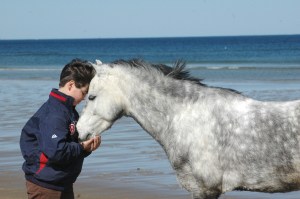
 Andalusians, Lusitanos, Lipizzans, and Friesians all fall under the banner of “Baroque” breeds because they share the same ancient heritage, dating back to the Iberian Peninsula and 25,000 B.C. “Spanish” horses, as they were known, were used by the Ancient Greeks and Romans as cavalry mounts. As history progressed, the breed’s strength, agility and bravery made them favorites in warfare. Only in the last 100 years have these breeds started to reach America and now that they have, their versatility and temperaments are making them hugely popular. Despite this, breeding regulations are strict and if you are serious about owning a piece of history you have to have patience and the time to search.






 ADRIANA SASSOON
