SOJOURN Vanity Fair Magazine
SOJOURN by Elan S.
REVIEWS
Finding the Correct pH Balance with Elan Sassoon


The Man who changed the fashion world with a pair of scissors.
O homen que mudou o mundo da moda com um par de tesouras.
Click below to watch video:
http://vids.myspace.com/index.cfm?fuseaction=vids.individual&videoid=13876824

http://www.behindthechairexchange.com/unlockinghope/site.asp?company=
It’s about time. Someone finally realized the Hairdressing community should have an upgraded title.Just as dressmaker upgraded to Fashion Designer.But, education comes with the upgraded title.Notably not everyone can be called a Fashion Designer. Same goes for hair or should I say Hair Desgners?Finaly……….I have being waiting for this day to come. And here it is. My design Thesis of 2003 I quoted.” The only profession that still has and old title is hairdressing.”Adriana Sassoon
http://www.nytimes.com/2009/06/01/arts/01iht-DESIGN1.html
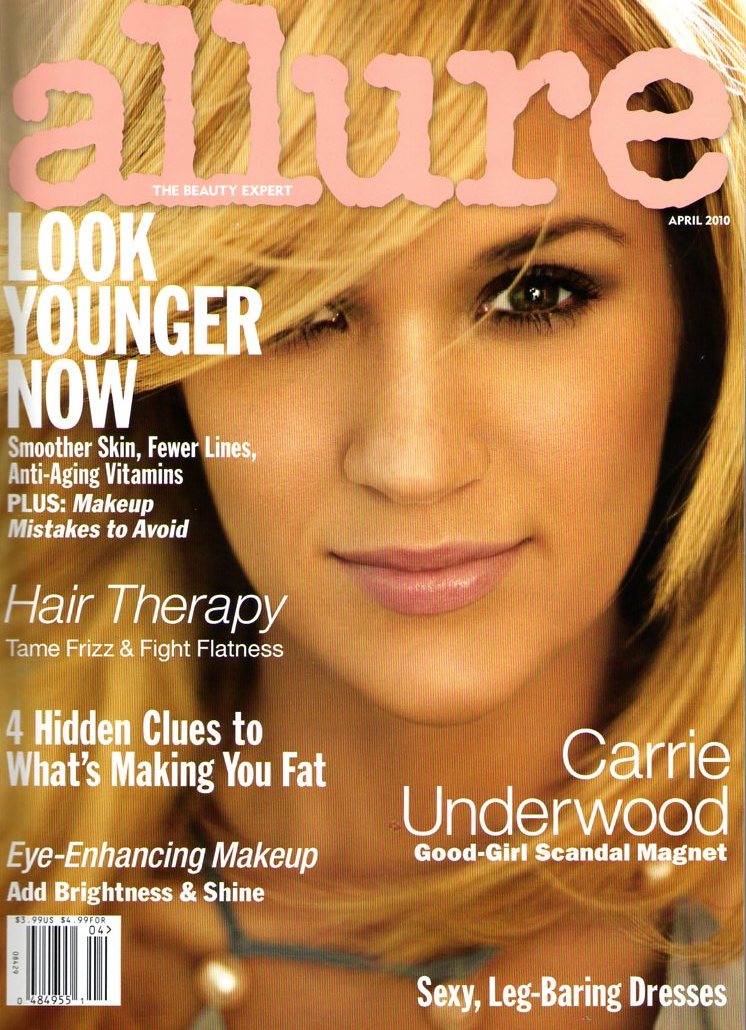

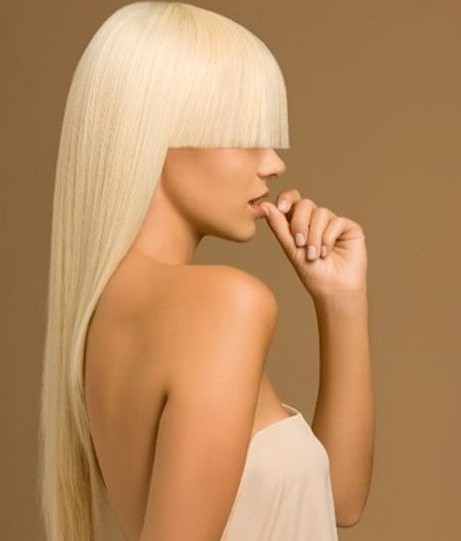
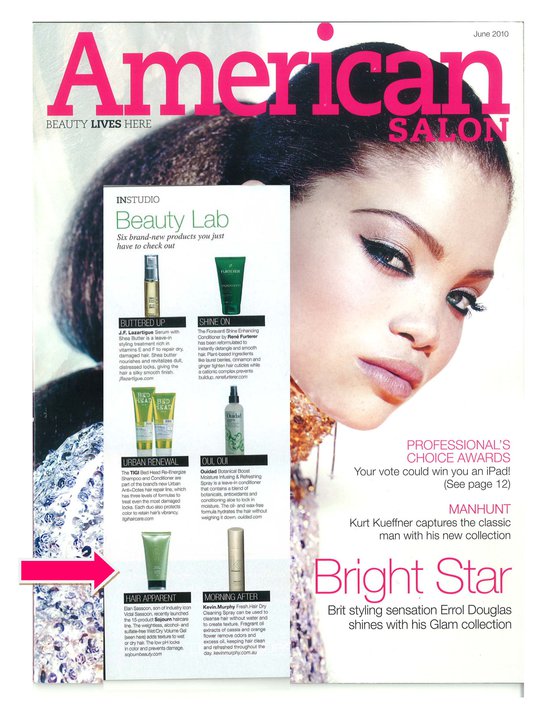
Elan Sassoon son of famed Vidal Sassoon is launching his line of hair care….Sojourn by elan s.

Elan Sassoon is also Owner of Mizu salons in New York and Boston.

 |
Sojourn Shampoo Moisture: All I have to say about this shampoo is that after applying and lathering it through my hair, it felt so moisturized I didn’t think I needed any conditioner to accompany it! The shampoo smells wonderful – with a hint of citrus. It left my hair healthy-looking and silky soft to the touch. I can definitely understand the power of the exclusive Keratin Cashmere Protein they use in this product – it does leave your hair permanently conditioned.Sojourn Conditioner Moisture: Okay…so I know I just said that I didn’t necessarily need the conditioner after the shampoo, but I used it anyways—and guess what, my hair was even MORE moisturized. I used both the shampoo and the conditioner first thing in the morning right after I woke up. My ‘bed head’ hair had tangles galore. After using this conditioner my hair felt as if I brushed them all out. On the bottle it advises you to leave the product in for two to three minutes (so it acts more like a deep conditioner). I saw a result after one minute. |
| Conditioner Moisture, Texture Molding Paste, Shampoo Moisture, Monoi Oil |
Sojourn Monoi Oil:
In other words. Wonder oil. It’s an ultra-light yet deep conditioning treatment specially formulated for chemically treated, dry, frizzy or environmentally damaged hair. This hydrating oil absorbs almost instantly and it doesn’t leave any residue or build up. When you first apply it, you can feel it in the hair. After about 15 minutes you can’t even tell it’s there. Hair feels a lot softer after this product.
Sojourn Texture Molding Paste: This paste has a thicker texture than the taffy, so it enables you to add a little more definition to any cut or style. You can use this product to create soft and loose curls or to stand hair straight up.
Sojourn Leave-in Detangler: it’s good to use for a little extra moisture and for tangle-protection! Comb this product through with a large toothcomb, and know that it can be used alone or before applying products.
 |
Sojourn Shampoo Colour Preserve: This is formulated with a potent plant-derived UV inhibitor for maximum protection against environmental free radical damage caused by UV light. The low pH locks in color and prevents premature fading for richer, vibrant, longer lasting color and shine.A few years ago, I dyed my hair a purple–maroon color. Since I was a lifeguard at that time I had no choice but to bake in the sun pretty much every day. After all that sun, my hair turned orange and definitely did not resemble its original color. Sounds like this product would have solved that problem…Sojourn Conditioner Colour Preserve: This product provides extra UV protection for colored, chemically treated hair as well as hair that has been overexposed to the harsh effects of heat, wind and the sun. Works just like Sojourn Moisture Conditioner. |
| Conditioner Colour Preserve, Sculpting Taffy, Shampoo Colour Preserve, Thermal Protection Straightener |
Sojourn Sculpting Taffy: I used a small amount on my hair while it was dry (you can use it on wet hair too). It added a little texture/separation to my layers and smells marvelous — like roses! This is an all-in-one sculpting tool that gives extra hold, shine and protection to long, short, or in-between styles. Contains maracuja oil, so it fortifies hair as it styles.
Sojourn Thermal Protection Straightener: I found this is a useful product. I have used it for the past week before I straighten my hair with a flatiron. In any situation, you should apply it BEFORE applying heat on dry hair. I sprayed it on my hair from roots to ends, one section at a time for maximum protection and moisture.
| Sojourn Wet/Dry Volume Gel: I took about a quarter amount of this gel and applied it at the ends to my roots. It left my hair weightless and soft. After blow-drying my hair it was like Va-Voom Volume! It works also in dry hair for a more piece-y look.So what was my favorite aspect about the entire collection besides the healthy effect it had on my hair? The scent. Floral, Herbal, Citrus…I got a surprise from ever bottle I opened. Trying out Sojourn was definitely a pleasant experience. |  |
| Modern Salon by Lauren Salapatek | Shampoo Volume, Wet/Dry Volume Gel, Conditioner Volume |
Walking along Davis street in London’s Mayfair. One of the smartest streets in central London in the mid 1970s, I saw a new beauty salon that had been featured in the trade magazine Hairdressers journal: “Toni&Guy”Four brothers Toni, Bruno, Guy and Anthony had been achieving some editorial coverage for their hair photographs. Their original salon was in a south London suburb Balham. Now they were aiming there sights high and the focus was on making a name and reputation for themselves bang in the heart of London’s Davis street, a stones throw from Bond street. You have to dedicate heart and soul mind and body on being a success, you have to give up so much at an early age.

Bruno Mascolo,Shane-,Harold Leighton and Guy Mascolo
I had already joined Glemby International (now part of the Regis group) whose office was just around the corner in Grosvenor street. My walks through Mayfair were a daily ritual to see the beautiful women coming out of the top hairdressing salons, Martin Douglas, Rene, Raymond, Steiner, Dumas and Vidal Sassoon to name a few.
My next free time I walked into their salon and introduced myself to the brothers and from that time on we have been friends. I have watch them grow in the world of fashion and become world statesmen photographer and product magnates into multi millionaires. Their name is around the globe in hair, their products are advertised in Vogue, Womens Wear Daily Harpers Bazaar internationally. If they sneeze they are written up in the media!
The names of there products range from Toni&Guy BedHead, Catwalk,TIGi, S Factor and makeup are sold around the world. In 2009 tragic news that Guy a talent in hair music writing, brother mentor and friend died suddenly some six weeks after they had sold part of the company to Unilever. Like their father Guy had a huge passion with hair and music, the brothers all mixed with artist musicians editors and grew so close developing their outside talents in the arts’ Guy’s talent and passion about his music art football and still playing in his sixties. His art captured the very essence of subjects and often sold his paintings to raise money for charities. As a talented guitarist he and all the brothers had such artistic talent, maybe one day there works will be in a museum! Elder brother Tony went his own way with his family still in the hair salon business in Europe.
Today Bruno is CEO, Anthony the youngest and Image producer trend setter with hair and photography lives out of Battersea London and part on an air plane traveling the globe. Open almost any fashion magazine and you will always see there advertising on there product lines that stands out alongside L’Oreal, Paul Mitchell, Redken.
To mention the talent of the brothers in one feature is impossible and hope that I can show you the art side of the image maker Anthony Hairdresser and photographer. With offices and homes in London Dallas and LA they travel the world teaching training at hair shows almost weekly, an amazing task even at a young age.
In 2008 I was privilege to be asked to visit Bruno and Guy in Dallas to see the structure, workings of this vast organization and was astounded to see how they had grown since the mid 1970’s. On visiting Bruno’s home I saw his other side – an artist that has given me the insight of this talented man and given me the opportunity to show and tell and to share with readers of The Epoch Times in this EXCLUSIVE interview. Not normally seen in this light. I felt the story had to be told and in Bruno’s words below with his own words “Intangible Truth”.
Colaboration of Harold Leighton,Paintings by Bruno Mascolo,Photographs Harold Leighton for Adriana Sassoon.
Shampoo is a hair care product used for the removal of oils, dirt, skin particles, dandruff, environmental pollutants and other contaminant particles that gradually build up in hair. The goal is to remove the unwanted build-up without stripping out so much as to make hair unmanageable.
Shampoo, when lathered with water, is a surfactant, which, while cleaning the hair and scalp, can remove the natural oils (sebum) which lubricate the hair shaft.
Shampooing is frequently followed by conditioners which increase the ease of combing and styling.
Shampoo originally meant head massage in several North Indian languages. Both the word and the concept were introduced to Britain from colonial India. The word shampoo in English is derived from Hindi chāmpo (चाँपो /tʃãːpoː/. Its English usage in Anglo-Indian dates to 1762. In India the term chAmpo was used for head massage, usually with some form of hair oil.
The term and service was introduced in Britain by a Bengali entrepreneur Sake Dean Mahomed in 1814, when Dean, together with his Irish wife, opened a shampooing bath known as ‘Mahomed’s Indian Vapour Baths’ in Brighton, England. His baths were like Turkish baths where clients received an Indian treatment of champi (shampooing) or therapeutic massage. His service was appreciated; he received the high accolade of being appointed ‘Shampooing Surgeon’ to both George IV and William IV.
In the 1900s, the meaning of the word shifted from the sense of massage to the that of applying soap to the hair. Earlier, regular soap had been used for washing hair. However, the dull film soap left on the hair made it uncomfortable, irritating, and unhealthy looking.
During the early stages of shampoo, English hair stylists boiled shaved soap in water and added herbs to give the hair shine and fragrance. Kasey Hebert was the first known maker of shampoo, and the origin is currently attributed to him.
Originally, soap and shampoo were very similar products; both containing surfactants, a type of detergent. Modern shampoo as it is known today was first introduced in the 1930s with Drene, the first synthetic (non-soap) shampoo.
In India, the traditional hair massage is still common. Different oils and formulations with herbs may be used; these include neem, shikakai or soapnut, henna, bael, brahmi, fenugreek, buttermilk, amla, aloe, and almond in combination with some aromatic components like sandalwood, jasmine, turmeric, rose, and musk.
Shampoo cleans by stripping sebum from the hair. Sebum is an oil secreted by hair follicles that is readily absorbed by the strands of hair, and forms a protective layer. Sebum protects the protein structure of hair from damage, but this protection comes at a cost. It tends to collect dirt, styling products and scalp flakes. Surfactants strip the sebum from the hair shafts and thereby remove the dirt attached to it.
While both soaps and shampoos contain surfactants, soap bonds to oils with such affinity that it removes too much if used on hair. Shampoo uses a different class of surfactants balanced to avoid removing too much oil from the hair.
The chemical mechanisms that underlie hair cleansing are similar to that of traditional soap. Undamaged hair has a hydrophobic surface to which skin lipids such as sebum stick, but water is initially repelled. The lipids do not come off easily when the hair is rinsed with plain water. The anionic surfactants substantially reduce the interfacial surface tension and allow for the removal of the sebum from the hair shaft. The non-polar oily materials on the hair shaft are solubilised into the surfactant micelle structures of the shampoo and are removed during rinsing. There is also considerable removal through a surfactant and oil “roll up” effect.
Shampoo formulations seek to maximize the following qualities:
Many shampoos are pearlescent. This effect is achieved by addition of tiny flakes of suitable materials, eg. glycol distearate, chemically derived from stearic acid, which may have either animal or vegetable origins. Glycol distearate is a wax.
In the USA, the Food and Drug Administration (FDA) mandates that shampoo containers accurately list ingredients. The government further regulates what shampoo manufacturers can and cannot claim as any associated benefit. Shampoo producers often use these regulations to challenge marketing claims made by competitors, helping to enforce these regulations. While the claims may be substantiated however, the testing methods and details of such claims are not as straightforward. For example, many products are purported to protect hair from damage due to ultraviolet radiation. While the ingredient responsible for this protection does block UV, it is not present in a high enough concentration to be effective. Shampoos made for treating medical conditions such as dandruff are regulated as OTC drugs in the US marketplace. In other parts of the world such as the EU, there is a requirement for the anti-dandruff claim to be substantiated, but it is not considered to be a medical problem.
The effectiveness of vitamins, amino acids and “pro-vitamins” to shampoo is also largely debatable. Vitamins and amino acids are the building blocks of proteins and enzymes within the body. While vitamins may be able to penetrate cells through the skin, amino acids and proteins are too large to enter a cell outside the bloodstream, and they can have no effect on dead tissue. Proteins are constructed from amino acids following an RNA blueprint inside the cell. A strand of hair is a long protein chain continually being added to at the root. The only way for an amino acid to be of any use is to be intentionally bound to other amino acids in a specific fashion by a living cell. Hair is not alive, and there is no possibility for an amino acid or protein to have any permanent effect on the health of the strand.[citation needed]
The case for vitamins is not as well understood. Some have demonstrated a moderate effectiveness in improving the health of skin,but most likely the benefit is derived from the effect of vitamins on living cells below the epidermis. Extending this benefit to hair, the vitamins and minerals could improve the health of new hair growth, but the benefit to existing hair is unsubstantiated. However, the physical properties of some vitamins (like vitamin E oil or panthenol) would have a temporary cosmetic effect on the hair shaft while not having any bioactivity.
Cosmetic companies have developed shampoos specifically for those who have dandruff. These contain fungicides such as ketoconazole, zinc pyrithione and selenium sulfide which reduce loose dander by killing Malassezia furfur. Coal tar and salicylate derivatives are often used as well.
Some companies use “all-natural,” “organic,” “botanical,” or “plant-derived” ingredients (such as plant extracts or oils), combining these additions with one or more typical surfactants. The effectiveness of these organic ingredients is disputed.
Alternative shampoos, sometimes marketed as SLS-free, claim to have fewer harsh chemicals – typically none from the sulfate family. They are sometimes claimed to be gentler on human hair.
Shampoo for infants and young children is formulated so that it is less irritating and usually less prone to produce a stinging or burning sensation if it were to get into the eyes. This is accomplished by one or more of the following formulation strategies:
The distinction in 4 above does not completely surmount controversy over the use of shampoo ingredients to mitigate eye sting produced by other ingredients, or of use of the products so formulated.
The considerations in 3 and 4 frequently result in a much greater multiplicity of surfactants being used in individual baby shampoos than in other shampoos, and the detergency and/or foaming of such products may be compromised thereby. The monoanionic sulfonated surfactants and viscosity-increasing or foam stabilizing alkanolamides seen so frequently in other shampoos are much less common in the better baby shampoos. [1]
Shampoo for animals (such as for dogs or cats) should be formulated especially for them, as their skin has fewer cell layers than human skin. Cats’ skin is 2-3 cell layers thick, while dogs’ skin is 3-5 layers. Human skin, by contrast, is 10-15 cell layers thick. This is a clear example of why one should never use even something as mild as baby shampoo on a cat, dog, or other pet.
Shampoo intended for animals may contain insecticides or other medications for treatment of skin conditions or parasite infestations such as fleas or mange. These must never be used on humans. It is equally important to note that while some human shampoos may be harmful when used on animals, any haircare products that contain active ingredients/drugs (such as zinc in antidandruff shampoos) are potentially toxic when ingested by animals. Special care must be taken not to use those products on pets. Cats are at particular risk due to their instinctive method of grooming their fur with their tongues.
Solid shampoos or shampoo bars use as their surfactants soaps and/or other surfactants conveniently formulated as solids. They have the advantage of being spill-proof, and the disadvantage of being slowly applied, needing to be dissolved in use.
Stiff, non-pourable clear gels to be squeezed from a tube were once popular forms of shampoo, and can be produced by increasing a shampoo’s viscosity. This type of shampoo cannnot be spilled, but unlike a solid, it can still be lost down the drain by sliding off wet skin or hair. Soap jelly was formerly made at home by dissolving sodium soap in hot water before being used for shampooing or other purposes, to avoid the problem of slow application of solids noted above.
Shampoos in the form of pastes or creams were formerly marketed in jars or tubes. The contents were wet but not completely dissolved. They would apply faster than solids and dissolve quickly. Jar contents were prone to contamination by users and hence had to be very well preserved.
Powdered shampoos are designed to work without water. They are typically based on powders such as starch or talc, and are intended to absorb excess sebum from the hair before being brushed ou Traditional Shampoos Indonesia.
Early shampoos used in Indonesia were made from the husk and straw (merang) of rice. The husks and straws were burned into ash, and the ashes (which have alkaline properties) are mixed with water to form lather. The ashes and lather were scrubbed into the hair and rinsed out, leaving the hair clean, but very dry. Afterwards, coconut oil was applied to the hair in order to moisturize it.
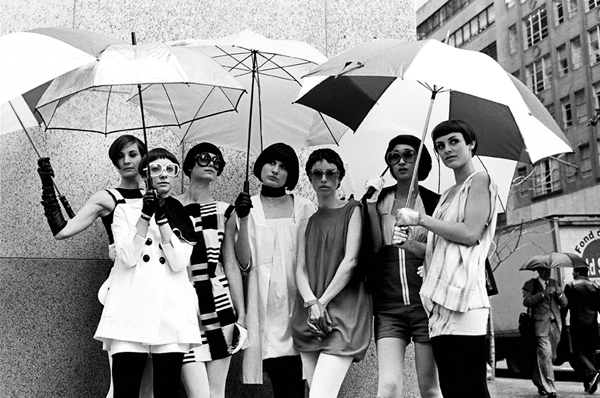

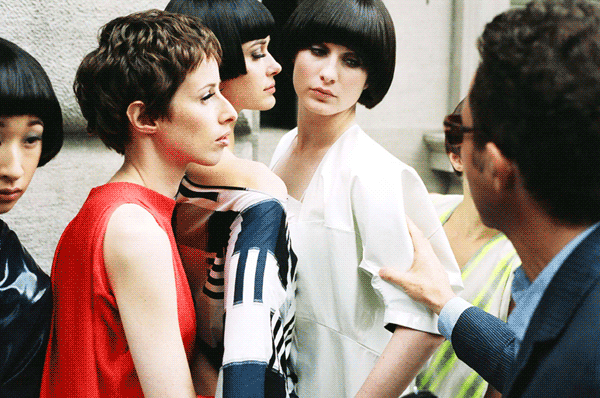
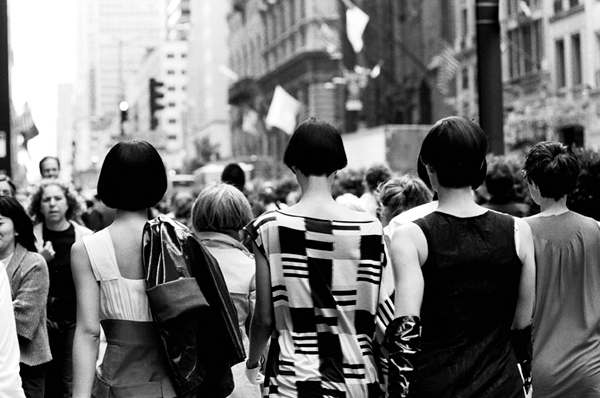
Sassoon was born to Jewish parents in London. His father was from Salonica (Thessaloniki in Greece), and his mother, whose family was originally from Kiev, was born in London. Although too young to serve in the Second World War, Sassoon became a member of the 43 Group, a Jewish veterans’ militia organisation that broke up Fascist meetings in East London after the end of the war. In 1948 he joined the Israeli Defence Forces to fight in the 1948 Arab-Israeli War.
Sassoon’s works include the geometric, the wash-and-wear perm, and the “Nancy Kwan.” They were all modern and low-maintenance. The hairstyles created by Sassoon relied on dark, straight, and shiny hair cut into geometric yet organic shapes. In 1963, Sassoon created a short, angular hairstyle cut on a horizontal plane that was the recreation of the classic “bob cut.” His geometric haircuts seemed to be severely cut, but were entirely lacquer–free, relying on the natural shine of the hair for effect. Sassoon is a father of modernist style and has also been a key force in the commercial direction of hair styling, turning its craft in to a multi-million dollar industry.

Vidal Sassoon é um cabeleireiro inglês, nascido em Londres, em 1928. Nos Estados Unidos estudou na universidade de Nova Iorque. Como cabeleireiro, notablizou-se por ter criado uma forma de penteado baseada na Bauhaus e nas formas geométricas.Vencedor de vário prémios, foi presidente da Multinacional Vidal Sassoon, presidente da Fundação Vidal Sassoon .

Sassoon’s works include the geometric, the wash-and-wear perm, and the “Nancy Kwan.” They were all modern and low-maintenance. The hairstyles created by Sassoon relied on dark, straight, and shiny hair cut into geometric yet organic shapes. In 1963, Sassoon created a short, angular hairstyle cut on a horizontal plane that was the recreation of the classic “bob cut.” His geometric haircuts seemed to be severely cut, but were entirely lacquer-free, relying on the natural shine of the hair for effect. Sassoon is a father of modernist style and has also been a key force in the commercial direction of hair styling, turning its craft in to a multi-million dollar industry.
He was a very influential person to people all over the world; especially those who have become cosmetologists. By the early 1980s, after moving to the United States, Sassoon had sold his name to manufacturers of haircare products and the multinational Procter & Gamble was applying his name to shampoos and conditioners sold worldwide. Former salon colleagues also bought Sassoon’s salons and acquired the right to use his name, extending the brand in salons into the United Kingdom and United States. However, in 2003, it was reported that Sassoon was suing Procter & Gamble for destroying his brand by skimping on marketing in favor of the company’s other hair product lines, notably Pantene. Also in 2002, the chain of Vidal Sassoon salons was sold to Regis Corporation. By 2004, it was reported that he was no longer associated with the brand that bears his name.[citation needed] Vidal Sassoon has authored several books, including A Year of Beauty and Health co-written with his former wife, Beverly Sassoon. He also had a short-lived TV series called Your New Day with Vidal Sassoon in the late 1970s.
In 1967, Vidal Sassoon married Beverly Adams. They had four children,CATYA, ELAN, EDEN including an adopted son DAVID. One daughter, actress Catya Sassoon, died of a drug overdose on January 1, 2002. The couple divorced in 1980.

| “ | Hair is nature’s biggest compliment and the treatment of this compliment is in our hands. As in couture, the cut is the most important element … haircutting simply means design and this feeling for design must come from within. | ”VS |
| “ | The only place where success comes before work is in the dictionary. | ”VS |

Vidal Sassoon stands for Very Simple and Very Stylish! Vidal Sassoon is the consumer brand that experts use when it comes to delivering fabulous haircare. The best of technology is used by Vidal Sassoon to deliver the ultimate in hair styling product expertise. Vidal Sassoon’s products are for the modern individual with the know-how and expectation of living in the 21st century.
Vidal Sassoon’s hair styling products are renowned in the world of fashion for bringing style and confidence to today’s image conscious consumer. Innovation, experience and value are all top of the agenda with Vidal Sassoon, the world leading authority on haircare.
Vidal Sassoon brings the vital hair styling tools for the modern sophisticate enabling you to create those elegant, silky and shiny looks.
 ADRIANA SASSOON