Spanish Clothing Chain Zara Grows by Being Fast and Flexible

Xurxo Lobato/Cover, for The New York Times

The Spanish clothing company Zara thrives by shipping new products to its stores every few days.

By JOHN TAGLIABUE
 

LA CORUÑA, Spain — This is the town that invented retailing’s secret sauce.

Zara, the big clothing chain based here, created a novel formula in apparel retailing by shipping new products to its 600 or so stores around the world every few days, not once a season, and by manufacturing more than 11,000 products a year, instead of several hundred.

Zara is opening new stores at a rate of one a week, and shows no signs of slowing. But its business model, developed by a publicity-shy entrepreneur who began his career here more than 50 years ago delivering hand-sewn shirts for a local tailor, is facing increased challenges as it expands.

As the dollar melts, the price gap is widening between Zara’s products, the bulk of them made at factories here in Spain, and competitors that import from low-wage countries and pay for goods in dollars. Zara still has plenty of room to grow in Europe before the market is saturated. But to reach its ambitions of becoming a global brand, it will have to replicate on other continents its finely tuned European distribution system, which is more akin to Dell Computer and Wal-Mart than to Gucci or Louis Vuitton.

Moreover, Zara’s parent, the big Spanish group Industria de Diseño Textil, known as Inditex, is moving in several directions at once. It is expanding its other retail chains, including brands like Massimo Dutti and Bershka; introducing new store concepts like Zara Home, a home furnishings outlet; and adding lines of larger-size garments for older women at Zara itself that some industry experts say may dilute Zara’s brand image.

“The question going forward is: how durable is the model as it gets bigger and goes international?” said David Oliver, a principal at Kurt Salmon Associates, a retailing-industry consulting firm.

Though not well known in the United States, where Zara has just 10 stores, six of them in New York, Zara has so far kept the challenges it faces from crimping its robust performance. Two important rivals, Gap and Hennes & Mauritz, are only beginning to show signs of rejuvenation after passing through rough patches, but Zara has been flourishing all along. With 250 million euros ($294.2 million) in net cash at the end of 2002, Zara is awash in liquidity. “We certainly don’t need cash,” said José Maria Castellano Rios, Inditex’s chief executive.

The company’s chairman, Amancio Ortega Gaona, may be one of the world’s wealthiest people, with assets estimated by Fortune magazine at $10.3 billion, but he is also one of the most retiring. Inditex’s ultramodern headquarters, a blend of Scandinavian glass and steel and Mediterranean stucco, is located outside La Coruña, a small city of 250,000 in Spain’s far northwest corner where his father, a railroad employee, moved the family when Amancio was 12. Now 67, he has turned over day-to-day operations to managers like Mr. Castellano while keeping a hand in strategic decisions.

Mr. Ortega never grants interviews, and until recently there were hardly any photographs of him in circulation.

Mr. Ortega took Inditex public in 2001, selling 32 percent of the company to investors on the Madrid Stock Exchange. He and other family members, including his three children, control the rest.

Now that management of the company is largely in the hands of professionals, has the flame diminished for Mr. Ortega? “There’s the same passion,” said Mr. Castellano, 55, who has worked with Mr. Ortega since 1976. “Maybe even more.”

Mr. Ortega opened the first Zara in La Coruña in 1974 to sell the apparel he was making in a factory he had opened a few years earlier with his own savings. Conventional wisdom called for retailers to franchise their stores and outsource their goods, but Mr. Ortega chose vertical integration, owning the factory, the stores and the distribution network in between. While Gap and Hennes & Mauritz contracted out manufacturing largely to plants in low-wage countries, notably in Asia, Mr. Ortega stocked his stores from his own factories in Spain.

The advantage was speed to market, achieving the kind of delivery and restocking frequency usually associated with grocery stores, not apparel merchants.

To be sure, Zara does produce seasonal clothing collections. The company is known for stylish designs, many resembling those of the big-name Italian fashion houses, sold at moderate prices. Yet if it finds that customers are coming in asking for, say, a rounded neck on a vest rather than the V neck on display, a new version with a rounded neck can be in the store within about 10 days. If Jennifer Lopez appears in a ravishing new item, Zara can get a version of it into its stores in a matter of weeks, not months.

To do that, Mr. Ortega built up an elaborate distribution structure over the years. Zara’s huge warehouse features customized sorting machines built in Denmark and patterned on the equipment used by overnight parcel services; they can now handle 40,000 items an hour, and the company’s capacity will roughly double in July when a big new center in Zaragoza in northeastern Spain comes on line.

Trucks deliver goods to Zara stores that are within 24 hours’ driving time; stores farther away are supplied by air. Twice a week, for instance, trucks make the three-hour trip to the airport in Porto in northern Portugal, where KLM 747 cargo jets pick up goods to fly to New York by way of Amsterdam.

Zara’s fashions appeal to dressier European tastes. Laetitia Sernet, 20, a stylist in Paris, contrasted Zara with Gap, saying Zara’s “things are more fashionable, more diversified. They follow fashion.” Ms. Sernet just bought two cotton tops, one for 35 euros ($41.19) and one for 40 euros.

Yet for all its technical prowess, quick delivery has its limits. “One interesting question is: are they locked in?” said John Gallaugher, a professor of information systems at Boston College who admires the company and teaches its model in his graduate business courses. Professor Gallaugher said that for Zara to penetrate the United States on a large scale, it would probably have to duplicate its manufacturing and distribution system in North America, perhaps in Mexico.

Mr. Castellano acknowledged that Zara had been purposely slow to expand in the United States, where in 1989 it first opened a store on Lexington Avenue in Manhattan. That is because there is still so much it can do in Europe, he said. Zara has only begun to crack the British market, and recently set aside its distaste for franchising to form joint ventures in two more difficult countries, Germany and Italy.

Still, he said, Zara does plan to open “two to three stores” in the United States, including one in Washington, in the fall. “In the American market, we have 10 stores, and they are all profitable,” he said.

The two planes to America each week could supply as many as 40 or 50 stores, Mr. Castellano said, “but there is no service that can replicate the model here.”

Mr. Castellano also knows that European competitors that manufacture in East Asia are reaping windfall profits that Zara cannot match. Hennes & Mauritz, for instance, gets roughly half its products from Asia, measured by value. Adidas of Germany and Aigle of France, two sportswear retailers, have both recently said that their profits are growing rapidly because they pay depreciating dollars for goods made in Asia and get strengthening euros when they sell them in Europe.

Zara has not completely resisted Asia’s temptation. Some basic items like T-shirts and jeans, which now account for 20 percent of the selection, are bought from manufacturers there.

But in the main, Zara looks to other aspects of its business for profit advantages. It spends much less on advertising than its rivals, for example, and its distribution system helps keep inventories low. “Price is important,” Mr. Castellano said, “but so is fashion.”

For all Zara’s success, though, Inditex is directing much of its new investment into a gaggle of other retail chains, some that it created and others that it bought, like Massimo Dutti, whose stores offer moderately priced apparel for men and women, and Oysho, a lingerie chain. Moreover, Inditex is expanding Kiddy’s Class, a competitor to Gap Kids, and the Zara Home chain.

But the initiative that raises the most eyebrows is the experimental line of plus sizes that Zara is adding.

Reiner Triltsch, chief international investment officer at WestAM, a Dallas asset management company, wondered about the strategy. “More mature plus sizes have got to be difficult to reconcile,” Mr. Triltsch said. “It changes the image” of Zara, he said, adding that it may alienate teenage customers who will not shop where their mothers do. “I don’t think it’s going to be easy,” he said.

Mr. Castellano says Zara is only testing the idea and has not committed itself. “There are people in the company who say, `Customers who were buying with us when they were 20, well, now they’re 50 or 45 and they want to stay with us,’ ” he said. “We are testing. A decision will come later.”

The diversification into other brands and store types will continue, Mr. Castellano said, with Zara’s share of Inditex’s total revenue falling to 62 percent over the next five years, from 72 percent now.

Essentially, he said, Zara’s strategy is hostage to its abundant cash flow. “We have to do something with the money,” he said.

http://www.zara.com

http://www.youtube.com/watch?v=Cao35GKYhCA

The World of Coco Chanel: Friends, Fashion, Fame


Gabrielle ‘Coco’ Chanel is an icon of fashion, and can lay claim to having invented the look of the 20th century. At the height of the Belle Epoque, she stripped women of their corsets and feathers, bobbed their hair, put them in bathing suits and sent them out to get tanned in the sun.


 She introduced the little black dress; trousers for women; costume jewellery; the exquisitely comfortable suit that became her trademark. Early in the Roaring Twenties, Chanel made the first ever couture perfume – No. 5 – presenting it in the famous little square-cut flagon that, inspired by Picasso and Cubism, became the arch symbol of the Art Deco style. No. 5 remains the most popular scent ever created.


 Chanel knew instinctively that the road to success lay in being absolutely at one with her own time.And what a time! The era of Picasso, Diaghilev, Stravinsky, Cocteau, Jean Renoir, Visconti – all of whom ‘Coco’ knew and collaborated with, even as she matched their modernist innovations by liberating women from the prison of 19th-century fashion and creating a whole new concept of elegance.


Os cabelos das atrizes da novela “A Favorita”

by Renata Ruiz ~ June 26th, 2008. Filed under: Beleza, Cabelos, Dicas, Famosos na Moda, Moda, Para usar.

Sempre que começa uma novela vem a expectativa de quem será a melhor, quem chamarea atenção, e também qual o modelito que fará a cabeça (literalmente) das mulheres. Muitas imitam uma roupa, um detalhe ou acessório. E os cabelos, ah.. esses são muito copiados.Tanto que numa conversa entre amigas, percebi que depois que a novela começou, muitas começaram a comentar sobre o cabelo da Mariana Ximenes. Ela radicalizou e cortou bem curtinho. É um corte todo desfiado e que lembra ao da Victoria “Posh Spice” Beckham.

http://beleza.terra.com.br/mulher/galerias/0,,OI47593-EI7590,00.html

E de um outro lado, temos a sempre camaleoa Taís Araújo que aparece com um cabelo longo, preto, liso e com uma franjinha (não lembra um pouco o da personagem maluca de Aline Moraes?)

Bastam alguns centímetros de cabelo para afirmar sua sensualidade à flor da nuca. Seja qual for o seu estilo embarque sem medo na onda dos curtos. Confira os cortes de cinco experts no assunto com exclusividade para Marie Claire.


‘Este look é para pessoas que buscam um curto versátil. Pode ser usado com franja, puxado atrás da orelha ou com acessórios como presilhas.

A base reta, quadrada, é cortada em camadas, do meio para as pontas.

Essa graduação dá movimento e as pontas repicadas contribuem com a leveza. Quem tem a testa pequena pode deixar a franja mais longa, abaixo do nariz’

Dica do cabeleireiro Julio Crepaldi, do Galeria

‘Apesar de curto, este look é feminino e sensual.

As mechas mais claras, tom sobre tom, no fundo castanho, dão relevo e movimento ao corte, quebrando a monotonia do tom escuro.

Os contornos não são marcados e o volume no alto da cabeça é desfiado.

A franja pode ser puxada sobre o rosto ou penteada para o lado, criando um novo look, com mais volume’

Dica do cabeleireiro Celso Kamura, do C. Kamura

‘Este cabelo, apesar de totalmente curto, pode ser usado em diferentes estilos. Não parece, mas dá.

Para uma noite glamourosa, é supersexy fazer uma risca lateral, aplicar um gel forte e deixar o cabelo bem colado à cabeça.

Para criar um look punk, meio moicano, basta colar as laterais com um gel e desestruturar os fios no alto da cabeça, descendo até a nuca. Todo mundo pode usar, desde que assuma o estilo. O mais importante é ter um formato de cabeça harmonioso.

Ao clarear as pontas, elimina-se o ‘efeito capacete’ que um tom uniforme poderia provocar. As mechas mais claras suavizam o rosto e quebram a masculinidade do look’, diz Robin Garcia, do salão BLZ

‘O mais importante em um corte crespo é garantir que o formato do cabelo não fique triangular, mais largo na base e estreito no alto.

Para isso, o contorno tem de ser irregular, com alguns cachos mais compridos que outros. Esse efeito também é conseguido com a finalização: ao usar o secador, prefira produtos mais aquosos, como gel-líquido, que não deixam o cabelo pesado.

Seque com difusor, amassando os cachos de baixo para cima. Termine soltando alguns cachos, puxando-os delicadamente com a ponta dos dedos, para quebrar a uniformidade do contorno’, diz Sérgio Gomes, do W Iguatemi

‘Este cabelo é uma evolução do corte Chanel. A princípio, quando foi criado por Vidal Sassoon, o corte era absolutamente reto. Repaginado, ficou mais assimétrico e desfiado.

É uma boa opção para quem cortou bem curto e agora quer algo mais longo. É um clássico, que combina com todo tipo de mulher. Para aderir ao look, bastam pequenas adaptações. Quem tem rosto redondo, por exemplo, pode optar por uma versão mais comprida, deixando as mechas da frente abaixo do queixo’, diz o cabeleireiro Narciso Guilherme, do MG Hair Design

‘Este é um semicurto desestruturado, uma versão mais comprida do cabelo curto. Requer uma manutenção de dois em dois meses, em média.

É perfeito para quem tem muito cabelo, porque mescla mechas curtas e compridas. A cor, com a raiz mais escura e as pontas claras, também ajuda a dar a sensação de cabelos menos volumosos. A franja e os fios em volta do rosto podem ser puxados para frente ou para atrás da orelha, criando uma moldura em volta do rosto. Na hora de modelar os fios, o ideal é usar pomadas leves, aplicadas com a ponta dos dedos’, diz Robin Garcia, do salão BLZ

Nike’s Radical New Olympic Riding Boot

It’s not yet clear how tradition-bound equestrians—or Olympic judges—will view the iconoclastic footwear

The Olympics & Innovation

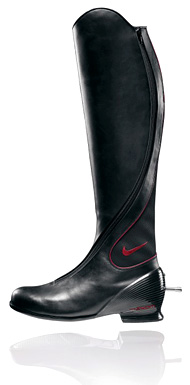
Instead of a vertical zipper on the back of the boot, Nike designed one that wraps around the calf Nike.The century-old spur system was replaced with a titanium screw-in model that was easier to install and adjust Nike

 
U.S. Olympian Amy Tryon will wear Nike’s Ippeas boots at the Games Carolyn Djanogly.When Nike (NKE) unveiled new footwear for athletes in all 28 sports at the Olympic Games, one of its offerings prompted skepticism: an equestrian boot. One rider opined on a Web site that it looks like “the stripper boot of the horse world.” U.S. Olympic rider Gina Miles wonders if wearing a swoosh might lead to lower scores in a sport that prides itself on centuries-old traditions. And Nike archrival Adidas, which is also creating new shoes for the Games, said no to riding boots. “We didn’t feel we could come in with some meaningful innovation,” says James Carnes, Adidas’ creative director.

Nike insists its offering, dubbed the Ippeas (Greek for “rider”), allows for better performance than hand-cobbled leather boots. It used its Air Zoom cushioning—a staple in its sneakers—in the sole to make the boot more comfortable. The century-old spur system was replaced with a titanium screw-in model that was easier to install and adjust. Instead of a vertical zipper on the back of the boot, Nike designed one that wraps around the calf. There’s also grippy rubber on the part of the boot that touches the saddle to improve handling, as well as red piping and a shiny heel for flourish.

The world will get to see the Ippeas on the feet of U.S. rider Amy Tryon, a bronze medal winner at the 2004 Athens Games, as well as on the 14 members of the Chinese equestrian team. Tryon says the snug fit gives her greater control over her horse than any other boot she has worn. “If nobody tries to push the envelope, nothing changes,” she says.


www.intermarine.com.br

Ao longo de sua história a Intermarine percorreu uma trajetória de grande sucesso, marcada por produtos que revolucionaram o mercado náutico brasileiro.


A Intermarine sagrou-se como uma marca de respeito, qualidade e prestígio. Acompanhando a evolução dos seus produtos, renovou o espírito da sua marca com a introdução de novos logotipos.

A Intermarine é o estaleiro líder em lanchas de alta performance no Brasil. Fundada em 1973, já produziu e comercializou mais de 5000 embarcações, consolidando-se como a marca de maior prestígio dos mares brasileiros.

Somos o único estaleiro no mundo a obter a Licença de Fabricação de Barcos do renomado estaleiro italiano Azimut Yachts , uma parceria que permite construir no Brasil embarcações homologadas e perfeitamente adaptadas as nossas condições de clima e mar. A Intermarine constrói a mais ampla linha de embarcações do mercado náutico brasileiro, de 38 a 98 pés. Estabelece, a cada lançamento, novos padrões de estética, engenharia e tecnologia, em sintonia com o que existe de mais moderno no mercado náutico mundial.

MISSAO & VISAO

Muitas qualidades definem uma embarcação Intermarine – design inconfundível, performance excepcional, sofisticação, alta qualidade de construção, assistência técnica eficaz e uma vibrante experiência ao navegar. E é a combinação de todas essas características que torna a marca Intermarine tão única.

Proporcionar aos nossos clientes momentos inesquecíveis, a bordo de um dos melhores barcos do mundo. A experiência única de desfrutar de uma Intermarine é resultado de produtos criados com paixão, qualidade, talento e criatividade. Superar-se constantemente e ser reconhecido como o melhor e mais distinto estaleiro de embarcações de lazer da indústria náutica brasileira

Excelência – Buscamos incansavelmente a qualidade máxima em produtos e serviços.

Garra – Superamos os desafios com determinação e comprometimento.

Evolução – Aperfeiçoamos constantemente nossa empresa, produtos, serviços e colaboradores.

Capital Humano – Os nossos colaboradores são os elementos mais importantes para a construção de uma empresa de sucesso.

Responsabilidade – Agimos com consciência social e ambiental.

Jato de US$ 28 milhões

Executivos e empresários que utilizam os serviços da aviação executiva já começaram a voar em um Falcon 2000EX Easy, que chegou recentemente ao Brasil.
Adquirido pela Alliance Jet Táxi Aéreo por cc.

É o primeiro jato desse modelo a ser usado como táxi aéreo no país.
Com capacidade para oito passageiros, que poderão usufruir de uma cabine mais larga do que a dos jatos convencionais, o Falcon também é intercontinental, com autonomia de 3,8 mil milhas (permite vôo ininterrupto de oito horas). A aeronave possui tecnologia avançada, com painel desenvolvido pela Agência Aeroespacial Americana (Nasa), telas de cristal líquido e controle por mouses, sem botões.

“A aquisição do Falcon 2000EX Easy consolida a Alliance como uma das empresas de táxi aéreo que possui uma das frotas mais modernas do país. Por esse motivo, investimos em equipamentos e buscamos os melhores profissionais do mercado”, explica o gerente administrativo da Alliance Jet Táxi Aéreo, Wesley Chagas.
A empresa atua no setor de aviação executiva desde 2005 e, a partir de outubro de 2006, começou a operar como táxi aéreo. O faturamento mensal da companhia é de cerca de R$ 500 mil e a previsão para maio já é de aumentar para R$ 1 milhão.

O novo modelo, fabricado na França e montado nos Estados Unidos, se juntou à frota de três aeronaves da Alliance Jet, empresa sediada em Sorocaba, interior de São Paulo. Além do Falcon 2000EX Easy, ela já conta com os jatos Citation CJ2 e Citation X e um helicóptero Bell 430.
A empresa estuda a aquisição de mais duas aeronaves.

Vidal Sassoon tames unruly, satanic hair

Sassoon For the past several years, I’ve suffered through a slow, teary falling out with my hair. (Ha! … Hey, that’s not funny! … Damn, I made myself feel bad.) Which brings us to a spot that crosses low-rent Twilight Zone imagery with a typical Vidal Sassoon commercial. Appropriately enough, it is a Sassoon spot (click the box on the right side), tagged “Your hair knows” and promising “answers” to every conceivable styling question. I have only one: How could you leave me this way? Though, if my once-abundant locks began mumbling satanically and reached out to unplug the dryer, I’m pretty sure I’d scream like a maniac and yank out every last remaining strand.

—Posted by David Gianatasio


Elan Sassoon
Lessons in Faith, Love and Looking Good

By: David K

According to PhoPhacts.net, “Being a heterosexual male hairdresser (H.M.H.) is almost like being god.” Francoise Marie Dubonet, the infamous Courtesan de Coiffure, declared one balmy English day to an unlikely assembly of crimpers and theologians in London’s Royal Parisian Hall, circa 1916. Philosophical Platonic thoughts continue, if we hold this truth to be self-evident, then as day follows night it also follows, being an H.M.H. from London’s “swinging mod sixties” with the surname Sassoon is being god.

Stay with the logic. If your first name happens to be Elan, as in panache, and your surname Sassoon, with the charm of your handsome father and looks from your charming and heavenly mother, then reason follows, YOU must be the prodigal son of god returneth home to Salonville, U.S.A..

Say Amen. Praise the Lord.
There’s only one slight blemish in the logic, one fine print detail omitted. The son of the father is only a heterosexual male H.M.; fact is Elan is not a hairdresser. Therefore, the common sense of it breaks down; the son needs a brand new bag and baby needs a new pair of shoes.

All homage, spirituality, ridiculosity and religiousity aside, as East Coast Director of Klinger Advanced Aesthetics, Elan Sassoon makes good use of his pedigree and entrepreneurial wiles overseeing the chain of nationwide salons, spas, medical centers, and hairdressing talents with the knowledge, history, and thicker than blood pumping blood through his veins passed down, as folklore would have it, from the father to the son.

I, meaning me, your humble narrator, became a haircutter for among other travel and financial motives to meet girls, chicks, women, broads, birds, dames, and ladies. All things being equal, though things are not equal nor are they fair, what was Elan’s raison d’être for getting into the hair and beauty game? Particularly after producing a run of successful film projects. Was it to carry on the family legacy, for the money, to meet women, or for some other more esoteric rationale?

“I enjoy producing films. My first movie ever was at Sundance and that was far out. They only take eight movies a year and we had the movie Café Society, that’s my pride and joy.” Another film, Homage, with Blythe Danner, was in the Cannes Film Festival for the Camera D’or. “We did very well with that film,” but he gets more excited about beauty than he does about profit and goes on about his gorgeous star in another of his movies, Brooklyn State of Mind, and “the drop dead gorgeous girl from Il Postino Maria Grazia Cucinotta.”

Love Lies Bleeding was with another A-List star Faye Dunaway. “That was the last film I did and then I had to make a choice. I was gone like three months, my wife couldn’t leave the country because she didn’t have her visa, and so she said to me, “Look, either you choose family or you choose your movie career.”” You can tell by the way he tells it, it was not an ultimatum and there are no regrets when he says, “So I said all right I choose family; I’m done.” Check this… I’m his wife’s hairdresser–good choice E; she’s a major babe.

“Then she said, “Good, let’s move.” And I said, cool; let’s move to Seattle. She said, “Why don’t we move to Miami?” I said, I don’t want to go to Miami; I’m going to Seattle.” His already sweet voice goes softer, “And she said, “Let’s just go look at it.” And I said, fine, you look in Seattle and I’ll go look in Miami and then we’ll make a choice.” All of a sudden a deep blue something washes over me like a romantic Tiffany Blue mist, though I’m certain he didn’t produce the new Capote. “She took me down to Cocoanut Grove, and like Coral Gables and South Miami, and y’know I was like, this is kinda cool.”

It’s at this point I inform Elan that he is but H.M. and Vidal and I are both H.M.H. –and with a tinge of a gloat explain what you have already read at the top of the story and the last thing I want to be is redundant or repeat myself over again repeatedly. He loves the H.M. designation and laughs. And I ask Elan, what have you learned from your dad?Not being a hairdresser what have you carried with you from him?

“The most valuable thing that I learned from him was surround yourself with excellent people. You surround yourself with excellent people and they will always make you look good. That was the number one thing he always told me. Bury the ego, look for the best people and you surround yourself with the best. That’s the key. Don’t always want to be the best, you know. You will be.” It makes me happy to know it was he who hired me.

The scope of his job encompasses recruiting talent to the actual physical buildings; non-stop cell phone calls, conference calls, meetings, bottom lines, and a neverending line of people needing to talk to or get next to the birthright heir to hair. “We (Klinger Advanced Aesthetics) have salons in twelve cities and I like the fact that we’re owned by Louis Vuitton.”

He loves the vision of the company. “Which is the 360 degree approach to beauty. It’s taking in everything about one’s self. Instead of just looking at the hair–it’s looking at their eyebrows, their skin, looking at all their features– it’s a whole package.” He represents, “Lots of salons will be opening around the U.S. and Europe.”


In the same way what it’s like to give birth, I’ll never know what it’s like to have such a recognizable name. How does it feel? What’s it like? He pauses and thinks thoughtfully and turns to the computer he’s been Googling his flicks and reminisces about the Faye movie. “Those were good years, um, I don’t know. As long as you take advantage of it in positive ways and not negative it can open a lot of doors for you, and you can help a lot of people. It’s hard to answer a question like that when you’ve grown up with it your whole life. I really don’t know any other way. I remember as a kid I was really shy and when I’d go to events with my mom and my dad I’d sneak in through the kitchen door of say the Beverly Wilshire Hotel at one of those black tie events instead of walking down the aisle.” He chuckles, “Going in through the back just to kind of avoid everything. Now it doesn’t bother me so much. It’s kind of nice, you know. As long as you’re grounded.”
So why did he get into the salon business? “There’s an incredible feeling, a rush, there’s an energy being around so many creative people in one place at the same time. There’s something special about being around people who want to help other people be beautiful. There’s a buzz and sense of joy.”

Given the opportunity to say one last thing and ask if there is anything he wants to say, he thoughtfully thinks and slowly says, “Peace.” A wonderful thought this holiday wartime season.

http://www.bostonmagazine.com/articles/connected_four/

Jason Goldberg

Jason Goldberg (born c. 1972) is an American film and television producer.

Goldberg is the producer of the films Guess Who and The Butterfly Effect and executive producer of the shows Beauty and the Geek and Punk’d.

He got his start as a producer on the film Homage with Blythe Danner in 1994. Next, he produced Cafe Society with Lara Flynn Boyle and Peter Gallagher. He, along with actor Ashton Kutcher, runs a production company, Katalyst Films.

Goldberg married actress Soleil Moon Frye on October 25, 1998. Their first child, daughter Poet Rose Sienna Goldberg, was born on August 24, 2005. Their second child, daughter Jagger Joseph Blue, was born on March 17, 2008.

Goldberg is on the Board of Directors for EMA, an environmental action group based in Los Angeles.

He often works with Ashton Kutcher.

TV’s Next Hit May Come from the Country’s Fringes

Listen Now [7 min 46 sec] add to playlist

This story is the fifth of a five-part series.

 Download the Series

Goldberg

Producer Jason Goldberg is Ashton Kutcher’s partner in Katalyst Films: “We felt that there was nobody communicating to youth culture at all — honestly communicating to youth culture.”

 Katalyst’s Resume So Far

The company also has a reality series, and other shows, in development.

  • Guess Who: Kutcher starred in this 2005 movie, a twist on Guess Who’s Coming to Dinner.
  • Beauty and the Geek: This reality show on the CW network, which debuted on the WB in 2005, pairs lookers and nerds to compete in challenges for prize money.
  • The Butterfly Effect: Supernatural thriller, released in 2004, starred Kutcher as a man who learns more about the memory blackouts he suffers.
  • Punk’d: The MTV reality series, with Kutcher playing pranks on his celebrity friends, first aired in 2003.

Source: IMDB

In the Works

A partial list of upcoming Katalyst projects:

  • Adventures in Hollyhood: Reality series about rap group Three 6 Mafia, airs on MTV in April.
  • Game Show in My Head: In this game-show pilot, contestants interact with unsuspecting participants on the street.
  • Daisy Dooley Does Divorce: Comedy is in development at ABC.
  • Sources: IMDB and Katalyst

 Day to Day, March 9, 2007 · Conventional advertising wisdom holds that if you are between the ages of 18 and 24 years old, there’s a decent chance you may not yet have settled on which brand of soda, denim or shampoo you like.

You might be more apt to try something new — and that makes you the kind of viewer that most television program sponsors would love to reach. The question is, how?

Television producer Jason Goldberg has done a decent job of figuring that out. With actor Ashton Kutcher, Goldberg created the MTV hit Punk’d, an update of Candid Camera where the prank victims happen to be celebrities.

Punk’d was such a hit when it debuted in 2003 that MTV ran half-hour episodes 50 times a week.

Now, Kutcher and Goldberg’s Katalyst Films is looking for its next big success. Katalyst deploys “street teams,” or hipster lookouts who watch kids in places you might not expect, such as Oklahoma and industrial cities in the Midwest.

In those more remote areas, kids feel so alienated and overlooked that they are inventing their own culture.

This, Goldberg says, is where the next big TV/Internet hit lies. His tip: To find something new that will capture 18-to-24-year old viewers, look to the outsiders.

Goldberg doesn’t claim to know the fate of networks, and the mode of programming delivery at this point remains fluid. But he does have one prediction to make: “I do feel that content will always be king.”

 David Benveniste (Beno) 

Benveniste has a unique and rich background in connecting, empowering, mobilizing and influencing youth culture. He founded StreetWise in 1997 to promote the band System Of A Down and is responsible for the company’s overarching philosophy that has established StreetWise as an award winning, premiere social marketing agency specializing in the youth market. Through his unique vision and personal tenacity, Benveniste has built a nationwide community of over 200,000 young influencers eager to participate in the brand building experience.  

Benveniste began his entrepreneurial pursuits as an independent band manager through which he founded Velvet Hammer Music and Management Group, a music management company with an impressive roster of top-selling and Grammy winning artists that include System Of A Down, Deftones, and Cypress Hill. Concurrent to his role at StreetWise, Benveniste is also CEO of Velvet Hammer.  Benveniste grew up in Beverly Hills, CA and is a graduate of Beverly High. He earned a Bachelors’ Degree in Communications from The University of Southern California.

System of a Down is the eponymous debut album by System of a Down, first released in 1998. The album was certified gold by the RIAA on February 2, 2000. Two years later, after the success of Toxicity, it was certified platinum.


Web Design

Guitar Hero®: Aerosmith®


StreetWise designed and developed the global marketing site for Guitar Hero®: Aerosmith®. The site’s robust interface and rich motion graphics create an exciting interactive experience that captures the “larger than life” style and swagger of the band. An elevator was created to move throughout the site’s content, playing off the band’s famous hit song “Love in an Elevator,” while taking the user on a journey through the multiple venues featured in the game.

The site features a mass of dynamic content, localized in 10 languages for 14 countries around the globe. The full track list of songs playable in the game are highlighted as well as multiple behind-the-scenes videos, in-game screenshots, exclusive downloads and enough bells and whistles to make every aspiring Guitar Hero® rise to rock royalty and become “The Bad Boys of Boston!”

1218036811_aerosmith

http://www.streetwise.biz