BALLET RUSSES

“Ballet Russes” by August Macke, 1912

The Ballets Russes (French for The Russian Ballets) was an itinerant ballet company which performed under the directorship of Sergei Diaghilev between 1909 and 1929. Some of their places of residence included the Théâtre Mogador and the Théâtre du Châtelet, though they worked in many countries, including England, the U.S.A., and Spain. Many of its dancers originated from the Imperial Ballet of St. Petersburg. Younger dancers were trained in Paris, within the community of exiles after the Russian Revolution of 1917. The company featured and premiered now-famous (and sometimes infamous) works by the great choreographers Marius Petipa, Michel Fokine, Bronislava Nijinska, Leonide Massine, Vaslav Nijinsky, and a young George Balanchine at the start of his career.

Ballet Russes poster, 1911

It created a huge sensation around the world, altering the course of musical history, bringing many significant visual artists into the public eye, and completely reinvigorating the art of performative dance. The Ballets Russes was one of the most influential theatre companies of the twentieth century, in part because of its ground-breaking artistic collaboration among contemporary choreographers, composers, artists, and dancers. Its ballets have been variously intepreted as Classical, Neo-Classical, Romantic, Neo-Romantic, Avant-Garde, Expressionist, Abstract, and Orientalist. The influence of the Ballets Russes lasts to this day in one form or another.

After Diaghilev’s early death in 1929, the dancers were scattered, and the company’s property was claimed by creditors. Colonel Wassily de Basil and his associate René Blum revived the company under the name Ballets Russes de Monte Carlo. George Balanchine and Leonide Massine worked with them as choreographers, and Tamara Toumanova as a principal dancer. De Basil and Blum argued constantly, so Blum founded another company under the name Original Ballet Russe.

During World War II the Ballets Russes de Monte Carlo toured extensively in the United States. When dancers retired and left the company, they often founded dance studios in the United States or South America, or taught at other dancers’ studios. With Balanchine’s founding of the New York City Ballet, many former Ballet Russes de Monte Carlo dancers went to New York to teach.

The Original Ballet Russe toured mostly in Europe. Its alumni were influential in teaching classical Russian ballet technique in European and British schools.

The Serge Lifar collection of Ballets Russes costumes and other memorabilia is on display at the Wadsworth Atheneum in Hartford, Connecticut.

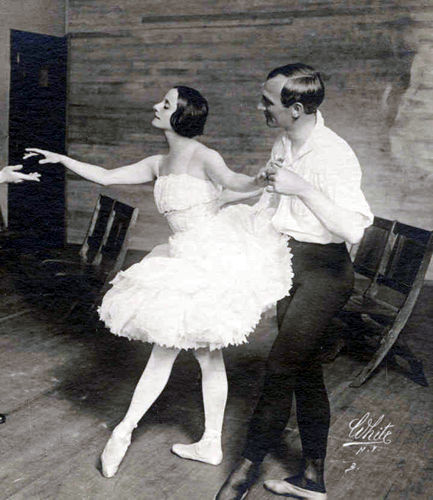
Two of the male stars of Diaghilev’s Ballets Russes in 1909 were Adolph Bolm (1884-1951) and Mikhail Mordkin (1880-1944). Bolm was a student at the Imperial School in St. Petersburg and Mordkin was trained at the Bolshoi, in Moscow. They both joined Diaghilev for his Paris season as leading dancers although they ranked above Nijinsky. Diaghilev made sure that the press wrote more about his young favorite.

mordkin_mikhail

Mikhail Mordkin graduated from the Bolshoi Ballet School in 1899, and in the same year was appointed ballet master. He joined Diaghilev’s ballet in 1909 as a leading dancer. After the first season he remained in Paris to dance with Pavlova. He then formed his own company, All Star Imperial Russian Ballet, which toured America in 1911 and 1912. Mikhail returned to the Bolshoi and was appointed its director in 1917. He left Russia after the October Revolution, first working in Lithuania, and finally settling in the United States in 1924. He founded the Mordkin Ballet in1926, for which he choreographed a complete Swan Lake and many other ballets. His company included such distinguished artists as Hilda Butsova, Felia Doubrovska, Pierre Vladimiroff, and Nicholas Zvereff. After a European tour the company disbanded in 1926. Mordkin continued to be a freelance artist and teacher. From among his students in America he formed a new Mordkin Ballet in 1937, the forerunner of Ballet Theatre (now American Ballet Theatre). His student Lucia Chase helped finance his company and after the first season of Ballet Theatre, she and Richard Pleasant took over the management from Mordkin because they thought his plans lacked ambition. Although he had been pushed into the background, Mordkin, like Bolm, helped build the foundation for ballet in America.

massine-leonide-laleggendadi-giuseppe

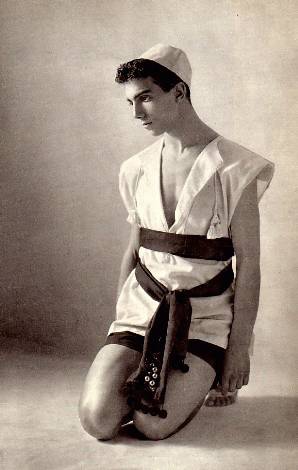
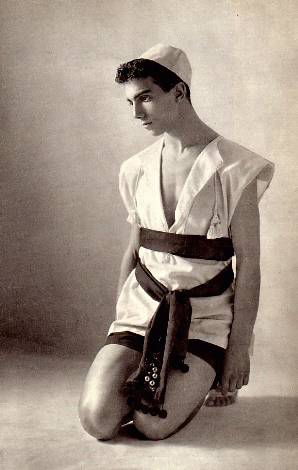
You may remember one of Diaghilev’s most famous dancers, Leonide Massine (1895-1979), because of his portrayal of the ballet master and shoemaker in the 1948 film The Red Shoes . Massine studied at the Moscow Bolshoi School, graduated in 1912 and joined the Bolshoi Ballet.

When Diaghilev fired Nijinsky after his marriage a void was left both in the ballet company, and Diaghilev’s life. Mikhail Fokine was working on a new ballet, The Legend of Joseph. While visiting in Moscow Diaghilev saw the Bolshoi Ballet, and noticed in Don Quixote and Swan Lake a handsome young man with big dark eyes who reminded him of St. George in an ikon. This was Leonide Massine not a particularly good dancer (with poorly shaped legs), but who had stage presence that would make him into a great star. Diaghilev became infatuated with Massine and persuaded him to leave the Bolshoi and join his company. It was understood that he would replace Nijinsky on and off the stage. Massine immediately began to work with the Ballets Russes’ teacher Enrico Cecchetti and was soon ready to star in Fokine’s new ballet.

Massine became an outstanding-actor dancer. Before joining the Ballets Russes, Massine had considered giving up dance and becoming an actor. He had even been offered the role of Romeo in Shakespeare’s play at the Maly Theatre in Moscow.

Massine joined the company in 1914 and by 1915 he had choreographed his first ballet for the Ballets Russes. To Diaghilev’s dismay Massine followed the same path as his predecessor and got married to the first of four wives in 1921. Diaghilev called him an ingrate, saying, “Nothing but a good-looking face and poor legs.” Massine continued to choreograph for every major company including three years as lead dancer and choreographer for the Roxy Theatre in New York City. In 1945 and 46 he formed his own company called Ballet Russe Highlights.

He was a prolific choreographer  he created 50 ballets. His greatest achievement is considered by many to be the development of the symphonic ballet as a separate art form.

To list all his ballets would take a whole page. A few are: The Good-Humored Ladies, La Boutique Fantasque, The Three Cornered Hat, Les Presages, Jeux d’enfants, and Gaîte Parisienne.

Massine was for twenty years considered the Western world’s greatest choreographer, but in later life he was overshadowed by George Balanchine .

http://ballets-russes.com

* The Ballet Rousses at Wang Theater Boston.Oh my god! I am speechless.Centenial Anniversary of Diaglev’s Ballet Company. Mikko, great job. What a surprise at the end Fire red costumes and real fire created a sensuous scenery. The illusion of 3D. A true CLASSIC.

FUELING UP

 By Inside Track  |   Tuesday, April 21, 2009  |  http://www.bostonherald.com  |  The Inside Track


Photo
Photo by Matthew Healey

While 26,386 Boston Marathoners braved blisters, cramps and dehydration during their self-imposed 26.2-mile trek to Copley Square yesterday, hundreds of Hub boldfacers partied ’til the last soul crossed the finish line.

And wasn’t that nice of them?

The new entry into race route parties this year was the swish Mandarin Oriental hotel on Boylston Street where GM Susanne Hatje hosted Red Sox [team stats] big guns John Henry and Tom Werner, who popped in after the team took its fourth game from the Orioles 12-1; Bryan Koop of Boston Properties; Mass Sports Partnership chief Paul Foster; Union Oyster House honcho Joe Milano and Mandarin man Richard Baker who flew in from the Left Coast for the foot-race festivities.

Over at PR princess Marlo Fogelman’s shop in the 600 block of Boylston, she broke out the Narragansett beer, shrimp cocktail and lobster sliders from Eastern Standard and whoopie pies from Baker’s Best at her third-floor digs.

On hand for the Marlo madness were real estate guy Mark Goldweitz and his wife, Joyce; Boston Music Awards ace Chip Rives; high-flying Cape Air gal Michelle Haynes; city events cheese Tony Nunziante; Nokona Brand mainman Josh Fink; XV Beacon GM Amy Finsilver; actor/bon vivant Richard DeAgazio and many, many more.

At Abe & Louie’s, “TV Diner” host Billy Costa and rival “Phantom Gourmet” foodie Dan Andelman toasted the runners with Boston Common publisher Glen Kelley and car czar Herb Chambers at a bash thrown by Mercedes Benz .

Then, across the street, there was a smattering of names and faces who gathered on the windy rooftop at the Lenox Hotel for what was billed by the Saunders Family as “the Longest Running Party.”

Spotted amongst the crowd schmoozing Jeff, Tedd and Todd Saunders were: New England Patriots [team stats] linebacker Tedy Bruschi [stats]; Boston City Councilor and mayoral candidate Sam Yoon; state Sen. Sonia Change Diaz; hair honchess Adriana Sassoon; State Room sweeties Jim and Alina Apteker; Boston Ballet artistic director Mikko Nissinen; attorney Tom Dwyer; Newsie Janet Wu; and a few Maggie Inc. models.

Cheers to all!

Article URL: http://www.bostonherald.com/track/inside_track/view.bg?articleid=1166991

BILL CLINTON

Earth Day 2009 Clinton Foundation
Earth Day

  spacer Dear ADRIANA,Today, on Earth Day, I want to share with you the work we’re doing in the fight against climate change.In a video I just recorded, I speak about the urgent need to reduce global greenhouse gas emissions. Despite the economic recession, we have a tremendous opportunity to solve both our environmental and economic challenges. We can do this through investment in green projects that save money and create jobs.My Foundation’s climate initiative is focusing on bringing these solutions to major cities around the world. Next month in Seoul, we will help bring together mayors from some of the world’s largest cities to share best practices in urban efficiency.Two weeks ago, we announced that my climate initiative is working with the Empire State Building in New York (you can watch a video here) to improve the skyscraper’s energy efficiency by up to 38 percent, greatly reducing its carbon emissions and cutting its utility bills by more than $4 million a year. We’re also working hard to deliver practical solutions for large-scale clean energy generation and for the prevention of deforestation.We’ll update you next month when the mayors convene in Seoul to learn from the shining examples of how cities around the world are working with my climate initiative to fight climate change.I know there are many requests for your attention this Earth Day. Please support the work of the Clinton Foundation — we need your donations to continue to find solutions for cities, clean energy, and forests.With best wishes,Signature
Bill ClintonP.S. Today staff from our offices in New York are helping to plant a community garden in Harlem. Everyone’s effort this Earth Day, and each day, adds up. Please do your part for the planet and support our work. 


Watch Bill Clinton's Earth Day 2009 Video > Clinton Climate Initiative. Why Cities? With a majority of the earth's population now living in urban areas, cities are responsible for about 75% of energy use. Why Clean Energy? Fossil fuels are the source of most of our energy today and generate nearly 60% of global emissions. Why Forestry? Deforestation releases nearly 20% of global emissions and arrests the forests' natural ability to absorb and store carbon. Learn more about the Clinton Climate Initiative > Donate Now > Watch the Empire State Building Goes Green Video >


New York Office: William J. Clinton Foundation • 55 West 125th St. • New York, NY 10027
Little Rock Office: William J. Clinton Foundation • 1200 President Clinton Ave. • Little Rock, AR 72201

http://www.mycommitment.org/node/1490

ROXCOMP JENNIFER HUDSON

This past Saturday night, I attended the Roxbury Comprehensive Community Health Center (RoxComp) Gala at the Boston Four Seasons. RoxComp is a leading provider of primary healthcare and outpatient mental and social health services in Roxbury and North Dorchester, and provides these services to individuals regardless of ability to pay. The event featured a lovely dine around dinner prepared by the Four Seasons Executive Chef Brooke Vosika (who first wowed me with his dishes at the Tour de Champagne), a silent and live auction, and an intimate live performance by Oscar / Grammy award winner Jennifer Hudson (Dreamgirls, Sex and the City, The Secret Life of Bees) to cap off the night.

 The illustrious crowd included supporters from Next Street Financial, Color Magazine, Roxbury Technologies, ELAN & ADRIANA SASSOON from MIZU Salon, Children’s Hospital Boston, numerous press people (myself included!), and Governor Deval Partick.

                                            ADRIANA SASSOON  &  ATHENA YANG

Before the Jennifer Hudson performance, there were words spoken by Emcee Karen Holmes Ward, RoxComp CEO Anita Crawford, and RoxComp Chairman Ronald Walker II. There was also an intense live auction where bidding wars escalated as charitable event patrons dug deep in their pockets to bid on Chicago getaway packages, VIP packages at the Four Seasons, and $10,000 donations to RoxComp.

                                      Jennifer Hudson! American Idol /Dreamgirls.To All and  AJ (event manager) and her team at Creative Events made this an unforgettable night filled with great music, food, and charity.

For more pictures, please click here: Party Pics

http://www.financefoodie.com

WERTHEIMER

PIERRE WERTHEIMER


Pierre Wertheimer (January 8, 1888April 24, 1965) was a French businessman.

In October 1910, Pierre Wertheimer married Germaine Revel, a daughter of a stockbroker and a member of the Lazard family of investment bankers.

In 1924, Pierre Wertheimer and his brother Paul became Coco Chanel’s partners in the House of Chanel perfume business. Two years before, in 1922, the Chanel No. 5 perfume had been introduced and Ms Chanel needed the Wertheimers’ extensive experience in commerce, their American business connections, and their capital to fully develop and market the product. During their partnership, Wertheimer owned 70% of the Chanel perfume company. Chanel owned 10% and Chanel’s friend, Théophile Bader, owned the remaining 20%.

JACQUES GUY WERTHEIMER

Jacques Guy Wertheimer (August 18, 1911February 6, 1996) was a prominent French businessman who inherited and ran the renowned House of Chanel perfume company. Jacques Wertheimer was born at the villa Les Forgettes in Deauville, the son of Germaine Revel and businessman Pierre Wertheimer who co-founded the Chanel perfume business in 1924.

On March 26, 1947, Jacques Wertheimer married Eliane Fischer, the daughter of an architect. They had two sons, Alain and Gerard. The marriage was short-lived, and after separating, their divorce decree was issued on September 11, 1952.

1984 but for a number of years continued to act as their bloodstock advisor. Head’s daughter Criquette took over as trainer and continued to have great success.

In the 1970s, Jacques Wertheimer boarded his Kentucky-based bloodstock at Hagyard Farm in Lexington, Kentucky. Among his broodmares were the French classic winners Dancing Maid, Gold River and Pistol Packer. All three are buried at Hagyard Farm.

ALAIN  WERTHEIMER

Alain Wertheimer The son of Jacques Wertheimer and Eliane Fischer, it was his grandfather Pierre who co-founded the Chanel business. The privately held company is run by Alain who has presided over the acquisition of several non-Chanel brands, including Eres Lingerie, Tanner Krolle saddles and leather goods, and Holland & Holland, a British gunsmith.

Based in France, the Wertheimer brothers own French vineyards like Rauzan-Segla in Margaux and Chateau Canon in Saint-Emilion, both of which have won rave reviews from oenophiles.

Both brothers are enthusiastic equestrians who also inherited and operate an important Thoroughbred horse racing stable they call La Presle Farm or Wertheimer farm for racing in the United States and is known as Wertheimer et Frère partnership in France. According to reports Alain’s son is to receive over $700 million, at the time of his death. He also has a very close relationship with his 3 grandchildren, who usually stay at his summerhouse during the summer. It’s been reported that he spent $7 million dollars throwing his granddaughter, Anastasia, a sweet sixteen.

GERARD WERTHEIMER

5. Alan et Gérard Wertheimer

Gerard Wertheimer (b.c.1950) is a French businessman based in France who owns and controls the House of Chanel perfume company in partnership with his brother, Alain.

The son of Jacques Wertheimer and Eliane Fischer, it was his grandfather Pierre who co-founded the Chanel business.

The privately held House of Chanel is run by Alain Wertheimer who has presided over the acquisition of several non-Chanel brands, including Eres Lingerie, Tanner Krolle saddles and leather goods, and Holland & Holland, a British gunsmith.

Based in France, the Wertheimer brothers own French vineyards like Rauzan-Segla in Margaux and Chateau Canon in Saint-Emilion, both of which have won rave reviews from oenophiles.

Both brothers are enthusiastic equestrians who also inherited and operate an important Thoroughbred horse racing stable they call La Presle Farm and/or Wertheimer farm for racing in the United States and in France as Wertheimer et Frère partnership.

BOY CAPEL

Captain Arthur Edward ‘Boy’ Capel,CBE (d. 21 December 1919 in a motor accident) was an English polo player best remembered for his affair with, and influence on the style of, Gabrielle “Coco” Chanel. He was wealthy and supplied her with resources she needed to open her first shop. His blazers inspired her to put a squared, masculine touch on classic suit designs. Capel was killed in an auto accident in 1919.

 coco018

In his daughter’s obituary, Capel was described as “an intellectual, politician, tycoon, polo-player and the dashing lover and sponsor of the fashion designer Coco Chanel.”. Nothing else is known of his earlier life; there are hints in biographies of Chanel about his (illegitimate) connections with the Capel earls of Essex but no connection has been established. He was already a rich man, and apparently a self-made man, by 1909.

Capel was portrayed by French actor Olivier Sitruk in Coco Chanel, a 2008 American television movie about Coco Chanel for Lifetime Television which starred Shirley MacLaine as an elder Chanel.

Image

His affair with Chanel apparently lasted from 1909 to 1918 when, as a friend of her then lover Etienne Balsan, he became acquainted with Balsan’s 26-year-old mistress.  Capel financed Chanel’s first stores and his own clothing style, notably his blazers, inspired her creation of the Chanel look. The couple spent time together at fashionable resorts such as Deauville, but he was never faithful to Chanel.

ETIENNE BALSAN

Etienne Balsan (1880–1953) was a French socialite and heir. He was a lover of Coco Chanel. Balsan bred the best horses in France and frequently attended horse races. He was abrother of aviator Jacques Balsan, and came from the family of wealthy industrialists from Châteauroux (Indre) who provided the army with uniforms and originated the famous cloth known as “blue horizon.”

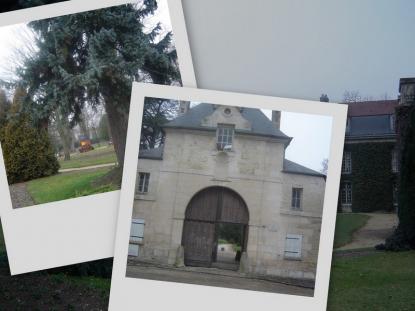
Le parc public de Bayser (Royallieu).

Le parc public de Bayser (Royallieu)  

Le parc de Bayser (ancienne propriété d’Etienne Balsan) est de nos jours un parc public.
Des jeux pour les enfants ont été installé.Photos :
Le parc et le château Bayser (Royallieu).

 
Le parc public de Bayser (Royallieu)

An officer in the cavalry, he renounced his career to breed horses and participate in races. A polo-player, he owned Royallieu, near Compiègne (Oise).

He noticed Coco Chanel in Moulins (Allier) and became her lover. They remained friends throughout their lives. In 1909, when Chanel settled in Paris, he lent her his bachelor flat on the ground floor, 160 Boulevard Malesherbes, and helped her to open a boutique in Deauville. He introduced her to high Parisian society.

His brother, Jacques Balsan, married Consuelo Vanderbilt, the former Duchess of Marlborough.

He was also a lover of Émilienne d’Alençon

Even after Capel married an aristocratic English beauty, he did not completely break off with Chanel. His death, in late 1919, was the single most devastating event in Chanel’s life.

In 1918, Capel married the Honourable Diana Wyndham, née Lister (7 May 1893-1983), a daughter of Lord Ribblesdale and widow of Captain Percy Lyulph Wyndham (killed in action 1914), who was the half-brother of the Duke of Westminster. Diana’s elder sister Laura was married to Lord Lovat, and another sister to a baronet.

By Diana, Capel had two daughters:

1. Ann Diana France Ayesha Capel (1919-4 May 2008). Ann was married three times and had children with her first two husbands. In 1940 she married her first husband, George Reginald Ward (1907-1988), who in 1960 became first Viscount Ward of Witley. Ward was a younger son of the 2nd Earl of Dudley. They divorced in 1951. She had two children with him: a son who died unmarried in his parents’ lifetime at the age of 40, and a daughter. On 7 August 1951 she married Richard Thurstan Holland-Martin (26 December 1908-1968), by whom she had two sons: Barnaby Robert (b. 1952) and Giles Thurstan (19554 May 2008). They were divorced in 1966. Ann Capel’s third and final husband was Peter Higgins.

2. June Capel (1920-26 September 2006), later Lady Hutchinson of Lullington. June was born after her father died, and he was apparently even unaware of her conception. Thus, he made no provisions for her in his will, and the will had to be contested to ensure that June got her fair share of her father’s fortune (most of it subsequently stolen by a lawyer, according to Lady Hutchinson’s obituary). In 1948 June married Franz Osborn, by whom she had a son Christopher. Her second marriage took place in May 1966 to Baron Jeremy Hutchinson, QC (born 28 March 1915). Hutchinson was the former husband of Dame Peggy Ashcroft. Her second husband was created a life peer on 16 May 1978 with the title Baron Hutchinson of Lullington, of Lullington in the County of East Sussex.

Capel’s living descendants today include the Honourable Mrs Patrick Tritton (daughter of his elder daughter Ann) and three sons by his younger daughter June, Lady Hutchinson. He had no issue with Chanel (who died childless).

The scoop is the story based on the early years and romances of Coco Chanel is one step closer to reality with the announcement that Alessandro Nivola (I love him – fab actor) will play her dashing American lover Arthur “Boy” Capel.
French actress Audrey Tatou will play a youthful Coco Chanel. The film, to be called Coco Avant Chanel (Coco before Chanel), will be directed by French director Anne Fontaine. Originally, the film was supposed to be released this 2009.

tautou-coco.jpg

(Top) Audrey Tatou as Coco Chanel (official poster), (Right) Coco Chanel/Audrey Tatou


Image


Image
Image
Chanel & Salvador Dali
ImageImage Image
chanel

http://www.toutlecine.com/images/film/0026/00262599-coco-avant-chanel.html

 OS SETE SENTIDOS

Os sentidos humanos são em número de 7, divididos em dois grupos, à saber:

  • Sentidos Extra Sensoriais
  • Sentidos Materiais

Os sentidos humanos, têm relação direta com os ORIXÁS, e na Umbanda se relacionam da seguinte forma:

SENTIDOS TIPO ORIXÁ
1. PALADAR MATERIAL ALMAS, PRETO-VELHOS
2. OLFATO MATERIAL OXÓSSI
3. VISÃO MATERIAL OGUM
4. AUDIÇÃO MATERIAL XANGÔ
5. TATO MATERIAL IBEJI
6. CLARIVIDÊNCIA EXTRA SENSORIAL SENHORAS (OXUM, IEMANJÁ, IANSÃ, NANÃ)
7. INTUIÇÃO MATERIAL OXALÁ

* A voz é o elo de complementação entre todos os sentidos.

A Intuição é um sentido extra sensorial que faz a ligação direta entre os Espíritos Protetores (ELEDÁ) e o espírito do ser encarnado, através de ordens, conselhos, advertências e avisos, muita vez confundido com a própria consciência do ser encarnado. É este sentido que nos faz, as vezes, ouvir vozes interiores, à zelar por nossos passos.


  • Clarividência espontânea
  • Clarividência provocada

A Clarividência espontânea é aquela que, acontece independente da nossa vontade, formando quadros de advertência, nas ocasiões e lugares menos esperados.

A Clarividência provocada o é através de duas formas diferentes: a Mentalização e a Vidência.
A Mentalização é a forma, grosseiramente material da clarividência em si, e consiste em mentalizar à quem se deseja falar, ou ver, tentando fazê-lo de olhos cerrados, até conseguir.
A Vidência é a faculdade que todos têm inata, podendo ser desenvolvida, através de exercícios especiais, para que possa ver (de olhos abertos), à sua frente ou através de Copo com Água, Bola de Cristal, Fumaça, etc., as Forças de Vibração Espirituais ou também Forças de Vibração Materializadas.

img149

Os Doze Sentidos E Os Sete Processos Vitais

by Rudolf Steiner

Rudolf Steiner nasceu em 27 de Fevereiro de 1861 em Kraljevec (Áustria). Tendo cumprido em Viena estudos superiores de ciências exatas, foi solicitado a dedicar-se, a partir de 1883, à edição dos escritos científicos de Goethe na coleção Deutsche National-literatur (Literatura Nacional Alemã). Atendendo ao convite para trabalhar no Arquivo Goethe-Schiller em Weimar, transferiu-se para essa Cidade em 1890, onde residiu até 1897, desenvolvendo um grande interesse cognitivo e uma conseqüente atividade literário-filosófica. É dessa época sua obra básica – A Filosofia da Liberdade (1894). Depois de alguns anos em Berlim como redator literário, Steiner passou a dedicar-se a uma intensa atividade como conferencista e escritor, no intuito de expor e de divulgar os resultados de suas pesquisas científico-espirituais, de início no âmbito da Sociedade Teosófica e mais tarde na Sociedade Antroposófica, por ele fundada. Em Dornach (Suíça) ele construiu em madeira o Goethanum, sede da Sociedade (e mais tarde também da Escola Superior Livre de Ciência Espiritual), edifício destruído em 31 de Dezembro de 1922 por um incêndio e posteriormente substituído pelo atual modelo em concreto. Foi em Dornach que ele faleceu em 1925, após realizar extraordinárias contribuições nos campos das artes, da organização social, da Pedagogia, da Medicina, da Farmacologia, da Agricultura, no tratamento de crianças excepcionais etc., com princípios adotados por instituições em todo o mundo.

 http://sab.org.br/antrop/GA-107-DezMandamentos.htm

http://www.ewrs.com.br

rudolf-steiner

by Rudolf Steiner

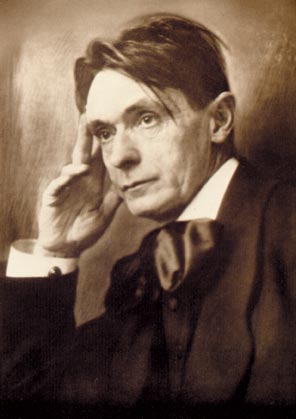
Rudolf Steiner (25 February 1861– 30 March 1925) was an Austrian philosopher, literary scholar, educator, architect, playwright, social thinker, and esotericist. After gaining initial recognition as a literary critic and cultural philosopher, at the beginning of the twentieth century he founded a new spiritual movement, Anthroposophy, as an esoteric philosophy growing out of European transcendentalist roots yet with links to the more Eastern-influenced Theosophy.

Steiner led this movement through several phases. In the first, more philosophically-oriented phase, Steiner attempted to find a synthesis between science and mysticism; his philosophical work of these years, which he termed spiritual science, sought to provide a connection between the cognitive path of Western philosophy and the inner and spiritual needs of the human being. In a second phase, beginning around 1907, he began developing artistic impulses that would transform drama, the movement arts (developing a new artistic form, Eurythmy) and architecture, culminating in the building of a cultural center to house all the arts, the Goetheanum. In a third phase, beginning after the First World War, Steiner worked to find practical manifestations of his philosophy; in cooperation with educators, farmers, doctors, etc. he founded Waldorf education, biodynamic agriculture, anthroposophical medicine as well as new directions in numerous other professions.

Steiner advocated a form of ethical individualism, to which he later brought a more explicitly spiritual component. He derived his epistemology from Johann Wolfgang Goethe‘s world view, where “Thinking… is no more and no less an organ of perception than the eye or ear. Just as the eye perceives colours and the ear sounds, so thinking perceives ideas.”A consistent thread that runs from his earliest philosophical phase through his later spiritual orientation is the goal of demonstrating that there are no essential limits to human knowledge.

http://www.rudolfsteiner.com.br/

MATTHEW WHITTINGER

matthew_hittinger_mipo

Matthew Hittinger is the author of Pear Slip, winner of the Spire Press 2006 Spring Chapbook Award. Shortlisted for the National Poetry Series, the New Issues Poetry Prize, and twice for the Walt Whitman Award, Matthew’s honors include a Hopwood Award and The Helen S. and John Wagner Prize from the University of Michigan, the Kay Deeter Award from the journal Fine Madness, and three Pushcart nominations. His work has appeared in many journals including American Letters & Commentary, Center: A Journal of the Literary Arts, DIAGRAM, Mantis, Memorious, Meridian, Michigan Quarterly Review, Oranges & Sardines and elsewhere, including the anthology Best New Poets 2005. Matthew lives and works in New York City.

3032395507_f6366597c3

Narcissus Resists

I am pleased to announce the release of my new chapbook Narcissus Resists.

In keeping with the spirit of the sequence, the chapbook is available both online and in print.
Head on over to www.resistthis.com where you can order a copy through Amazon or CreateSpace, read the online interactive version, and even listen to audio of me reading it.

Special thank-yous to Didi Menendez at MiPOesias who helped this project finally see the light of day, to Sean Keogh for the recording session, and to Connie Brady who lent me work for the front and back covers.  You can hear Sean’s work here and contact Connie here to see more of her work.

Narcissus now lives at www.resistthis.com.  Spread the word!

 http://issuu.com/didimenendez/docs/narcissusresists?mode=embed&documentId=090215164732-881ce723cc4d407a8f8e0ab79fd763cf&layout=grey

Uma nova paisagem para São Paulo

Lei possibilita um novo olhar à cidade, agora com bem menos interferência publicitária. Isso é bom ou ruim?


Lei Cidade Limpa, em vigor na capital paulista desde janeiro deste ano, tem contribuído não só para a regularização da propaganda exterior mas, principalmente, para uma questão que há anos não se via na cidade de São Paulo: a sua paisagem natural e os elementos que compõem o cenário urbano.

O prazo para adequação dos anúncios indicativos das fachadas (aqueles que têm a função de identificar os estabelecimentos comerciais) terminou em 31 de março e hoje já é possível notar a diferença.

Livre de painéis, faixas e cartazes, agora quem passa pela cidade pode contemplar prédios históricos, praças e monumentos tais como foram concebidos e, com isso, renasce uma nova relação com a cidade, bem mais pessoal e afetiva, já que a propaganda em excesso escondia as peculiaridades de cada bairro. Além disso, a retirada das faixas e placas revelou muros e fachadas carentes de manutenção e pintura, que já passam por transformações.

De acordo com o professor da Faculdade de Arquitetura e Urbanismo (FAU/USP) e coordenador do núcleo de pesquisas do Laboratório da Imagem e Comunicação Visual (Labim) da USP, Issao Minami, essa lei veio para instaurar uma ordem onde já não havia mais regras. “Em São Paulo havia cerca de um milhão de anúncios publicitários e, desse total, apenas cerca de 60 mil constavam no Cadastro de Anúncios (Cadan).

O certo seria cada anúncio ter seu número de registro, o que acabava não ocorrendo na prática” explica o professor.

Ainda de acordo com Minami, a medida radical – de proibir
todos os anúncios das fachadas dos comércios e outdoors – foi tomada para que a organização comece a partir da estaca zero. “Como é que você vai legislar sobre algo que está completamente ilegal. Por isso é que foi decidida a proibição de propaganda no espaço aéreo da cidade”, completa Minami.

Já para o consultor de Imagem de Marca da BBN Brasil e da Rede BBN Mundial, Augusto Nascimento, a medida vem causando um grande prejuízo à cidade. “O prejuízo financeiro é gigantesco para o comércio, para aqueles que estão tendo que tirar as placas e que não sei se terão dinheiro
para colocar outras placas menores nesse momento. Estou vendo milhares de buracos nas paredes, de onde foram tiradas as placas. A cidade ficou muito feia, perdeu vida”.

Polêmica

A lei tem causado muita polêmica, principalmente entre os profissionais da área de comunicação, que não vêem a determinação com bons olhos. Nascimento defende que a comunicação visual não é só propaganda, mas também informação e prestação de serviço e, sem as placas, será mais difícil as pessoas se localizarem e encontrarem os seus destinos. “A prefeitura está prestando um desserviço.

Agora, o cidadão deve estar tentando achar a loja que sabia onde ficava e já não sabe mais porque o prefeito fez sumir as placas. Esse vai botar o carro na rua e, não vendo a placa, vai errar o caminho.

Vai gastar mais combustível e vai causar mais congestionamento nas ruas. Quem vai pagar pela perda de tempo das pessoas e pelos seus custos de gasolina?”, defende.

Males à saúde

Por outro lado, o excesso de placas, painéis, cartazes, cavaletes, faixas, banners, totens, outdoors, back-lights, front-lights, painéis eletrônicos e painéis televisivos pode afetar diretamente o psicológico das pessoas, sem que elas percebam. Assim como os demais tipos de poluição, a poluição visual também causa males à saúde, tais como stress, fadiga, ansiedade, podendo até
mesmo propiciar o início de um processo de depressão.

Isso ocorre porque a superexposição de imagens, dispostas tanto no espaço terreno como no aéreo, exige um esforço muito maior na decodificação das mensagens. “Existe um efeito psicossomático chamado estresse visual que, sem dúvida afeta os sentidos, o bem estar e o equilíbrio emocional de maneira quase que direta” explica Minami. Augusto Nascimento defende o contrário. Segundo ele, São Paulo é uma cidade que necessita de um alto nível de redundância em comunicação visual, para a própria funcionalidade e redução do stress de sua população.

“O urbanismo do século XXI exige mais intensidade de comunicação e não menos, como quer o prefeito”.

Contribuição

A participação da sociedade, organizada em grupos, pode ser decisiva na mudança do cenário urbano.

A Associação dos Moradores e Amigos do Pacaembu mostrou que uma ação bem organizada pode surtir em resultados satisfatórios. A convite da própria associação, professores da FAU (Faculdade de Arquitetura e Urbanismo da USP) analisaram o caso da publicidade na avenida Angélica e constataram que havia um exagero nas propagandas, que atrapalhavam a visão não só de quem
passava pela avenida, mas também dos moradores dos prédios. Sendo assim, as empresas que tinham anúncios exagerados na avenida concordaram em adaptar seus luminosos e totens para
modelos mais adequados.

Ainda assim, na opinião de Minami, para que a cidade fique realmente livre dos exageros, não basta estabelecer novos critérios de fachada. Os próprios comerciantes e publicitários devem ter consciência do que é realmente adequado à divulgação do estabelecimento, respeitando as características da região e, principalmente, as pessoas que vivem no entorno. “A lei estabelece um limite máximo para as placas, no entanto, os comerciantes e publicitários sempre optam pelo máximo.

É necessário que a escolha parta de uma questão ética, para que tanto a paisagem como as pessoas não sejam prejudicadas”, afirma Minami.

Extensão

Em Santo André, existe um projeto de lei semelhante ao adotado em São Paulo, que visa estabelecer critérios com a preocupação de melhorar o visual da cidade. Apresentado pelo executivo, o projeto ainda está na câmara dos vereadores, aguardando a análise das comissões. Caso haja aprovação, a lei limitará o tamanho das inserções publicitárias nas fachadas de lojas e empresas, delimitará locais para instalação de outdoors e proibirá cavaletes nas calçadas, propagandas em viadutos, monumentos e bens tombados, além de panfletagem nas ruas.

Vidal Sassoon11wtcvidal1

 The world’s most famous hairdresser, lends his scissors to storm-recovery effort.

Vidal Sassoon, the world’s most famous hairdresser, was in Lacombe on a bright, cool Sunday afternoon last month. He had come to celebrate the success of “Hairdressers Unlocking Hope,” an international fund-raising effort by beauty professionals that has generated more than $1.7 million for the East St. Tammany Habitat for Humanity.

6


Strolling around East Chestnut Street, he posed for pictures, helped screw in the railing on a new Habitat house and chatted with dozens of hairstylists laying sod and spreading mulch around the tidy cottages they helped construct.

 whatsnew-hairdressersunlockinghope

 Looking remarkably fit, (he swims four times a week) and naturally gray- haired at 79 years old, (he turns 80 in January), Sassoon borrowed a black marker and added his autograph to a piece of white poster paper listing contributors to the project. There are big fans of the Sassoon line of hair products. Vidal  Sassoon the name that’s graced a million shampoo bottles.

nova-linha-sassoon

  “If you don’t look good, we don’t look good” Vidal Sassoon.

http://www.behindthechairexchange.com/unlockinghope/site.asp?company