WHAT DREAMS MAY COME

Martin Luther King Jr

Martin Luther King, Jr. (15 de janeiro de 1929, Atlanta, Geórgia4 de abril de 1968, Memphis, Tennessee) foi um pastor e ativista político estadunidense. Membro da Igreja Batista, tornou-se um dos mais importantes líderes do ativismo pelos direitos civis (para negros e mulheres, principalmente) nos Estados Unidos e no mundo, através de uma campanha de não-violência e de amor para com o próximo. Se tornou a pessoa mais jovem a receber o Prêmio Nobel da Paz em 1964, pouco antes de seu assassinato. Seu discurso mais famoso e lembrado é “Eu Tenho Um Sonho“.

Vida familiar

Luther King Jr. nasceu em Atlanta, filho de Martin Luther King que era agricultor e Alberta Williams King que era pastora. Graduou-se no Morehouse College, em 1948, com um bacharelado em sociologia. No Morehouse, teve como mentor Benjamin Mays, um ativista dos direitos civis. Em 1951 viria a formar-se no Seminário Teológico Crozer, em Chester, Pensilvânia, e em 1954 se tornou pastor da Igreja Batista, em Montgomery, Alabama. Em 1955 recebeu um PhD em Teologia Sistemática pela Universidade de Boston, razão do uso comum do titulo de Doutor.

Em 1955, Rosa Parks, uma mulher negra, se negou a dar seu lugar em um ônibus para uma mulher branca e foi presa. Os líderes negros da cidade organizaram um boicote aos ônibus de Montgomery para protestar contra a segregação racial em vigor no transporte. Durante a campanha de 381 dias, co-liderada por King, muitas ameaças foram feitas contra a sua vida, foi preso e viu sua casa ser atacada. O boicote foi encerrado com a decisão da Suprema Corte Americana em tornar ilegal a discriminação racial em transporte público.

Depois dessa batalha, Martin Luther King participou da fundação da Conferência de Liderança Cristã do Sul (CLCS, ou em inglês, SCLC, Southern Christian Leadership Conference), em 1957. A CLCS deveria organizar o ativismo em torno da questão dos direitos civis. King manteve-se à frente da CLCS até sua morte, o que foi criticado pelo mais democrático e mais radical Comitê Não-Violento de Coordenação Estudantil (CNVCE, ou em inglês, SNCC, Student Nonviolent Coordinating Committee). O CLCS era composto principalmente por comunidades negras ligadas a igrejas Batistas. King era seguidor das idéias de desobediência civil não-violenta preconizadas por Mohandas Gandhi (líder político indiano também conhecido como Mahatma Gandhi), e aplicava essas idéias nos protestos organizados pelo CLCS. King acertadamente previu que manifestações organizadas e não-violentas contra o sistema de segregação predominante no sul dos EUA, atacadas de modo violento por autoridades racistas e com ampla cobertura da mídia, iriam criar uma opinião pública favorável ao cumprimento dos direitos civis; e essa foi a ação fundamental que fez do debate acerca dos direitos civis o principal assunto político nos EUA a partir do começo da década de 1960.

Martin Luther King Jr. profere o seu famoso discurso “Eu tenho um sonho” em março de 1963 frente ao Memorial Lincoln em Washington, durante a chamada “marcha pelo emprego e pela liberdade”.

Ele organizou e liderou marchas a fim de conseguir o direito ao voto, o fim da segregação, o fim das discriminações no trabalho e outros direitos civis básicos. A maior parte destes direitos foi, mais tarde, agregada à lei estado-unidense com a aprovação da Lei de Direitos Civis (1964), e da Lei de Direitos Eleitorais (1965).

King e o CLCS escolheram com grande acerto os princípios do protesto não-violento, ainda que como meio de provocar e irritar as autoridades racistas dos locais onde se davam os protestos – invariavelmente estes últimos retaliavam de forma violenta. O CLCS também participou dos protestos em Alabany (19612), que não tiveram sucesso devido a divisões no seio da comunidade negra e também pela reação prudente das autoridades locais; a seguir participou dos protestos em Birmingham (1963), e do protesto em St. Augustine (1964). King, o CLCS e o CNVCE uniram forças em dezembro de 1964, no protesto ocorrido na cidade de Selma.

Em 14 de outubro de 1964 King se tornou a pessoa mais jovem a receber o Nobel da Paz, que lhe foi outorgado em reconhecimento à sua liderança na resistência não-violenta e pelo fim do preconceito racial nos Estados Unidos.

Com colaboração parcial do CNVCE, King e o CLCS tentaram organizar uma marcha desde Selma até a capital do Alabama, Montgomery, a ter início dia 25 de março de 1965. Já haviam ocorrido duas tentativas de promover esta marcha, a primeira em 7 de março e a segunda em 9 de março.

Na primeira, marcharam 525 pessoas por apenas 6 blocos; a intervenção violenta da polícia interrompeu a marcha. As imagens da violência foram transmitidas para todo o país, e o dia ganhou o apelido de Domingo Sangrento. King não participou desta marcha: encontrava-se em negociações com o presidente estado-unidense, e não deu sua aprovação para a marcha tão precoce.

A segunda marcha foi interrompida por King nas proximidades da ponte Pettus, nos arredores de Selma, uma ação que parece ter sido negociada antecipadamente com líderes das cidades seguintes. Este ato tresloucado causou surpresa e indignação de muitos ativistas locais.

A marcha finalmente se completou na terceira tentativa (25 de março de 1965), com a permissão e apoio do presidente Lyndon Johnson. Foi durante esta marcha que Stokely Carmichael (futuro líder dos Panteras Negras) criou a expressão “Black Power“.

Antes, em 1963, King foi um dos organizadores da marcha em Washington, que inicialmente deveria ser uma marcha de protesto, mas depois de discussões com o então presidente John F. Kennedy, acabou se tornando quase que uma celebração das conquistas do movimento negro (e do governo) – o que irritou bastante ativistas mais radicais e menos ingênuos.

A partir de 1965 o líder negro passou a duvidar das intenções estadunidenses na Guerra do Vietnã. Em fevereiro e novamente em abril de 1967, King fez sérias críticas ao papel que os EUA desempanhavam na guerra. Em 1968 King e o SCLC organizaram uma campanha por justiça sócio-econômica, contra a pobreza (a Campanha dos Pobres), que tinha por objetivo principal garantir ajuda para as comunidades mais pobres do país.

Também deve ser destacado o impacto que King teve nos espetáculos de entretenimento popular. Ele conversou com a atriz negra do seriado Star Trek original, Nichelle Nichols, quando ela ameaçava sair do programa. Nichelle acreditava que o papel não estava ajudando em nada sua carreira e que o estúdio a tratava mal, mas King a convenceu de que era importante para o negro ter um representante num dos programas mais populares da televisão.

Martin Luther King era odiado por muitos segregacionistas do sul, o que culminou em seu assassinato no dia 4 de abril de 1968, momentos antes de uma marcha, num hotel da cidade de Memphis. James Earl Ray confessou o crime, mas anos depois repudiou sua confissão. A viúva de King, Coretta Scott King, junto com o restante da família do líder, venceu um processo civil contra Loyd Jowers, um homem que armou um escândalo ao dizer que lhe tinham oferecido 100 mil dólares pelo assassinato de King.

Em 1986 foi estabelecido um feriado nacional nos EUA para homenagear Martin Luther King, o chamado Dia de Martin Luther King – sempre na terceira segunda-feira do mês de janeiro, data próxima ao aniversário de King. Em 1993, pela primeira vez, o feriado foi cumprido em todos os estados do país.

Martin Luther King Jr

Martin Luther King, Jr. (January 15, 1929 – April 4, 1968) was an African American clergyman, activist and prominent leader in the American civil rights movement. His main legacy was to secure progress on civil rights in the United States and he is frequently referenced as a human rights icon today.

A Baptist minister, King became a civil rights activist early in his career. He led the 1955 Montgomery Bus Boycott and helped found the Southern Christian Leadership Conference in 1957, serving as its first president.

King’s efforts led to the 1963 March on Washington, where King delivered his “I Have a Dream” speech. There, he raised public consciousness of the civil rights movement and established himself as one of the greatest orators in U.S. history.

In 1964, King became the youngest person to receive the Nobel Peace Prize for his work to end racial segregation and racial discrimination through civil disobedience and other non-violent means. By the time of his death in 1968, he had refocused his efforts on ending poverty and opposing the Vietnam War, both from a religious perspective.

King was assassinated on April 4, 1968, in Memphis, Tennessee. He was posthumously awarded the Presidential Medal of Freedom in 1977 and Congressional Gold Medal in 2004; Martin Luther King, Jr. Day was established as a U.S. national holiday in 1986.

Legacy

King’s main legacy was to secure progress on civil rights in the United States, which has enabled more Americans to reach their potential. He is frequently referenced as a human rights icon today. His name and legacy have often been invoked since his death as people have debated his likely position on various modern political issues.

On the international scene, King’s legacy included influences on the Black Consciousness Movement and Civil Rights Movement in South Africa.King’s work was cited by and served as an inspiration for Albert Lutuli, another black Nobel Peace prize winner who fought for racial justice in that country. The day following King’s assassination, school teacher Jane Elliott conducted her first “Blue Eyes/Brown Eyes” exercise with her class of elementary school students in Riceville, Iowa. Her purpose was to help them understand King’s death as it related to racism, something they little understood from having lived in a predominately white community.

King’s wife, Coretta Scott King, followed her husband’s footsteps and was active in matters of social justice and civil rights until her death in 2006. The same year that Martin Luther King was assassinated, Mrs. King established the King Center in Atlanta, Georgia, dedicated to preserving his legacy and the work of championing nonviolent conflict resolution and tolerance worldwide. His son, Dexter King, currently serves as the center’s chairman.Daughter Yolanda King is a motivational speaker, author and founder of Higher Ground Productions, an organization specializing in diversity training.

There are opposing views even within the King family — regarding the slain civil rights leader’s religious and political views about homosexuals, lesbians, bisexuals and transgendered people. King’s widow Coretta said publicly that she believed her husband would have supported gay rights. His daughter Bernice believed he would have been opposed to them.

The King Center includes discrimination, and lists homophobia as one of its examples, in its list of “The Triple Evils” that should be opposed. Universally, moderate African-American civil/human rights activists and moderate gay rights activists support the middle view: gay rights is a private sexual matter between consenting adults. However, they contend gays’ social issues should be equated to more grievous social injustices such as the now defunct slave trade, past Jim Crow laws and the brutal murder of 14-year old Emmett Till.

In 1980, the Department of Interior designated King’s boyhood home in Atlanta and several nearby buildings the Martin Luther King, Jr. National Historic Site. In 1996, United States Congress authorized the Alpha Phi Alpha fraternity to establish a foundation to manage fund raising and design of a Martin Luther King, Jr. National Memorial on the Mall in Washington, DC.King was a member of Alpha Phi Alpha, the first intercollegiate Greek-letter fraternity established by and for African Americans. King was the first African American honored with his own memorial in the National Mall area and the first non-President to be commemorated in such a way. The sculptor chosen was Lei Yixin. The King Memorial will be administered by the National Park Service.

King’s life and assassination inspired many artistic works. In 1969 Maya Angelou published her autobiography I Know Why the Caged Bird Sings. In spring of 2006, a stage play about King was produced in Beijing, China with King portrayed by Chinese actor, Cao Li. The play was written by Stanford University professor, Clayborne Carson.

What a Wonderful World – o original

Publicado por Marco Santos [18/Junho/2007]. Categoria: Música

Relacionado (ou não): Da Noruega aos bares de Nova Iorque [14/Fevereiro/2006]
Marcadores: ,

Louis ArmstrongEm 1967, ano em que foi lançado What a Wonderful World, vivia-se um dos períodos raciais e políticos mais conturbados nos Estados Unidos. Era o ano de Martin Luther King e de Malcom X, o ano dos happenings hippies e da contestação à Guerra do Vietname.
O artigo da Wikipédia refere-se à canção como tendo sido feita de propósito para apaziguar os ânimos raciais nos Estados Unidos, embora falhe por não especificar como ou por quem – e eu não encontrei nenhuma referência à canção como qualquer coisa “encomendada”.
Inocente ou perversa, a canção foi um fiasco nos Estados Unidos. Teve um enorme sucesso na Grã-Bretanha, onde chegou ao primeiro lugar dos tops, mas na América, numa primeira fase, não vendeu mais de 1000 discos.
Talvez o autor do artigo da Wikipédia baseie a sua ideia no facto de Louis Armstrong ter conseguido a proeza de ser uma figura aceite tanto por brancos como por negros, até mesmo pelos brancos racistas. O temperamento generoso e bonacheirão de Armstrong valeu-lhe críticas duras: chamavam-lhe Uncle Tom, ou seja, um preto subserviente em relação ao branco. E não lhe perdoavam o facto de dar concertos no Sul dos Estados Unidos, onde as audiências eram segregadas: brancos de um lado, pretos do outro.
O que Armstrong nunca quis foi comprometer-se porque, acima de tudo, tentava preservar a sua carreira. Em termos políticos, sabe-se agora, o jazzman preferia os bastidores: foi um dos que contribuiu com mais dinheiro para o movimento dos direitos civis encabeçado por Martin Luther King.
Desde então, a canção tem servido para tudo: elevar o espírito optimista (ou ingénuo?) nos homens mas, sobretudo, como contraponto irónico e sarcástico a imagens de guerra e violência. Para a história, eis a versão original de What a Wonderful World.

TIME FOR CHANGE  & REFLECTION

money1


Recession

In economics, the term recession generally describes the reduction of a country’s gross domestic product (GDP) for at least two quarters.  The usual dictionary definition is “a period of reduced economic activity”, a business cycle contraction.

The United States-based National Bureau of Economic Research (NBER) defines economic recession as: “a significant decline in [the] economic activity spread across the economy, lasting more than a few months, normally visible in real GDP growth, real personal income, employment (non-farm payrolls), industrial production, and wholesale-retail sales.”

Attributes of recessions

In macroeconomics, a recession is a decline in a country’s gross domestic product (GDP), or negative real economic growth, for two or more successive quarters of a year.

An alternative, less accepted definition of recession is a downward trend in the rate of actual GDP growth as promoted by the business-cycle dating committee of the National Bureau of Economic Research. That private organization defines a recession more ambiguously as “a significant decline in economic activity spread across the economy, lasting more than a few months.” A recession has many attributes that can occur simultaneously and can include declines in coincident measures of activity such as employment, investment, and corporate profits. A severe or prolonged recession is referred to as an economic depression.

Speculation

Speculation (in a financial context) is the assumption of the risk of loss, in return for the uncertain possibility of a reward. Only if one may safely say that a particular position involves no risk may one say, strictly speaking, that such a position represents an “investment.” Financial speculation involves the buying, holding, selling, and short-selling of stocks, bonds, commodities, currencies, collectibles, real estate, derivatives, or any valuable financial instrument to profit from fluctuations in its price as opposed to buying it for use or for income via methods such as dividends or interest. Speculation represents one of four market roles in Western financial markets, distinct from hedging, long- or short-term investing, and arbitrage.

The economic benefits of speculation

The well known speculator Victor Niederhoffer, in “The Speculator as Hero” describes the benefits of speculation:

Let’s consider some of the principles that explain the causes of shortages and surpluses and the role of speculators. When a harvest is too small to satisfy consumption at its normal rate, speculators come in, hoping to profit from the scarcity by buying. Their purchases raise the price, thereby checking consumption so that the smaller supply will last longer. Producers encouraged by the high price further lessen the shortage by growing or importing to reduce the shortage. On the other side, when the price is higher than the speculators think the facts warrant, they sell. This reduces prices, encouraging consumption and exports and helping to reduce the surplus.

Another service provided by speculators to a market is that by risking their own capital in the hope of profit, they add liquidity to the market and make it easier for others to offset risk, including those who may be classified as hedgers and arbitrageurs.

If a certain market – for example, pork bellies – had no speculators, then only producers (hog farmers) and consumers (butchers, etc.) would participate in that market. With fewer players in the market, there would be a larger spread between the current bid and ask price of pork bellies. Any new entrant in the market who wants to either buy or sell pork bellies would be forced to accept an illiquid market and market prices that have a large bid-ask spread or might even find it difficult to find a co-party to buy or sell to. A speculator (e.g. a pork dealer) may exploit the difference in the spread and, in competition with other speculators, reduce the spread, thus creating a more efficient market.

GOOD SIDE OF RECESSION

The U.S. economy has been officially in a recession since December 2007 as significant decline in economic activity, triggered by the housing downturn starting in 2006, spread across the economy, lasting more than a few months. The economy contracted at a seasonally adjusted 0.5 percent annual rate in the third quarter of 2008.


For sure the recession is bad as it drives up unemployment. It has the good side though. Here are some benefits of the recession:


  • Unsupportable debts are being erased.
  • Inefficient businesses are wiped out.
  • Dying industries are being cleaned up.
  • Workers are exiting dying industries.
  • Consumers are rebuilding their savings
  • Consumers are lowering their living standards to match reality.
  • Asset prices, especially houses and stocks prices, are falling to or below their fair value
  • Assets taken away from weak hands and given to strong ones (through distress sales, foreclosures, and bankruptcies) create the conditions for future growth.

5

8972


Soffer Ari

Adriana & Ari

Adriana  &  Ari
About Soffer Ari :
In 1995 Ari founded S.A. Leather when he created his first piece, a pair of handmade leather pants, which quickly became a necessity among the Hollywood Elite. Soon after he created his leather pants customers wanted belt straps and buckles to match. Ari quickly became the go-to person for custom pieces for movies and rock tours. Today, Ari houses a complete lifestyle collection and has earned a reputation for distinction, beauty, and quality craftsmanship.
The Soffer Ari collection is a very large and extensive collection. Ari has chosen some of his favorite pieces to offer in this online store. If you do not see what you are looking for in this store, you can send an email and order almost any piece that is shown on Ari’s online catalog which is viewable under “online catalog” at http://www.saleather.com


IMG_6575.JPG

IMG_6583.JPG

http://media.saleather.com/

Baroque Breed Showcase

Written by Amy Rafferty   

A look at how these fairy-tale breeds can be within reach of the everyday horse owner

For many people, owning a member of the Baroque family of horses is a far away dream. Known for their athletic ability, flowing manes and jaw-dropping beauty, they are often referred to as a “fairy-tale” breed. Despite Baroque breeds often being small in number and sometimes difficult to locate, we talked to some lucky owners and discovered that finding one of these beautiful horses to buy is a dream that could come true.

ImageAndalusians, Lusitanos, Lipizzans, and Friesians all fall under the banner of “Baroque” breeds because they share the same ancient heritage, dating back to the Iberian Peninsula and 25,000 B.C. “Spanish” horses, as they were known, were used by the Ancient Greeks and Romans as cavalry mounts. As history progressed, the breed’s strength, agility and bravery made them favorites in warfare. Only in the last 100 years have these breeds started to reach America and now that they have, their versatility and temperaments are making them hugely popular. Despite this, breeding regulations are strict and if you are serious about owning a piece of history you have to have patience and the time to search.
Andalusians and Lusitanos

The breeds of horses known in the United States as the Andalusian and Lusitano are cousins, who trace their genetic roots back to two studbooks: one in Portugal, the other in Spain. For years, the studbooks in those two mother countries allowed cross-registry, and the horses were recognized as the same breed. When political maneuverings closed the studbooks of Spain and Portugal to each other in the late 1960s, people outside North America began to treat the two bloodlines as different breeds.

In 1967 Lusitanos were given their own studbook, and since then the number of purebred foals registered with the studbook has peaked at 1,800 in 2000.

The International Andalusian and Lusitano Horse Association believes that all purebred horses, whether of Portugese or Spanish descent, should be referred to as Andalusians and the association maintains the Purebred Andalusian Studbook, in which horses of both bloodlines continue to be eligible for registration. For the purpose of this article, the two breeds will be referred to separately.

Referred to by some as “the most versatile riding horse in the world,” Andalusians and Lusitanos made a name for themselves on the battlefield, where they were the favored mounts of war leaders and the nobility. Many paintings from the Renaissance feature generals and royalty astride their favored Andalusian and Lusitano warhorse.

As warhorses became obsolete, the breed progressed to schools of classical dressage and to the bullfighting arena, where once again their agility, intelligence, and bravery made them ideal participants.

Like Arabians and Thoroughbreds, Lusitanos are hot blooded, and according to the Lusitano Breed Society of Great Britain, were consistently used on the battlefield due to their compact body (which lent itself to being highly maneuverable). The Lusitano is a native of Portugal, and when warfare became less about precision the Lusitano progressed to the bullfighting arena, where once again their suppleness and nerve made them ideally suited. Today, the breed’s genetic disposition of maneuverability, according to one owner, means they can be “fantastic barrel racers and cowboy mounted shooting horses.” The breed is also known for its success in dressage, driving and show jumping, as highlighted by show jumping legend John Whitaker’s Lusitano stallion, Novilheiro.

Despite their steadily rising popularity and increasing numbers, Lusitanos remain quite expensive. According to Dr. Louise Turkula, owner of Lusitano breeding facility Casa Do Cavalo Real, a Lusitano may set you back between $10,000 and $25,000. However, don’t let this put you off if your heart is set on owning one of these versatile horses. They are known for their generous temperament and love for their owners; they are hardy and can weather the harshest climates and conditions. The breed is also known for their ability to remain calm and focused in stressful situations such as shows.

For Dr. Turkula, Lusitanos are well worth the money. “They are beautiful to look at, and the most comfortable horse to ride,” she says. Linda Denniston of the Eastern Region Andalusian Club says, “They are so sensitive to personal contact and they really enjoy being worked with. They are very much a rideable horse.”

Lusitanos average between 15.1 and 15.3 hands; however, they excel in high performance levels of training and have become champions in various disciplines. According to Linda, the breed is easy to train because of their intelligence. “They are easy as youngsters, and they will always remember you,” Linda adds.

Andalusians were imported from Spain, where their ancestry dates back to the 8th century Moors. Like their Lusitano cousins, Andalusians were used in wars because of their speed and agility. Due to the breed’s rarity and the Spanish wish to maintain Andalusian purity, there was an export ban until the 1960s and it wasn’t until 1965 that the first Spanish import was registered in America. Today, there are only around 2,500 Andalusians in the United States and the International Andalusian Horse Association registers around 220 new foals in America every year.

Interest in Andalusians, which range in height from 15.2 to 16.2 hands, is growing rapidly and while California and Texas own over half of the Lusitano and Andalusian population, the breeds are becoming more common in the east. Like the Lusitano, Andalusians are versatile and can be ridden English or western and have excelled in dressage, show jumping, cutting and driving. They are also known for their calm demeanor and family-friendly temperaments.

The International Andalusian and Lusitano Horse Association has recently begun an education program which aims to preserve the historical conformation and temperament of the Andalusian horse.

The IALHA is a great place to start your education on Andalusians and Lusitanos. Of course it is ideal to talk to someone locally who already owns one of the breeds, so that you can go and see them firsthand. Links to members and breeders across the country are provided on the IALHA website (www.ialha.org) to help you locate owners and breeders in your area.

Prices for Andalusians can vary greatly, from $7,000 for a purebred youngster to $55,000 depending on age, level of training and accomplishments. Unlike many common breeds, with an Andalusian you pay for their rarity.

The best advice for finding your first Lusitano or Andalusian is to buy one young and to do your research before you start making calls to set up appointments. Linda suggests you talk with your trainer and perhaps have them go with you to look at prospective youngsters. Dr. Turkula says, “Don’t just look for a color or long hair. Look at the gaits, listen to what the trainer has to say.”
Lipizzans

Lipizzans are one of Europe’s oldest domesticated horses. This breed is best known for its high-stepping gait and its ballet performances, in which specially trained horses perform classic equestrian skills known as haute êcole. The 430-year-old Spanish Riding School in Vienna is, “the only riding academy in the world where the Renaissance tradition of classical horsemanship is preserved.” The school and its classic techniques are responsible for increasing awareness of this incredibly athletic, graceful breed.

The Lipizzan Association of North America estimates that there are only around 1,500 Lipizzans in North America and a mere 2,000 throughout the rest of the world. If you look into breeding programs for Lipizzans, however, you will see that their small numbers are by design: breeders go to extreme lengths to maintain the purity of the breed, and their rarity is what attracts many prospective owners. The United States Lipizzan Registry says that “much effort has been expended to develop educational programs to foster voluntary adherence to traditional breed goals and objectives.”

Described by the United States Lipizzan Registry (USLR) as having “a rare combination of courage, strength, ability, temperament and intelligence,” it is understandable why people continue to strive to own a Lipizzan. Sandy Heaberlin, director of the Lipizzan Association of North America says, “Lipizzans possess intelligence, coupled with classic beauty and an athletic, harmonious way of moving. Lipizzans excel at several different disciplines, and possess beauty, strength and a willingness to work. Additionally, they are a long-lived breed and can still be under saddle and working into their mid-20s.”

While Lipizzans do not grow higher than 16 hands, Sandy believes that the breed’s round physique enables a taller rider to be comfortable in the saddle. Sandy also credits the breed’s ease to keep with their “sparkling personality, sensitive nature and good temperament.” The breed excels at all levels of dressage and driving. They are also ideal for pleasure riding.

As is true with Lusitanos and Andalusians, Sandy’s advice for anyone who is daunted by the thought of the cost of owning a Lipizzan is to purchase one young. “The price for weanlings and youngsters average $7,000 depending on where you look geographically,” she says. “The advantage of purchasing one young is that you get to bond with them; Lipizzans enjoy a relationship with their owners. A horse ready to go under saddle will begin at around $12,000, which compared to most Warmbloods and other European imports is a bargain.”

You can start your search by talking to other Lipizzan owners or by checking print ads and browsing the Internet. The Lipizzan Association of North America (www.lipizzan.org) gives advice on buying a Lipizzan and lists breeders. It also gives up-to-date news on events and clinics. You can also go to local shows and watch for Lipizzans in open or dressage classes. Most owners will be more than happy to talk about their horses and offer their knowledge and experience.

Lipizzans are the definitive horse people’s horse, and if you have your heart set on owning a piece of history, with enough searching it is possible to find one without breaking the bank.
Friesians

What most people notice about Friesians is their characteristic shiny black coats and their long manes. Today, the only white allowed for a Friesian to be considered pure bred is a small white star.

Friesians, originally bred as utility horses, are the only horse native to Holland and are easily recognizable by their beautiful black coats and their high step. Believed to be one of the oldest domesticated horses in the world, it is thought that Arabian and Andalusian bloodlines were introduced to Friesians to lighten the breed, giving them their characteristic gait and arching neck. This breed typically stands between 15 and 17 hands.

Andrea Harris of Pine Feather Farm in Acton, Mass., describes Friesians as “versatile, giving, forgiving and very light in their movements.” According to Andrea, no matter what discipline you enjoy most, your Friesian will be eager to please.

Friesians are known to be intelligent and very capable and the disciplines they excel in are dressage and driving, although they also compete successfully in saddle and hunt seat classes, western and dressage. While they are not widely known for it, Andrea says that some Friesians, particularly the modern ones, enjoy jumping.

“Friesians have become increasingly popular,” says Andrea. “They have been finding more support in local clubs and can be found competing in local open shows.”

As with the other Baroque breeds, costs associated with buying a Friesian vary widely. Andrea advises prospective buyers to purchase a youngster. “They’re quite easy to train,” she says, and for a Friesian with Ster status you will be looking at tens of thousands of dollars. A youngster can cost anywhere from $5,000 to $10,000 and for Andrea, a new owner has to determine what their goals are before they begin looking for their horse. “Look for something that could be the best at that discipline; your gut instinct with these horses is usually right. Once you’re a Friesian owner, you’ll understand,” she says.

A good place to start looking for your Friesian is with the Friesian Horse Association of North America, who can refer you to local clubs and associations. If you visit http://www.fhana.com you can look at the history of the horse and see how the rating system works. You will also find horses for sale and contact information for people who already own a Friesian who may be more than happy to share their knowledge and experiences with you.

Just like finding a pedigree breeder for the family dog, owning a Baroque breed takes time, dedication and research. A prospective owner must decide what they want to use their horse for and whether the breed is for them. None of the Baroque breeds are prohibitively expensive if you are willing to start with a youngster, and there are always local owners eager to share their knowledge and experience. If owning a horse is still a far-away dream, why not try to find someone who wants to lease out their Baroque horse? You could offer to help out at a breeder’s barn in exchange for riding privileges while you learn about the breed. Don’t let the small numbers put you off: Baroques are horse people’s horses, and once you own one, you won’t go back.
Thank you to the following people for helping with this article: Sandy Heaberlin, Director of the Lipizzan Association of North America; Dr. Louise Turkula, Casa Do Cavalo Real; Linda Denniston of the Eastern Region Andalusian Club; Andrea Harris of Pine Feather Farm; Courtney Tripp of Tempel Lipizzans; and members of the IALHA.


– Lusitano Horse demonstration

– Portuguese food and wine

– Fado music and folk dances

– Artisans

– Activities for kids

For more information, log on to the Sons of the Wind School website or contact Vitor Silva on:
vsilva@lusitanofarm.com
Phone: (978) 346-8882
Cell: (978) 423-9619

http://www.sonsofthewindfarm.com/

Cadre Noir

The Cadre Noir is an equestrian display team based in the city of Saumur in western France. The troop was founded in 1828, and gets its name from the black uniforms that are still used today. It is one of the most prestigious horsemanship school in the world.

In 1972, the National School of Équitation was constituted around the Cadre Noir, which form its core teaching staff. Today, there are about 50 horses and a team of elite riders, usually limited to 22. The members of the Cadre Noir are either under a civilian or a military status. Some of the riders have reached the highest level of international sport, being olympic or world champions.

The equitation on which the school is built was taught by Francois Robichon de la Gueriniere, the French riding master to King Louis XV and author of the book École de Cavalerie, which was published in 1731.

The Cadre Noir mainly uses Thoroughbreds, Anglo-Arabians, Hanoverians and Selle Français, but also keeps Lusitano horses to demonstrate the 16th and 17th century baroque style of riding. The Thoroughbreds and Anglo Arabians are used for the Grand Prix dressage, and perform individually, pas de deux (two horses), pas de trois (three horses), and dûe quantité (four or more horses). They may be either displayed in hand or ridden.

The Selle Français are used to display the ‘airs above the ground.’

A jumper of the Cadre Noir de Saumur national equestrian school performs with his horse 22 September 2006 at the Haras du Pin in Le Pin au Haras, center France, during a show “Generation Haras” directed by Mario Luraschi during celebrations for the 200th anniversary of the re-establishment of the national Haras by emperor Napoleon. The haras of France, the National Studs or breeding farms, are one of the country’s oldest administrations. They were created under Louis XIV by his financial advisor Colbert in 1665. During the French Revolution when everything that smacked of royalty was destroyed or ransacked, the haras were abolished and not re-established until 1806 by Napoleon, who favored Arabs as his mount of choice. The early role of the haras was essentially military and now has evolved to coordinate the various activities of the French horse industry. AFP PHOTO / JEAN FRANCOIS MONIER AFP PHOTO JEAN-FRANCOIS MONIER (Photo credit should read JEAN FRANCOIS MONIER/AFP/Getty Images)

www.le-cheval-bleu.com/cadrenoir.htm

 ” To speak with a horse, there does not need words. It is a carnal pressure which feeds our dreams.”Bartabas
The tradition, is the deformation of a message through the multiple chain links. It arrives one moment when
it is necessary to return at the origin.” Pierre Boulez


Fox Hunting in America

Riding to hounds has been as much of a sport among well-to-do Americans as among the British gentry

By CAROLINE JONES

Ask anyone where fox hunting originated and odds are he will respond promptly, “Why, the British Isles, of course.” Indeed, the cry of “Tallyho!” conjures up visions of Lord or Lady Poddlesmere galloping across the English countryside, leaping mammoth hedges for hours on end, and sipping strong waters around the fireside at the end of the day. As it turns out, though, we Americans can lay just as much claim to pioneering the sport as our cousins across the Atlantic, and probably no one will ever know for sure who is entitled to the honors.

What we do know, however, is that fox hunting today still adheres to strict rules of protocol established two hundred years ago. It caters primarily to the wealthy because usually only they can afford the cost of a good hunter and the means of keeping him, not to mention the expense of properly outfitting themselves. Good hunters are customarily thoroughbreds, though not the smaller, rather slight thoroughbreds found at the racetrack. And unlike the quarter horses that are bred for speed in short stretches and are commonly seen out West, hunting thoroughbreds are often crossed with heavier breeds for endurance and solidity, are taller and more muscular, and are trained to run long distances (most hunts last all day) and jump a variety of fences and ditches.

The organized hunting club, whose season runs from September to March, has been fairly well standardized. Its hierarchy consists of the Master of Foxhounds (MFH), the huntsman, the whippers-in, the hunt secretary, and the members of the hunt, or field. Today there are about 140 such hunts throughout the United States and Canada registered with and thus recognized by the Masters of Foxhounds Association of America. The association has jurisdiction over all hunting matters, and its constitution and bylaws set forth its function: “The Corporation is formed for the purposes of improving the breeds of Foxhounds … registering Packs of Foxhounds, Packs of Harriers [hounds used for chasing hares] and Hunts, keeping for reference maps of the Fox and Drag Hunting Countries of America, and settling disputes in regard to the same, with authority to hold real estate and other property in furtherance of such purposes, and with such other powers as may be naturally incident to such purposes.” A drag hunt, incidentally, usually takes place when there is a lack of foxes. Instead of chasing a live animal, the pursuers and hounds follow a scented trail laid out by touching the ground with a fox’s brush or litter from the fox’s den.

as if reviewing troops. The Squire of Mount Vernon should be leaning forward.

First Gentleman of Virginia BYJOHN WARD DUNSMORE, 1909; CXHJRITSY

The Master of Foxhounds is in direct command of the field. He dedecides if weather conditions permit the hunt, and where it will take place; he arranges with farmers for access to hunt on their land and makes peace with and recompense (through the hunt secretary) to any angry landowner whose gate has been left open or fence knocked down. He may also maintain the pack and kennels and be responsible for controlling the hounds in the field, but usually he turns over these last duties to his huntsman.

The Master of Foxhounds generates a rather mystical aura and is held in great esteem. Said one British lord: “No one is too good to be a Master of Fox-hounds. If he be gifted with the average endowment of tact, administrative talent, power of penetrating character, and all other attributes that form the essential equipment of a successful public man, so much the better. … He should [be the] … possessor of a remarkably thick skin.” One former Master offers this advice: “As a general rule [the MFH] can enjoy your conversation and society more when not in the field, with the hounds, riders, foxes and damages on his mind. N.B., the proffer of a flask is not conversation, within the meaning of the above.”

The huntsman, who originally was an employee, is not only responsible for the hounds in the field. He is also the blower of the horn, his way of calling various signals to the dogs. This horn can produce only one note, but in several variations. The huntsman is assisted by the whippers-in, or whips, as they are more commonly known. The whips go to the covert (a thicket or section of woods where the fox is supposed to be) and watch for the fox to “go away,” and then they signal (“Holloa”) the fox’s escape from the covert.

The beginning of the hunt, once the field has been assembled in the location of the covert to be drawn, is the actual “draw,” or flushing of the fox out of the woods. The Master presumably has had word that a fox is there, or has a good idea that he is. The huntsman then blows a sharp, brief note to warn the fox of their approach, giving the fox a chance to escape and thereby preventing a chop. (A chop occurs when the hounds catch the fox immediately in the covert and kill him, thus defeating the purpose of the chase—an immensely undesirable event.) The hounds fan out in a line and advance into the covert as the fox, in theory anyway, emerges from the other side. If no fox is found, the hunt proceeds to another covert until one is produced or at least until the hounds pick up the scent of a fox recently in the area. Sometimes a fox may be spotted in the open, as foxes often choose to sun themselves in the fields if it is a particularly cold day.

Once the chase begins, the hounds are in front, baying loudly if they have a scent, and the Master and held follow at a respectable distance. When a fox has been viewed up ahead, a view halloo (such as “Tallyho”) is called by the rider who spots the animal, and this person is supposed to point his horse in the direction of the fox and hold out his hat. The huntsman sounds “gone away,” a series of long and short notes in rapid sequence. Most times the fox will temporarily be able to lose the hounds, in which case the hunt must stop. The huntsman then blows a few long mournful notes to tell the field of the missing quarry, and everyone waits till the hounds have picked up the scent once more, or “made a hit.”

After this has gone on for anywhere from a half-hour to an entire dav, the hunt sometimes losing one fox entirely and having to start all over again, the chase ends when the hounds either catch the fox or, more commonly, the fox “goes to earth,” disappearing down his hole where he cannot be reached. The hounds then “mark to ground,” or stand and bay in frustration. The huntsman dismounts and calls off the dogs.

Contrary to popular belief, the purpose of the hunt is not necessarily to kill the fox, although in colonial days this was often the case. It is now the exception rather than the rule. If the fox is caught, the dogs soon make short work of the hapless creature, and the huntsman sounds the “whoohoop” to announce the death of the fox—a series of long and short notes with a tremolo at the end. Those members of the hunt who have never seen a fox killed will then be blooded, that is, their foreheads will be marked with the blood of the dead quarry. But foxes are so scarce in the United States today that it is more desirable not to kill one if at all possible; besides, the chase is much more enjoyable if the quarry is a veteran of two or three seasons and is thus able to make more of a sport of it.

Another misconception is that the fox is a terrified and confused creature—somewhat like a deer—frantically trying to escape from the pack of baying hounds. Not so. He is an extremely clever, calculating animal who knows exactly how good or bad the scenting conditions are and who frequently controls the entire chase by various ruses and deceptions. He seemingly enjoys the sport of it, then goes home when finally tired. An exMaster reports that on one hunting day in 1926, during a four-and-a-half hour period, a fox deliberately led the pack over “every bad scenting spot he could pick out; he walked on rocks for a half mile; he traversed over three miles of stone walls, and in one place walked a rail fence for three hundred yards, retracing his own steps to add to the fun.”

In colonial days there was no problem as far as fences were concerned, as the use of wire was unknown. Now, however, it is often necessary to obtain a farmer’s permission to employ “panelling,” since it is unwise to attempt to jump a horse over a wire fence, which he cannot see. Panelling entails the erection of jumpable posts or boards over the wire; one such structure is the chicken-coop jump, which forms a sort of pyramid of boards over the wire fence.

What about the hounds? The pack, of course, is an integral part of a successful chase, and many hunting clubs hold an annual ceremony at which the hounds are blessed by a clergyman. If the hounds are unable to scent the fox or if they pick up the scent and then lose it, there will be no run. A good pack of hounds has always been an asset and a valuable piece of property to any man, and hounds are carefully bred to incorporate certain qualities. Two of the most important are the cry and the nose. The cry must be loud and clear in order to be heard over and across the rolling woodlands. The nose must be very keen indeed, for the fox is tracked solely by the scent he leaves behind, and scenting conditions can vary greatly. The fox’s scent comes from a gland just under his brush and from others in the pads of his feet; a fine, oily substance is left behind on anything he touches.

Costume has also assumed importance for a proper hunt. A “rat-

catcher”—someone who is informally dressed—would be frowned upon in most good hunting circles.

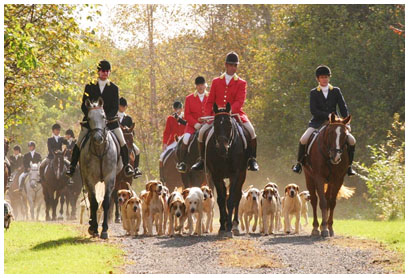
The fox-hunting costume is designed to be practical as well as handsome. The leaders of the hunt, that is, the MFH and the huntsman, wear scarlet coats so that they will be easily visible at all times, even in the midst of a deep forest. These scarlet coats are called pinks, not because of their hue, but because the original hunting coat was designed long ago by an English tailor named Pink. Sometimes an exceptionally good rider who has demonstrated skill, loyalty, and experience will be allowed to wear the scarlet coat, thus making it an object of prestige. Women (although this may soon change) are not allowed to wear scarlet coats unless they happen to be Masters of Foxhounds. They, as well as the rest of the field, customarily wear black, gray, or tweed jackets and tan breeches flared at the thigh and very tight at the calf, so as to be easily tucked into the high black or brown boots. The outfit is set off by a white stock, a sort of ascot that can be pressed into service as a bandage or sling in case of emergency; it is held in place by a simple gold stock pin placed horizontally, never vertically, to avoid injury to the chin. Hard headgear, either a derby or a black velvet hat, is always worn and is constructed to protect the wearer from low tree branches or a nasty tumble on the head; the crown is lined with cork or some other durable material. Finally, leather gloves are worn to save the hands from chafing reins, or string gloves in rainy weather.

The exact origins of fox hunting, both here and abroad, are clouded by incomplete and often contradictory facts and by fictions as well. But as Dixon Wecter points out in his Saga oj American Society, “Society has always adored both horses and dogs.” Thus it was only logical that when the fox—an animal who proved to be much cleverer than the stag or hare- turned out to be catchable by use of the combination, fox hunting became firmly entrenched in the aristocratic way of life. Hounds have always been kept for hunting purposes in Europe; for many centuries the stag, boar, and hare were pursued in one fashion or another, as witness the countless tapestries and paintings with this theme. And it appears that hounds were first used to hunt various and sundry pests, such as opossums, wolves, raccoons, and foxes, in the Colonies sometime in the second half of the seventeenth century.

The history of American fox hunting seems to fall quite naturally into several distinct time periods. The first encompasses the colonial days up until the Revolution. The sport at first consisted of the colonials and their untrained dogs chasing a fox now and then “in between Indian vigils.” By 1775 fox hunting was firmly entrenched as a somewhat organized sport. The next period ranges from 1781 to 1861, when foxes were hunted quite regularly by wealthy landowners in Pennsylvania, Maryland, and Virginia. A pack of hounds became as integral a part of a gentleman’s assets as his “horses, slaves and guns.”

From 1865 to 1906 many organized hunts sprang up, with seventy-six known in North America as of 1904, and the sport spread into the North and westward toward the Mississippi. With the establishment of the Masters of Foxhounds Association of America in 1907, fox hunting became increasingly regulated. Since then the sport has grown steadily in popularity.

On record, the first gentleman to have a pack of hunting dogs in the Colonies was a well-to-do Londoner named Robert Brooke, who arrived in Prince Georges County, Maryland, on June 3o, 1650, the recipient of a two-thousand-acre plot from Lord Baltimore to be developed into a successful plantation. Brooke settled in with wife, ten children, twenty-eight servants, and hounds. It is unlikely that the dogs were brought over for the express purpose of chasing foxes. Back in England they had probably served as harriers or all-purpose hunting dogs. In fact the first known packs of foxhounds were not recorded in England until 1666; they belonged to a Viscount Lowther. Others were reported belonging to Lord Arundell of Wardour in 1690 and to Thomas Boothby of Leicestershire in 1698. However, at this stage fox hunting was no more formalized a sport than was the shooting of squirrels. To understand this, we should take a look at Reynard himself.

The fox has always been the farmer’s enemy, and in those early days he was despised as vermin in the class of the rat or weasel, a thief of the worst sort whose wiles made it well-nigh impossible to keep him out of any chicken coop. The fox populations in both England and America were overrunning the countryside, so hunting was less a sport than a necessity.

There has always been some argument as to which kind of fox was hunted here and, in fact, was even native to the North American continent. Although some experts have it that only the gray fox was found here by the colonists and that red foxes were imported from England in the eighteenth century, this is contradicted by evidence supplied by naturalists at the Smithsonian Institution. They insist that the red fox is indeed indigenous to North America and can be found everywhere today except in the south Atlantic coastal region and Florida, the Pacific coast, the desert areas, and the midwestern plains. Although some English red foxes were imported, they were soon incorporated into our larger-sized strain. In any case the red fox, reputed to be more clever and more speedy than his gray relative, has always predominated in the mid-Atlantic and northern regions, whereas the gray prefers the warmer climes of the South. The gray fox is a better treeclimber than runner; thus he is a less desirable quarry because he doesn’t give his pursuers much of a chase.

Prior to the eighteenth century fox hunting was probably conducted on foot for the most part. At this time many families kept three or four dogs to destroy such marauders as wolves and foxes. The wolf was the first of these animals hunted with hounds and horses in Virginia and Maryland, probably because it was easier for a person on horseback to keep up with the hounds. When the wolf population became depleted in the eighteenth century, the fox was a natural replacement. One fox-hunting authority, J. Blan Van Urk, notes that a bounty on the red fox was recorded “as early as 1714 in New Jersey and 1723 in New York.” In the i73o’s a rising prosperity in Virginia and Maryland led many of the well-to-do to breed fine racehorses as well as hunting horses for sportive riding to hounds. People also began breeding hounds specifically for fox hunting; thus they became foxhounds. Hounds originally fell into four categories, all English strains: the staghound, the southern hound or bloodhound, the fox beagle, and the harrier. As these breeds were crossed and mixed, a good foxhound was eventually developed.

One of the early private hunting packs of pre-Revolutionary days employed strictly for hunting foxes belonged to Dr. Thomas Walker of Albemarle County, Virginia, later a member of the House of Burgesses. He founded the Castle Hill Hounds in 1742, having imported his dogs from England. Othei prominent colonials who maintained foxhound packs included Maryland’s Charles Carroll and George Calvert and Virginia’s Charles Lee and George Washington. Washington, not even excepting Jacqueline Kennedy Onassis, must be the best-known fox hunter of all time, and his diaries indicate a great enthusiasm for the sport. He was first introduced to it while in his teens by Lord Thomas Fairfax, who settled in Virginia in 1746. Fairfax was a devoted fox hunter who brought his horses and hounds with him from England. Between 1759 and 1774 Washington spent a great deal of time and effort breeding his own hounds, giving them such romantic names as Musick, Countess, and Truelove. He inspected his kennels twice daily and hunted the dogs several days a week from September until May. Often he would hunt with his neighbors’ packs as well. Mount Vernon was frequently aswarm with guests from near and far—mostly Maryland and Virginia- who rode with him to the hounds. They would take the field at dawn after a candlelight breakfast of corncakes and milk. A typical Washington diary entry of the time is one of January i, 1768: “Fox Hunting in my own Neck with Mr. Robt. Alexander and Mr. Colvill. Catched nothing.” And February 12 of the same year: “Went fox-hunting with Colonel Fair-fax, Capn. McCarty, Mr. Chichester, Posey, Ellzey and Manley, who dined here with Mrs. Fairfax and Miss Nicholas—catched two foxes.”

Washington cut a dashing figure in the field astride his favorite hunter, Blueskin. He possessed a wardrobe, as described by social historian Foster R. Dulles, of “riding frocks, waistcoats of superfine scarlet cloth and gold lace … elegant buckskin breeches … all specially made in England.” Martha, when she occasionally joined him, also wore scarlet.

Washington gave up the sport at the onset of the Revolution, of course. Afterward he tried to pick it up again; Lafayette even sent him a pack of French staghounds in 1785, although these proved unsatisfactory for fox hunting. But more urgent matters forced him to break up his kennels and give away all his dogs in 1787.

There were, however, other prominent Virginians who hunted foxes. Charles Lee was reputed to be so fond of his pack that he allowed the hounds to follow him everywhere, even to his host’s dining table when visiting (just as to his own). Little is recorded about Thomas Jefferson’s taste for the sport, although Van Urk says that while in his teens (1757), “attending the Reverend Mr. Maury’s School in Virginia,” Jefferson fox-hunted on foot with his classmates. “A little later, however, he rode to hounds and was both enthusiastic and capable.” But being more scholarly and serious than Washington, Jefferson did not become a lifelong devotee.

There were other fox hunters, however, who lacked the time or wherewithal to own a pack of dogs and so settled on the next best solution: the organized hunting club. The first such club, by all accounts, was established near Philadelphia on October 29, 1766: the Gloucester Foxhunting Club. Its initial meet was held on December 13 of that year, all twentyseven members gathering at the Philadelphia Coffee House on the corner of Front and Market streets. From then on, hunts were held regularly on Tuesdays and Fridays. The elite of Philadelphia hastened to join: Benjamin Chew, one-time chief justice of the Pennsylvania supreme court; James Wharton and John Cadwallader, scions of distinguished Philadelphia families; Thomas Mifflin, later a Revolutionary general and member of the First Continental Congress; and Robert Morris, financier and later United States senator from Pennsylvania, among others. Articles were drawn up including a call for dues of five pounds “current money” to be paid for the upkeep of the pack. When a fox was killed, the members took up a collection in a hat to give to the huntsman. In 1774 the members decided to add an air of elegance to their sport, adopting a uniform that consisted of a dark-brown coat with “lapelled dragoon pockets, white buttons and frock sleeves, buff waistcoat and breeches, and a black velvet cap.”

After 1780 dues rose to a rather steep thirty pounds annually. Although interrupted temporarily by the Revolution (during which twentytwo members formed the First Troop of the Philadelphia City Cavalry), the members continued to hunt thereafter for nearly a half century, and the present-day Rose Tree Foxhunting Club claims to be a direct descendant.

The opening of the hunt season in Washington, D.C., in 1828 prompted this poetic stanza in the American Farmer:


At the sound of the horn

We rise in the morn,


And waken the woods as we thunder along,


Yoix, yoix, tally ho!

After Reynard we go,


While echo on echo redoubles the song;

We waken the woods as we thunder along,


Tally ho, tally ho,

After Reynard we go,


While echo on echo redoubles the song.

On Long Island fox hunting was introduced shortly after the Gloucester Hunt began when an Englishman named John Evers began to hunt his own hounds near Hempstead in 1768. He imported dogs, horses, and huntsmen from the British Isles. The descendants of his hounds were used in the nineteenth century to form the Meadow Brook Hounds, one of whose chief backers was August Belmont, the New York banker and diplomat.

Hunting was enjoyed in Brooklyn as early as 1781, although no formally organized hunt existed there until 1856. A notice appeared in the Royal Gazette on November 14, 1781, reading: “Hounds will throw off at Denyse’s Ferry, on the estate of Denyse Denyse, Esq., at the Narrows [now Fort Hamilton] at 9 o’clock, Thursday morning, and a guinea will be given for a good, strong, bag fox.” (A bag fox is one brought to the hunt in a sack and turned loose. This practice is thought by many to be unsportsmanlike.)

In 1783 a subscription hunt (one where the members subscribe by paying dues), the St. George, was formed on Long Island. It listed such prestigious active members as Henry Astor, Alexander Hamilton, John Jay, Charles Lee, and George Washington. Most of the other older fox-hunting clubs were established in the 1800’s.

Fox hunting was slower to catch on in Puritan New England, although certainly individuals had maintained hounds for hunting on foot since the founding of the Massachusetts colony. (One resident, a Concord man, wasn’t so enthusiastic about the sport; he is quoted as saying that he considered hunting “a godless custom” and that he regretted the “bringing back of the red coats, which were driven out of Concord in 1775.”) The first organized hunt club in New England did not appear until 1866; it is the Millwood Hunt in Framingham, Massachusetts. A little later (1879) the Myopia Hunt Club grew out of Winchester, Massachusetts, and is now more famous, perhaps, for its polo matches. Tradition has it that its peculiar sobriquet was derived from the fact that nearly all the original members were nearsighted and bespectacled.

Even New York City, on the island of Manhattan, produced a hunting club, the Belvidere, shortly after the War of 1812. Edward Prime was the founder, and he called the meets in front of Cato’s Inn, situated at what is now Sixty-seventh Street and Third Avenue. Cato’s took its name from the owner, Cato Alexander, a popular black man who catered to the foxhunter trade.

The first American military hunting club originated far from the East—in Oklahoma, at Fort Gibson, in 1835. A number of ex-cavalrymen there found fox hunting an excellent diversion from daily routine. They did not, apparently, chase only foxes but pursued any animal that could run.

The decade of the 1870*5 saw a great burst of new hunting clubs. The year 1877 was the birth date of the Richmond County Hounds on Staten Island. Foxes were abundant there, and the island was said to be ideal for the sport. It consisted largely of farms and dairies with lots of fences, and scenting conditions were excellent. Not one farmer denied the hunt permission to ride over his land. In turn, the Master held a Farmers’ Ball and supper each year to be sure to stay on the good side of the landowners.

In Maryland, a state still renowned for its beautiful horses and horse country, the Elkridge Hunt was formed in 1878. It soon had a rival in the Harford Hunt (with which it has since merged), but the oldest Baltimore families at first refused to patronize the latter because it was started by one Foxhall Keene and some Long Island friends. The thirdoldest hunt in Maryland, the Green Spring Valley Hunt, introduced in 1894 the Maryland Hunt Cup, a point-to-point steeplechase run over four miles of high fences, water ditches, and other unpleasant obstacles. The race was the result of an argument among five Baltimore horsemen as to who had the best hunter in the neighboring area. (Incidentally, the word “steeplechase” comes from the old custom of using a church steeple as the goal of a race.) The Hunt Cup was so popular at one point that in 1928 special trains were run from New York and Philadelphia to carry the racing enthusiasts to Baltimore, and local hotels were booked solid. Even today the race engenders a weekend of parties and social events, picnics, and other festivities, although many viewers are so full of spirits by the time the race takes place that they are either uninterested in, or perhaps incapable of, watching. According to Dixon Wecter, one prominent Green Spring Valley devotee of the late nineteenth century was General Felix Agnes, “an Irish boy who had come over steerage, saved enough to buy an interest in a newspaper, risen to great affluence in business, and more because of his blarney and personal charm than increasing wealth became a favorite of Baltimore society. In Green Spring Valley he kept a vast establishment with a black boy to wait on every guest, and computed that 10,000 mint juleps were required to run it from Friday to Monday.”

There are, of course, many other hunting clubs in America founded during the last two centuries; there are even two organized hunts in California at present, but foxes are scarce due to the arid climate of the state. And there are many stories connected with the eccentricities of those who have followed the sport. Dr. Rush Shippen Huidekoper, a founder of the Rose Tree Hunting Club, near Philadelphia, had a fantastic hunter named Pandora. He thought of her as such a rare piece of horseflesh that upon her death he served her up in steaks to some friends at a dinner at his club.

There are others who are devotees to the utmost, such as one Master of Foxhounds who said in 1933: “Foxhunting is not merely a sport—and it is more nearly a passion than a game. It is a religion, a racial [sic] faith. In it … is … the attempt at escape from life as it is to life as we would have it.”

There also are those who scorn the sport as atavistic or absurd and mock it much as William Shenstone, the English poet, did in 1760. He observed: “The world may be divided into people that read, people that write, people that think, and foxhunters.” Certainly the sport’s excessively proper and rigid structure would invite humorous remarks by the disdainful, such as Oscar Wilde’s caustic quip describing fox hunting as “the unspeakable in full pursuit of the uneatable.” Despite all of its excess of folderol, fox hunting really remains an exciting sport for which it is easy to become an avid and lifelong enthusiast.

http://www.myopiahunt.com

http://www.guilfordhounds.com/

http://nashobavalleyhunt.org/

Legend of the Temple of Nine Wells


Before the Beginning of Beginnings
Before the Birth of the Aeons
Before even the Great Night of Time
In Rhythm and Motion
The Source of Sources awakened
and Life stirred
From One came Two, Spirit and Matter
Inextricably, Eternally Merged.
The Two Holy Primal Powers of Goddess and God
Attained Self-Awareness.
In Sacred Union and Divine Embrace,
Together they begat Mind and Cosmos
and the very Spirit of Life itself.
From their Union came forth
Those Central Sparks of Light, Love and Life.
Once again, She gave birth
That Great Womb of Worlds,
Once again the Twain became One.
The Great Mother gave birth to the Child of Promise
and the Cycle of Existance began.

Many are the Names and Aspects of the Great Mother,
Yet She is One.
Many are the Names and Aspects of the God,
Yet He is One.
Polar Powers, Eternal Balance
Goddess and God,
In Union they are One.

Then Light, Love and Life
In Triune expression
Flashed forth Seven Rays and Nine Vessels to hold and contain Them
To concentrate, emanate and dispense
The varied blessings pouring forth
From the Source of All Sources
And those Blessed Wellsprings we invoke here this night…

The Well of Wisdom
The Well of Healing
The Well of Empowerment
The Well of Magick
The Well of Love
The Well of Understanding
The Well of Beauty
The Well of Peace
And The Well of Wholeness

From Within to Without
Let these Rays shine forth from this place
And may all who join us in worship at the Temple of Nine Wells
And partake of these sacraments
Share in their Blessings, Virtues and Delights.

So Mote It Be!


Rev. HP Rich Ravish
Temple of Nine Wells – ATC ©2001 

1. Make me a channel of your peace.
Where there is hatred, let me bring your love.
Where there is injustice, your pardon, Lord,
And where there’s doubt, true faith in you.
2. Make me a channel of your peace.
Where there’s despair in life, let me bring hope.
Where there is darkness only light,
And where there’s sadness ever joy.
3. O Master, grant that I may never seek
So much to be consoled as to console,
To be understood as to understand,
To be loved, as to love, with all my soul.
4. Make me a channel of your peace.
It is in pardoning that we are pardoned,
In giving of ourselves that we receive,
And in dying that we’re born to eternal life.
1. Hazme un instrumento de tu paz,
donde haya odio lleve yo tu amor,
donde haya injuria, tu perdón, Señor,
donde haya duda fe en ti.
2. Hazme un instrumento de tu paz,
que lleve tu esperanza por doquier,
donde haya oscuridad lleve tu luz,
donde haya pena tu gozo, Señor.
3. Maestro, ayúdame a nunca buscar
el ser consolado sino consolar,
ser entendido sino entender,
ser amado sino yo amar.
4. Hazme un instrumento de tu paz,
es perdonando que nos das perdón,
es dando a todos que tú nos das,
y muriendo es que volvemos a nacer.

May today there be peace within.
May you trust God that you are exactly where you are meant to be.
May you not forget the infinite possibilities that are born of faith.
May you use those gifts that you have received and pass on the love that has been given to you.
May you be confident knowing you are a child of God. Let this presence settle into your bones and allow your soul the freedom to sing, dance, praise and love. It is there for each and every one of us.