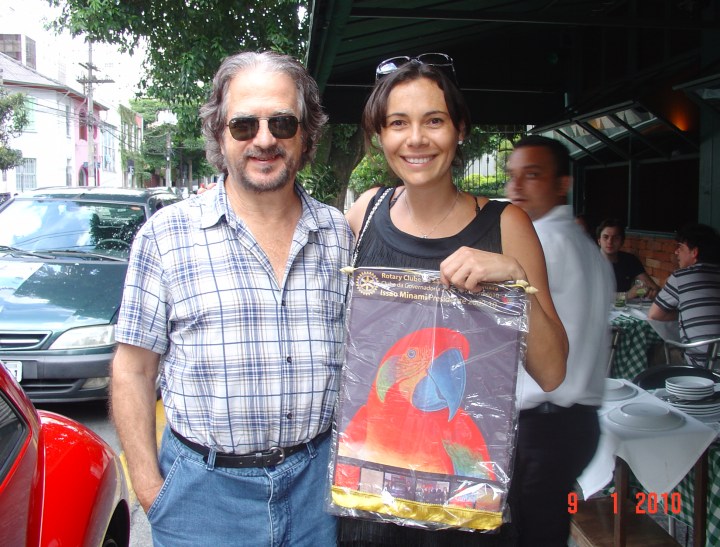
PALESTRA FEITA POR ADRIANA SASSOON NO ROTARY CLUB JABAQUARA.
CLAUDIO TOZZI & ADRIANA SASSOON
Por Daniel Pereira,
As sacolas plásticas ou saquinhos de supermercado são uma praga moderna que devem aos poucos ser abandonadas por nós. Uma praga pois, qualquer coisa que compramos no supermercado, é embalada nela. Os saquinhos plásticos são derivados de petróleo, substancia não renovável feita de uma resina chamada polietileno de baixa densidade PEBD e sua degradação no ambiente pode levar séculos, ou seja, nossos s tataranetos vãos se deparar com os saquinhos que nós jogamos fora hoje. No brasil 9.7% do lixo é compósto por sauinhos de lixo e a sua produção é nociva para o meio ambiente, pois para produzir uma tonelada de plástico é necessário 1 140 kw/hora (7600 residencias iluminadas com lampadas economicas por uma hora).
Outra coisa nociva: a poluição dos mares e dos rios por este tipo de lixo. os saquinhso plásticos csão confundidos por peixes e pelas tartarugas por exemplo, com águas vivas que são alimentos e ao ingerir os plásticos, iamginem o que acontecem com os peixes e tartarugas. No espaço do projeto Tamar podemos ver expostos cadaveres de animais mortos desta forma.
Os saquinhos também provocam entupimentos em bueiros e contribuem para reter mais lixo. Quando incinerados, os sqaquinhos liberam toxinas perigosas para a saúde.
A grande idéia é irmos susbstituindo aos poucos, como diz o companheiro Pablo, os saquinhos por outras formas, como sacolas não desacartáveis, do mesmo modo que foram substituindo os nossos saqinhos de papel. Uma dica é pois levar seja ao supermercado, a quitanda, a feira ou a padaria, uma sacola própria para fazermos as compras. Eu me lembro de uma sacola de feira muito forte e tambérm uma tipo “embornal” que minha mãe costurava e ela sempre carregava.
Outra coisa é utilizar caixas de papelão quando a compra é grande ou se compramos verduras.
Ora poderemos sim, repensar os armazenqamentos de nossas compras sim. Na Europa os costumes já começaram a mudar. Na Alemanha por exemplo, o sujeito que não levar sua própria sacola os uspermercados pagam um preçoa bem alto por cada saco que utiliza. Na Irlanda e na Inglaterra já temos sacolas biodegradáveis.
As ecobags – sacolas retornáveis poderãos ser cada vez mais adotadas pelos supermercados – são ecologicamente corretas e, em alguns casos, visualmente atrativas para os consumidores. O consumidor não criou ainda o hábito de substituir as antigas sacolas plásticas. A discussão sobre a troca dos sacos em Natal no RN foi calorosa , com a aprovação na Assembleia Legislativa de uma lei que obriga os supermercados da cidade a eliminarem em, no máximo dois anos, os plásticos para carregar compras.
Das empresas locais às redes de abrangência nacional, as bolsas ecológicas já fazem parte do dia-a-dia dos consumidores nos supermercados de Natal. Geralmente, elas ficam posicionadas junto aos caixas, uma forma de estimular o consumidor a adquiri-las. O valor das sacolas são variáveis: em algumas redes elas são vendidas por menos de R$ 1 mas há opções que chegam perto de R$ 2,50. A maior parte é feita de algodão cru, mas há opções também de plástico mais resistente que pode ser reutilizado.
Nas lojas do Extra em Natal, a redução do uso de sacolas plásticas já chega a uma média de 20%. “Este resultado é fruto do trabalho que o hipermercado tem realizado junto aos seus clientes, estimulando a utilização de sacolas retornáveis e evitando o desperdício das embalagens plásticas”, disse Messias Lima – gerente da loja do Midway Mall,. O percentual vem somar ao balanço geral que o Grupo Pão de Açúcar acaba de liberar de suas 597 lojas do Brasil, que ao todo conseguiram uma economia de 35% de sacolas plásticas no este ano se comparado ao mesmo período do ano passado.
Autor do projeto de lei que foi aprovado ontem na AL, o deputado estadual Paulo Davim declara que é preciso uma ação rápida dos supermercados para substituir os plásticos. A nova lei admite que sejam utilizados produtos biodegradáveis, papel ou outros tipos de opções para o consumidor. “O plástico demora milhares de anos para se decompor. Precisamos substituí-los o quanto antes.
Em Bauru, no interior paulista onde meu filho Yuhu estuda, pude rpesenciar os estudantes portando embornal de algodão para os seus trotes e depois para carregar livros.
Assim, em São Paulo já sentimos alguns movimentos nos entido de reduzir o numero de sacos plásticos e uma campanha de esclarecimento a população precedida de ações como utilizar suas próprias sacolinhas nos parece muito adequada e apropriada. Companheiros temos que começar algum dia. Pablo term razão. Podemos começar já!.
Visitamos, neste fim de semana, após um almoço no D.Pepe di Napole na bela companhia dos artistas Cláudio Tozzi e Caciporé e da querida eterna Adriana Sassoon, o projeto que o arquiteto Isay Weinfeld fez para o Havaianas Store na Oscar Freire . Vi que a proposta de utilizar uma ecobag é genial. As mulheres percorrem o espaço com uma sacola pendurada e vao comprando e colocando tudo na sacola.
*Adriana é adepta dos movimentos ambientalistas e tem uma griffe de produtos e achou muito boa a idéia da sacola retornável e até posou com a imagem do artista Claudio Tozzi para dar uma ideia de como poderia ser uma eco-bag com o papagaio do Claudio estampando uma delas.
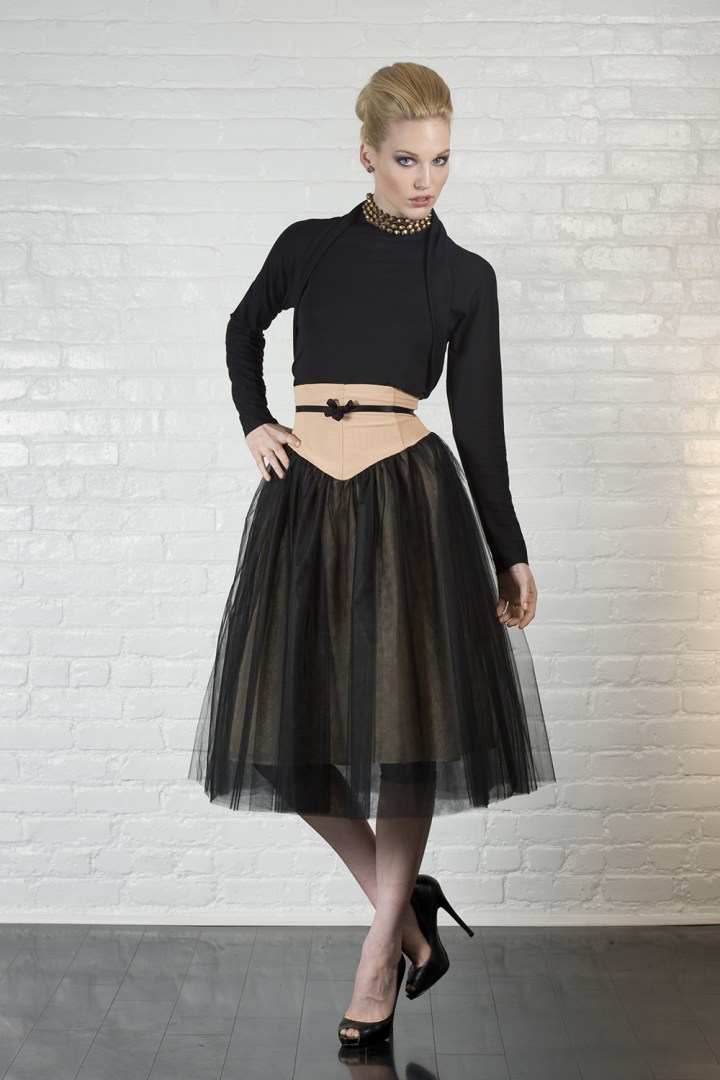
Callula Lillibelle Designed by William Calvert Fall 2010
Melanie Hart and William Calvert co-design all the pieces. Willian Calvert, of The Fashion Group International Rising Star Award winner and designer for the American Haute Couture fashion house Callula Lillibelle named after Hart’s daughter Callula.
“Callula Lillibelle’s collection from desk to dinner. Simplicity is the key ingredient for my friend Melanie’s collection.The collection was inspired by the Tippy Hedren .Melanie, I wish you success on your new venture!
Vidal Sassoon é um cabeleireiro inglês, nascido em Londres, em 1928. Nos Estados Unidos estudou na universidade de Nova Iorque. Como cabeleireiro, notablizou-se por ter criado uma forma de penteado baseada na Bauhaus e nas formas geométricas.Vencedor de vário prémios, foi presidente da Multinacional Vidal Sassoon, presidente da Fundação Vidal Sassoon .
Influence in hairstyling
Sassoon’s works include the geometric, the wash-and-wear perm, and the “Nancy Kwan.” They were all modern and low-maintenance. The hairstyles created by Sassoon relied on dark, straight, and shiny hair cut into geometric yet organic shapes. In 1963, Sassoon created a short, angular hairstyle cut on a horizontal plane that was the recreation of the classic “bob cut.” His geometric haircuts seemed to be severely cut, but were entirely lacquer-free, relying on the natural shine of the hair for effect. Sassoon is a father of modernist style and has also been a key force in the commercial direction of hair styling, turning its craft in to a multi-million dollar industry.
He was a very influential person to people all over the world; especially those who have become cosmetologists. By the early 1980s, after moving to the United States, Sassoon had sold his name to manufacturers of haircare products and the multinational Procter & Gamble was applying his name to shampoos and conditioners sold worldwide. Former salon colleagues also bought Sassoon’s salons and acquired the right to use his name, extending the brand in salons into the United Kingdom and United States. However, in 2003, it was reported that Sassoon was suing Procter & Gamble for destroying his brand by skimping on marketing in favor of the company’s other hair product lines, notably Pantene. Also in 2002, the chain of Vidal Sassoon salons was sold to Regis Corporation. By 2004, it was reported that he was no longer associated with the brand that bears his name.[citation needed]Vidal Sassoon has authored several books, including A Year of Beauty and Health co-written with his former wife, Beverly Sassoon. He also had a short-lived TV series called Your New Day with Vidal Sassoon in the late 1970s.
Family
In 1967, Vidal Sassoon married Beverly Adams. They had four children,CATYA, ELAN, EDEN including an adopted son DAVID. One daughter, actress Catya Sassoon, died of a drug overdose on January 1, 2002. The couple divorced in 1980.
Quote
“
Hair is nature’s biggest compliment and the treatment of this compliment is in our hands. As in couture, the cut is the most important element … haircutting simply means design and this feeling for design must come from within.
”VS
“
The only place where success comes before work is in the dictionary.
”VS
SASSOON STYLING PRODUCTS
Vidal Sassoon stands for Very Simple and Very Stylish! Vidal Sassoon is the consumer brand that experts use when it comes to delivering fabulous haircare. The best of technology is used by Vidal Sassoon to deliver the ultimate in hair styling product expertise. Vidal Sassoon’s products are for the modern individual with the know-how and expectation of living in the 21st century.
Vidal Sassoon’s hair styling products are renowned in the world of fashion for bringing style and confidence to today’s image conscious consumer. Innovation, experience and value are all top of the agenda with Vidal Sassoon, the world leading authority on haircare.
Vidal Sassoon brings the vital hair styling tools for the modern sophisticate enabling you to create those elegant, silky and shiny looks.
Education: Studied sculpture at l’École des Beaux Arts, Paris.
Family: Adopted son, Gérard Benoit-Vivier.
Military Service: Performed military service, 1938-39.
Career: Designed shoe collection for friend’s shoe factory; opened own , 1937, designing for Pinet and in France, Miller and Delman in U.S., Rayne and Turner in UK; designed exclusively for Delman, New York, 1940-41 and 1945-47; studied millinery, 1942; opened New York store, Suzanne & Roger, with milliner Suzanne Remy, 1945; returned to Paris, 1947, designing freelance; designed for Dior’s new shoe department, 1953-63; showed signature collections, from 1963; reopened own business in Paris, 1963; designs collections for houses, including Grés, St. Laurent, Ungaro, and Balmain; resigned with Delman, 1992-94; new licensing with Rautureau, 1994; opened new Paris boutique, 1995.
Exhibitions: Musée des Arts de la Mode, Paris, 1987 [retrospective]; Nina Footwear Showroom, New York, [retrospective], 1998; Folies de dentelles, Musée des Beaux-arts et de la dentelle, Alençon, France, 2000.
Awards: Neiman Marcus award, 1961; Daniel & Fischer award; Riberio d’; honored by Nina Footwear, 1998.
Died: 2 October 1998, in Toulouse, France.
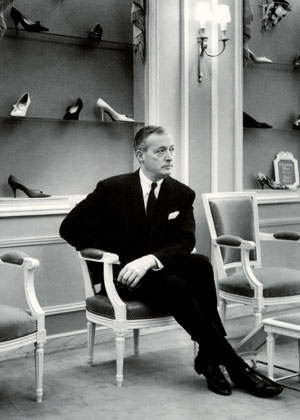
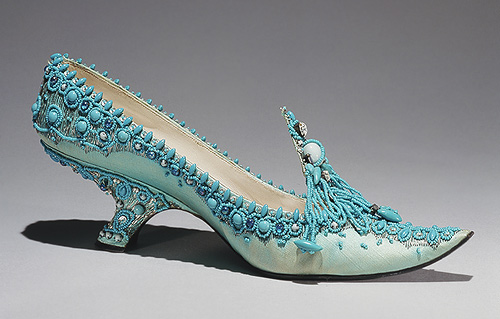
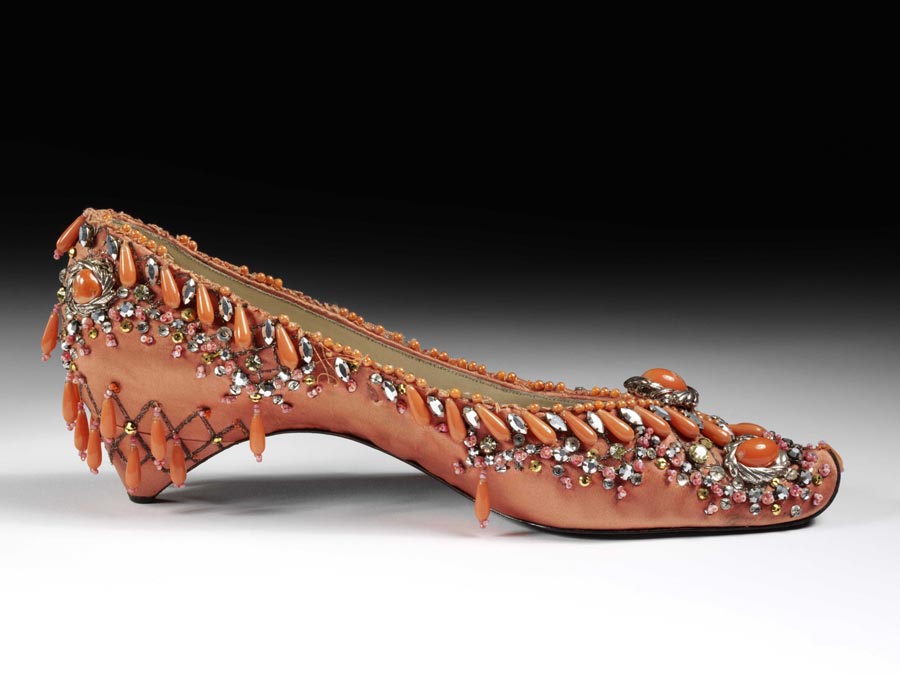
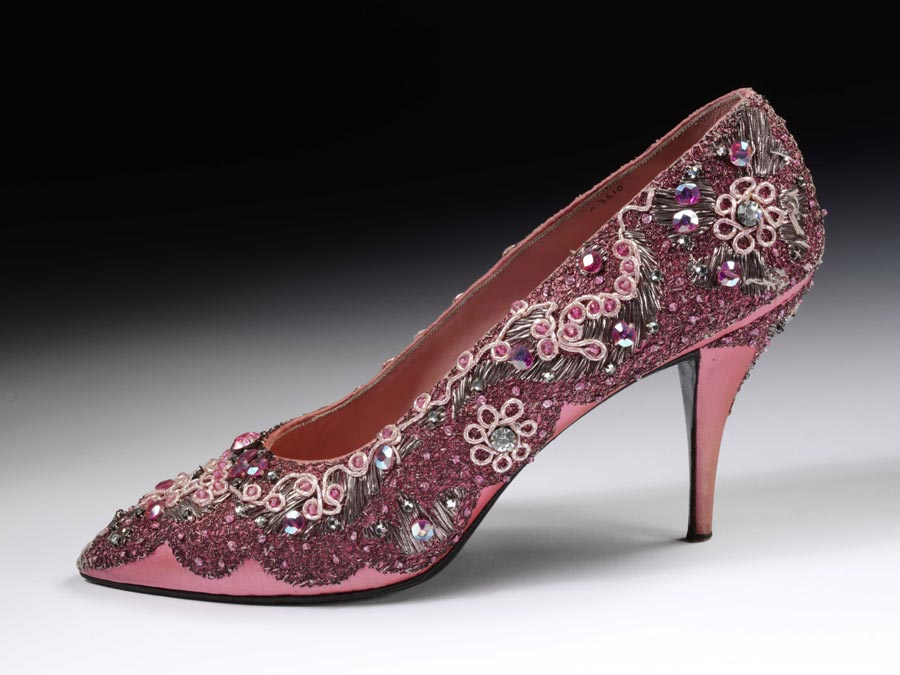
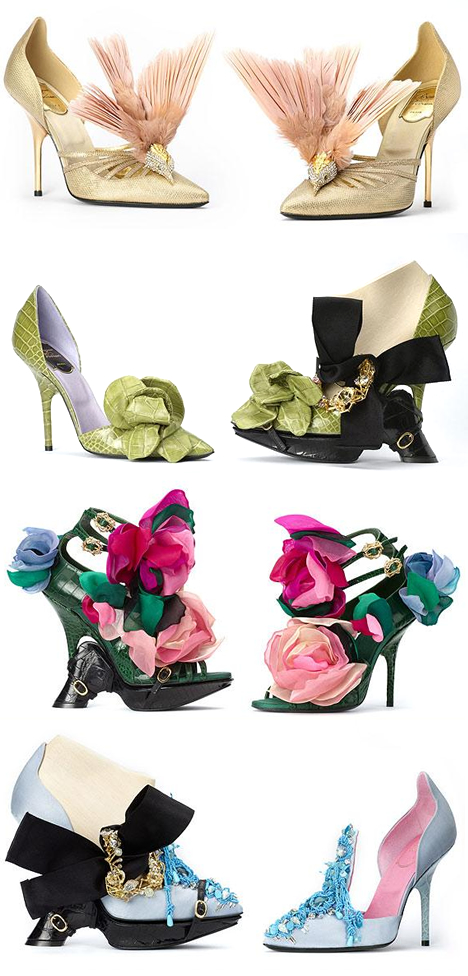
Roger Vivier was perhaps the most innovative shoe designer of the 20th century and beyond. Vivier’s shoes have had the remarkable ability to seem avant-garde yet destined at the same time to become classics. He maintained an eye for the cutting edge of fashion for six decades. Vivier looked back into the history of fashion and forward to the disciplines of engineering and science for inspiration. The shoes may seem shocking at first; however, it is the way they complete the that has made Vivier so coveted by top fashion designers for decades. With a sophisticated eye for line, form, and the use of innovative materials, Vivier created worn by some of the most and prestigious people of both the 20th and 21st centuries, among them Diana Vreeland, the Queen of England, and Marlene Dietrich.
Vivier worked with some of the most innovative fashion designers, such as , Christian Dior, and Yves Saint Laurent, at the height of their careers. Schiaparelli was the first designer to include Vivier’s shoes in her collections. Vivier was working for the American firm Delman at the time; Delman rejected Vivier’s sketch of the shocking platform shoe which Schiaparelli included in her 1938 collection. In 1947 Vivier began to work for and the New Look brought new emphasis to the and foot. Vivier created a number of new shapes for Dior, including the and the heel. During their ten-year association, Dior and Vivier created a golden era of design. In the 1960s Vivier created the low heeled “pilgrim pump” with a square silver , and this shoe is often cited as fashion’s most copied footwear.
Vivier was one of the first designers to use clear plastic in the design of shoes. His first plastic designs were created in the late 1940s after World War II; however, in the early 1960s he created entire collections in plastic. Vivier popularized the acceptance of the thigh-high boot in the mid-1960s, a fashion considered for women. Vivier teamed with Delman again in 1992, and the mood his later collections continued to be imaginative and forward thinking. Drawing his inspiration from nature, contemporary fashion, the history of fashion, painting, and literature, Vivier updated some of his earlier designs and was constantly creating new ones to challenge the ideas of footwear design.
Vivier studied sculpture at the École des Beaux-Arts in Paris and later apprenticed at a shoe factory. It was this solid base of training in both aesthetics and technical skills that led him to become known for precision fit as well as innovative design. A Vogue ad for his shoes in 1953 educates the viewer to look beyond the design. Showing the shoes embraced in callipers and other precision tools the ad read, “Now study the heel. It announces an entirely new principle—the heel moved forward, where it carries the body’s weight better.” In another ad from Vogue (1954) the experience of owning a pair of Vivier shoes was likened to owning a suit or dress, “a perfection of fit and .”
Vivier’s shoes not only had the ability to complete a silhouette with an that made a whole, but the beauty of their line, form, and made them creations that stood alone as objects of art. Vivier’s strong combination of design and craftsmanship allowed his shoes to stand prominently in the permanent collections of some of the world’s most prestigious museums—the Costume Institute of the Metropolitan Museum of Art, New York; the Victoria & Albert Museum, London; and the Musée du Costume et de la Mode of the Louvre, Paris.
In 1994 the 86-year-old Vivier signed a new licensing agreement with Rautureau Apple Shoes, which in turn allowed him to open a in Paris the following year. The Rautureau venture gave Vivier the backing to continue doing what he loved most—designing shoes. Yet three years later, in October 1998, Vivier died in Toulouse, France. He was remembered by many, including fellow shoe designer , who told People magazine, “People try to copy him, but it’s impossible to find that mix of technical skill and design.” Kenneth Jay Lane, who had worked with the master , declared, “He was the world’s greatest artist of shoe design.”
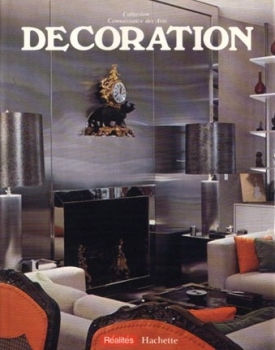
An invaluable collection of great design! Offering a range of styles, the interiors represent the best from the late 1960s into the first years of the 70s. Included are Britwell Salome’s estate designed by David Hicks, Federico Forquet’s apartment in Rome, Roger Vivier’s apartment in Paris, Maurice Rheims’ apartment in Paris, Lagerfeld’s Paris apartment including the bathroom, Valentino’s apartment in Rome, Chateau Mouton-Rothschild, Count Panza’s apartment in Milan, the Paris home of Quasar and Emmanuelle Khanh, and the apartment of Gunther Sachs in the Palace Hotel in Saint-Moritz. This collection profiles the work of Serge Royaux, David Mlinaric, Jacques Thual, Aldo Jacober, David Hicks, Jean Dive, Piero Pinto, Michel Cruchot, Gerard Gallet, Alberto Pinto, Yves Vidal and Charles Sevigny, Anita Bachman, Michel Boix-Vives, Alain Demachy, Jacques Demachy, Jay Spectre, Marc du Plantier, Yves Houdin, Francois Catroux, John Stefanidis, Henri Samuel, Didier Aaron, Jean-Paul Faye, Gae Aulenti, Gerard Gallet, Jacques Simon, Pierre Sels, Paolo Tommasi, Michel Boyer,Maria Pergay, Isabelle Hebey, Martine Dufour, Andre Putman, Francois Arnal and Atelier A, Nanda Vigo, architect Claudio Dini, architect Michel Sadirac, architect Carla Venosta, architect Lawrence Michaels, architect Arthur Finn, and the Swiss house by Marcel Breuer.
Left to right: Creative Director Bruno Frison with Ines de la Fressange; A display of Roger Vivier shoes; Diego Della Valle, CEO of Tod’s Group.
INES DE LA FRESSANGE
Inès Marie Lætitia Églantine Isabelle de Seignard de la Fressange (born 11 August1957), is a French supermodel and designer of fashion and perfumes.
She was born in Gassin, Var, France. Her French father, André de Seignard de La Fressange (b. 1932) (a marquis), was a stockbroker, and her mother, Cecilia Sanchez-Cirez, was an Argentine model. She grew up in an 18th-century mill outside Paris with three brothers. Her grandmother was Madame Simone Jacquinot, heiress to the Lazard banking fortune.
In the 1980s, she became the first model to sign an exclusive modeling contract with an haute couture fashion house, Chanel, by fashion designer Karl Lagerfeld, whose muse she became. However, in 1989, Lagerfeld and De la Fressange had an argument and parted company. Likely this argument was, at least in part, regarding her decision to lend her likeness to a bust of Marianne, the ubiquitous symbol of the French republic. Lagerfeld reputedly condemned her decision, saying Marianne was the embodiment of “everything that is boring, bourgeois, and provincial” and that he would not dress up historic monuments.
In 1990, she married Luigi d’Urso (d. March 23, 2006), an Italian railroad executive, with whom she had two daughters.
Currently, De la Fressange does not model very often. Instead, she is a businesswoman with a chain of clothing boutiques, a designer, and a consultant for Jean-Paul Gaultier. She presented a creation by Gaultier for his Spring/Summer 2009 haute couture collection at the Paris Haute Couture Fashion Week and walked the runway for Gaultier during the event, at age 51.
PUBLICATIONS
By Vivier:
Books
Vivier, Paris, 1979.
Vivier, Roger, and Cynthia Hampton, Les souliers de Roger Vivier [exhibition catalogue], Paris, 1987.
On Vivier:
Books
Swann, June, Shoes, London, 1982.
McDowell, Colin, Shoes: Fashion and Fantasy, New York, 1989.
Trasko, Mary, Heavenly Soles: Extraordinary Twentieth-Century Shoes, New York, 1989.
Provoyer, Pierre, Vivier, Paris, 1991.
Pringle, Colombe, Roger Vivier, New York & London, 1999.
Musée des Beaux-arts et de la dentelle, Folies de dentelles, [exhibition catalogue], Alençon, France, 2000.
Articles
Cassullo, Joanne L., “Four Hundred Shoes,” in Next, December 1984.
Bricker, Charles, “Fashion Afoot: Roger Vivier, the Supreme Shoemaker Comes to New York,” in Connoisseur (New York), December 1986.
Buck, Joan J., “A Maker of Magic,” in Vogue (New York), December 1987.
“Styles,” in the New York Times, 9 August 1992.
Weisman, Katherine, “Rautureaus Sell Stake; Ink Vivier Deal,” in Footwear News, 28 February 1994.
Menkes, Suzy, “Master Cobbler Sets Up Shop Again,” in the International Herald Tribune, 24 January 1995.
Baber, Bonnie, et al., “The Design Masters,” in Footwear News, 17 April 1995.
Weisman, Katherine, “Roger Vivier, 90, Mourned by Shoe World,” in Footwear News, 12 October 1998.
“Died, Roger Vivier,” in Time, 19 October 1998.
“Roger Vivier, France’s Footwear Extraordinaire,” [obituary] in People, 26 October 1998.
Carmichael, Celia, “Legendary Status: Nina Honors the Creative Genius of Roger Vivier,” in Footwear News, 21 December 1998.— Dennita Sewell; updated by Sydonie Benét
*I always loved Roger Vivier’s designs.Takes me back in time. Is romantic, aristocratic and timeless.Thirteen years ago, I did a project called Palais Royal and Roger and Chanel were my inspiration.
Adriana Sassoon has a unique background in fashion and beauty and is one of those rare people – whether behind the scenes or in front of the camera- that achieves what she sets out to accomplish. At age thirteen, an age at which a young person’s ideas are still fluid, she knew she had a particular fondness for the classical disciplines. She was already flirting with fashion working as a top model for Elite Model Management where her beauty appeared in countless magazine advertisements, fashion shows, and television commercials.
From her native Sao Paulo, Brazil, Adriana graduated “The Ecole desBeaux’s- Arts” with her first degree in Industrial Design before arriving in the United States where she received a second degree in Interior Design from the FIDM Los Angeles.
Adriana, who is fluent in Portuguese, Spanish, French and English, has an elite work history.
A Docent for the French Trade Commission Exhibition “Les Paris desCreateurs”.
Adriana always kept a close eye on fashion. “I pick up on its vibrations”. Adriana embarks into the realm of fashion accessories as she proudly introduces her latest project.
The creation of “Adriana Sassoon Handbags” is a supported idea by her family and friends.
Adriana Sassoon has a Handbag Company with the focus in Minimalist Design. The main ingredient is to help a Charity founded by her father and mentor as well as charities that work with children of developing countries”…. .
“If I can make a difference by doing what I love and being able to help others in need, what a marvelous accomplishment!AKS.
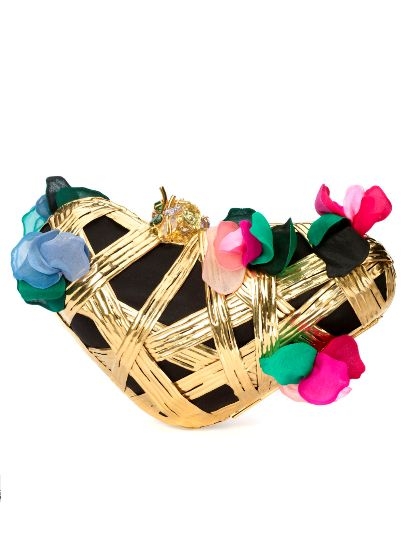
The collection created by Adriana Sassoon Scarf Handbags was inspired by one of the founders of the Vienna Secession association. Koloman Moser was born in Austria and became a famous architect, designer, and painter. He was a very important figure in the initiation process of the movement after joining Klimt, Schiele, and Kokoschka. The Adriana Sassoon Handbag debut Collection combines predominantly geometric features creating a rhythmical space of cubic forms in which the bags were designed. The strong contrasting colors of the flower and circular scarf patterns compliment the overall design. The ornamentation of the bags is finalized by a Swarovski broach, symbolizing the feminine figure. The Jugendstil style or Young Style (+/- 20 years) so called in Germany or otherwise known as Art nouveau in France, started at the end of the XIX century. I chose this particular style to begin my collection to celebrate the freedom we enjoy now. I am paying homage to the artists that had to fight in order to live their dreams in an age in which the Nazis closed the famous Bauhaus of Dessau. Many atrocities were done to the human race during that period and unfortunately still exist. The collection celebrates the new Parisian trend amongst boutiques, opened by architects and designers, who want more than just being able to create beautiful clothes or buildings. I would like the artistic community to be recognized by ones work and not just as a label or mere product. I think that one must protest against the so-called business individuals who purchase art and/or a craft business, and change the designs to appeal to a commercial mass market. This movement is killing branding images and any form of association with the original concept from the designer. Through my work I would like to utilize an artistic vehicle to reiterate the rejection of the “plastic society”. The phrase “less is more” needs to truly take shape in the 21st century. The business world can work in tandem with the art world by joining forces and understanding each other’s strengths. The final creations will then take form and are better then the work we see today. The human community needs to pray for peace and protest war as the artistic movements have done in the past.
I would like be able to communicate with my buyers and call their attention to what we all know matters in life after all. We are all human beings and must treat each other well. In starting this adventure I will be able to help other people and create a better world to live in. Every one of us has to try to make a difference. To find more information about The Vienna painters “Klimt, Schiele, Moser, & Kokoschka Vienna 1900” the “Galleries Nationales du Grand Palais” in Paris presented an exhibition. The exhibition was held October 2005 to January 2006 or can be studied online at http://www.paris.org. The main sponsor was LVMH.
Hand Bags: Made with 100% genuine leather.*
Scarves: Made with 100% Viscose fabric .*
Description of Products:Design- Attention to design and up to date pieces an ever-changing collection.It isn’t just a bag it is a product with a purpose!
Purpose- The collection celebrates the new Parisian trend amongst boutiques opened by architects and designers who want more than just being able to create beautiful clothes, or buildings. To be able to be recognized by ones work not just as a label or mere product. Sassoon goes beyond Salon.–A label with the sole focus on environmental awareness.
The collectible Handbags – Please keep in mind this is not the type of product intended to mass-produce. The Designer chose to keep it very Artesanal. Therefore the products will have a particular feel and look.The Scarf Bag is not just a standard bag. Is a Bag that by itself dresses an individual.The Scarf bag an innovative way of utilizing a Bag. You can also dress your own Bag for any occasion by changing the scarves.
Charities
“Adriana Sassoon” started as a company whose principles are founded in basic human need for charity. Adriana’s main purpose is to be able to help a charity founded by her father in Brazil. A charity that has helped many children discover education and learn to survive and thrive within their own communities. Ame Amoroso has over 280 children that need constant care. Adriana prides herself in being able to help those children find a future. Adriana will also help other charities that need help in the form of product donation. The product can then be sold and the proceeds used to help that charity in need.
* A percentage of the profit goes for the AME AMOROSO charity for each handbag sold.Web Site:
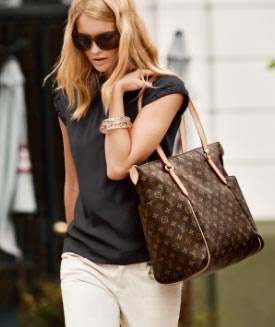
Luxury bags fall victim to their own success; exclusive over ostentatious
By CHERYL LU-LIEN TAN and RACHEL DODES
Irene Weisburd used to buy 20 handbags a year, dutifully getting on waiting lists for the season’s designated “it” bag and filling her “bag wardrobe” with Fendi Baguettes, a Louis Vuitton Murakami bag and Prada nylon backpacks.Recently, however, she has bypassed popular styles such as last fall’s Gucci Indy bag and the ubiquitous Fendi ‘B’ bag in favor of unadorned pieces from Bottega Veneta and lesser-known labels such as New York’s MZ Wallace.
“I felt like, ‘Gee, all these bags are so attainable by a lot of people that everyone’s carrying around that bag,’ ” says Ms. Weisburd, a 59-year-old homemaker who lives in New York City. “I wanted something that was more exclusive.”
For the past 10 years or so, fashion houses have churned out expensive bags with distinctive shapes and logos in the hopes that they’d catch on as that season’s sensation. Consumers, seeking the status a recognizable bag conferred, flocked to buy them, helping to fuel the recent luxury boom.
But as big luxury brands have expanded world-wide, offering more entry-level products to reach more consumers, some high-end shoppers are getting turned off. The proliferation of knockoffs has helped erode the mystique of owning a high-end bag. Affluent customers have grown confident in their own sense of style and increasingly turning to unique accessories to set themselves apart from the crowd. On top of that, the recent stock market selloff and downturn in consumer spending has many consumers shunning spending that could be considered ostentatious. As retailers head into the new year, some are declaring that “it” is over.
“The ‘it’ bag isn’t important any more,” says Stephanie Solomon, women’s fashion director at Bloomingdale’s. “It’s all about looking different from your neighbor.”
Instead of one hot, recognizable style, retailers this spring will be pushing a variety of styles and brands, many of them lesser-known. Intermix, a high-end New York-based retail chain, is making a big push for handbags from labels such as Zagliani and Lanvin. Scoop is stressing Jamin Puech, Whiting & Davis and other relatively unknown, expensive brands. For spring, Henri Bendel is picking up LVMH Moët Hennessy Louis Vuitton’s brand Loewe, which is popular in Asia but hasn’t been widely sold in the U.S.
Adriana Sassoon has a Handbag Company with the focus in Minimalist Design. The main ingredient is to help a Charity founded by her father and mentor as well as charities that work with children of developing countries “.The bags are very exclusive and they range between $295 – $1,000.
Adriana Sassoon red tote $1,000. At FIDM fashion Museum store Los Angeles, The studio, Boston.
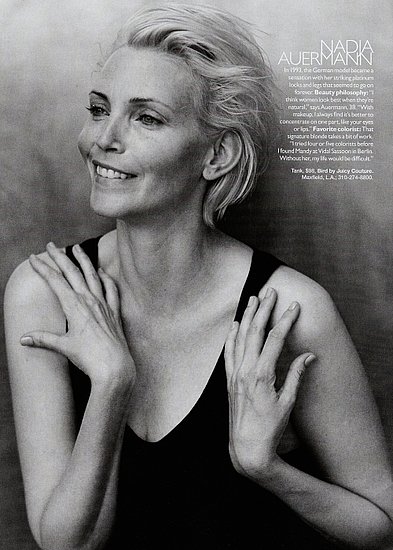
Peter Lindbergh seems to be quite taken with this no-makeup, minimal-to-no retouching concept: In April, he captured Eva Herzigova, Ines de la Fressange, and a slew of European actresses without makeup or retouching for French Elle. A month after, he told the New York Times that he was tired of subjects in fashion magazines looking like overly-Photoshopped “objects from Mars”: “My feeling is that for years now it has taken a much too big part in how women are being visually defined today. Heartless retouching should not be the chosen tool to represent women in the beginning of this century.”
Lindbergh continues to lead the charge against excessive retouching, this time by capturing supermodels Amber Valletta, Nadja Auermann, Helena Christensen, Shalom Harlow, Claudia Schiffer, Tatjana Patitz, Cindy Crawford, and Kristen McMenamy without makeup or excessive retouching for Harper’s Bazaar‘s September 2009 issue.
“NO RE:TOUCHING”
“ My feeling is that for years now it has taken a much too big part in how women are being visually defined today. Heartless retouching should not be the chosen tool to represent women in the beginning of this century.” Peter Lindberg
Do you love clothes? I do….How about Fashion? Are you a Fashionista?
Don’t they look good hanging in our closets? How about now……………..
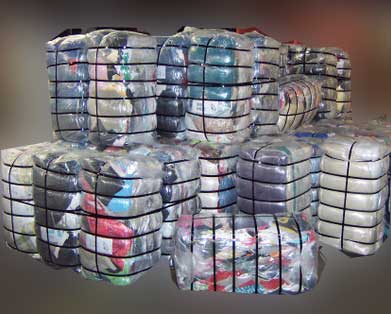
WHAT IS A LANDFILL SITE?
Landfill sites are carefully designed structures built on or on top of the ground in which rubbish is being dumped. The idea is to make sure that the rubbish is kept apart from the surrounding environment, which includes groundwater, air and rain. The rubbish is kept dry and not in contact with air. Under these conditions, rubbish will not decompose very much. A landfill is not like a compost heap, where the rubbish is buried in such a way that it will rot down (decompose) quickly. Bacteria in the landfill break down the waste even though there is no oxygen present (anaerobic). A by-product of this anaerobic breakdown is landfill gas, which contains approximately 50 percent methane and 50 percent carbon dioxide with small amounts of nitrogen and oxygen. This presents a hazard because the methane can explode and or burn. So, the landfill gas must be removed. To do this, a series of pipes are placed within the landfill to collect the gas. In some landfills, this gas is vented or burned.
HOW MUCH DO WE DUMP?
When new trends and styles hit the stores each season do you throw out your old stuff to make way for the new or do you take a more fashionable approach and reuse or recycle them? Americans throw away an estimated 10 million tons every year while over 80% of waste generated in China is land filled. The Solid Waste Management Department of Karachi in India claims that over 7,000 tons of rubbish is generated daily. Waste management is now a global concern.
Research carried out by Global Cool the climate change charity, found that women who shop online are twice as unlikely to return unwanted clothes than those that are bought in store. The charity asked 3,500 UK women who revealed that they spent an average of £470 last year on items that they did not ever wear, which is a hefty figure considering that this equates to an estimated UK total of £11.1 billion.Even scarier perhaps though, is that one in ten of the women who took the survey admitted that they just bin the unwanted clothes which actually contributes to an estimated 900,000 tonnes of landfill waste. This waste also leads to needlessly creating 8 million tonnes equivalent of CO2 through the purchase of unworn clothes.by Clare Saxon
Cotton: The production of (non-organic) cotton destroys farmland and pollutes waterways. The production of a simple T-shirt requires two pounds of pesticide!
Dyes: Most common dyes that are used in fabrics contain heavy metals that can be harmful to animals, the natural environment, and ourselves.
Synthetic polyesters and nylons: These are made from petrochemicals via a process of refining crude oil, which creates horrible pollution.
Silk: Commercial silk is made by boiling the silkworms’ cocoons, then unwinding the single silk strand onto reels. This results in the silkworms being boiled to death in their cocoons.
Our “throw away attitude” contributes to the large increase in waste now being created causing, what the US Protection Agency has identified as a greenhouse gas 20 times more potent than carbon dioxide, Methane Gas. Since the Industrial Revolution in the late 1700’s, the earth’s methane concentration has increased by 150%. As world population grows the consumption of resources increases and the output of waste is increased.
Fashion itself promotes consumption as each season the latest styles in clothing, shoes, handbags and the like, encourage us to throw out the old and consume the new. A report published in 2006 by the University of Cambridge Institute for Manufacturing stated that “in 2000 the world’s consumers spent around US $1 trillion worldwide buying clothes. A third of that in Western Europe, another third in North America and about a quarter in Asia”. “Fast fashion” made from cheaper materials which may only last one season, provide affordable items aimed mostly at young women and their insatiable desire to have the season’s latest styles.
Fashion Week Boston starts September 25th to October 2nd.
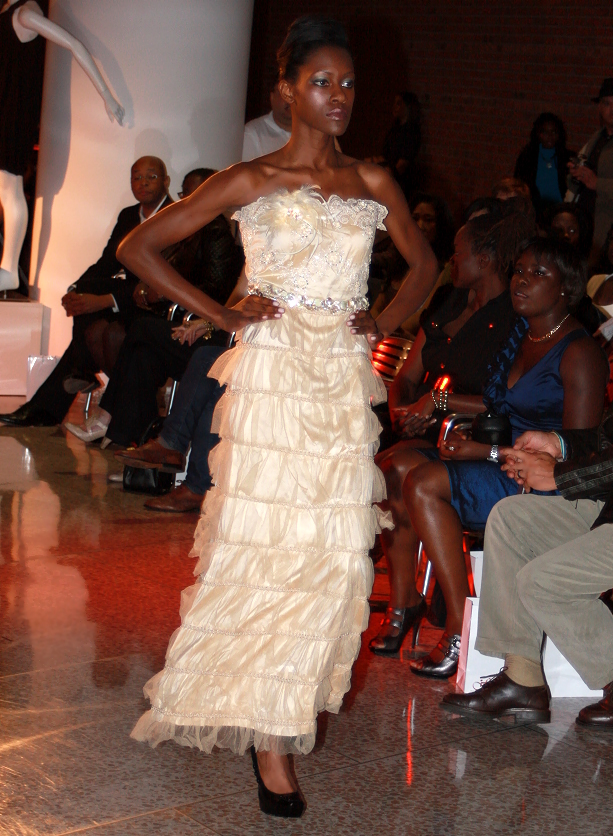
The Boston Fashion Week started with a timid Party at the Beehive on Friday the 9/25. Saturday was ruled by “Recessionista Shopping Tour” and Sunday “Fashion Evolution”.Boston Fashion Week is evolving. It cannot be compared to Sao Paulo, NY, Paris, London or Milan.The Boston community should support their local designers.I interviewed designers during the weekend.
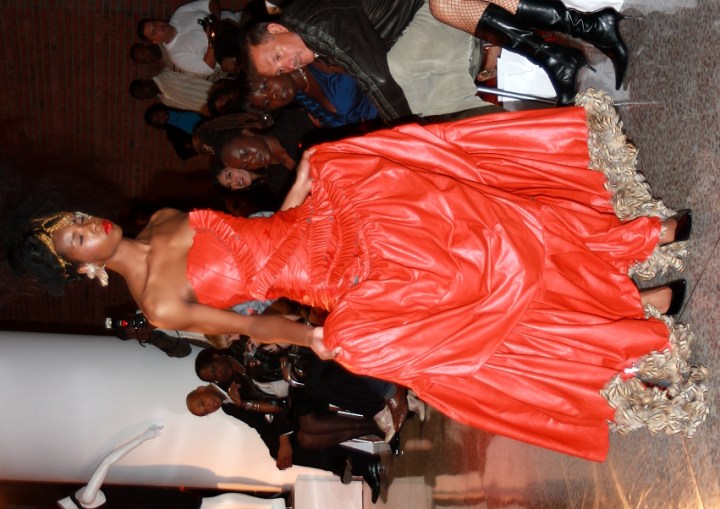
At the “Fashion Evolution” Forever Party I interviewed Cindy Mathieu a Canadian designer, David Chum and Delise Ana Parker.Cindy Mathieu brought over to the show one of her gowns worn by ETC show host Cheryl Hickey.Designer David Chum just re:released his women’s collection called “Sela Do’r”. At the same show designer Delise Ana Parker showed an orange synthetic Leather Gown with feathers.
“Semana de Moda de Boston, ainda nao pode ser comparada a uma Sao Paulo Fashion Week!”
Por Adriana Sassoon
A semana de moda de Boston, comecou na ultima Sexta 25/9 com uma festa um pouco timida na Beehive.O final de semana ficou por conta de “Recessionista Shopping Tour” no Sabado e “Fashion Evolution” no Domingo. Nem de perto a Semana de moda de Boston, pode ser comparada a uma SPFW. O Brasil esta muito a frente neste quesito! A SPFW e considerada uma das mais conceituadas semanas de moda do mundo.Tanto pela criatividade como tambem em qualidade e desenvolvimento do Design de Moda.Entrevistei dois designers durante a “Fashion Evolution” .Cindy Mathieu uma designer Canadense, que ja teve seu trabalho divulgado pela apresentadora do Entertainment Tonight Canada Cheryl Hickey , David Chum que lancou sua colecao “Sela Do’r” em Marco deste ano e a designer Delise Ana Parker,mostrou um vestido em couro sintetico laranja com plumas.A semana promete mais.
Cindy Mathieu Mother of Pearl Dress
David Chum and Model’s
Delise Ana Parker her Orange synthetic Leather gown with Feathers
All images are courtesy of Ian Larraga Phorography
Para saber mais detalhes sobre as entrevistas acesse o site:
Isabel Toledo was born in Cuba and moved to New Jersey where she attended high school and met her future husband and collaborator, Ruben Toledo. She attended the Fashion Institute of Technology (NY) and Parsons School of Design (NY) where she studied painting, ceramics, and fashion design. An avid seamstress from a young age, Toledo’s work reflects not only a distinct design sense but a keen understanding of garment construction and appreciation for the geometric intricacies of pattern shapes.
They describe their work life as entirely entwined with their “real life”, creating being as essential as breathing. Their personal and professional relationship is an anomaly, and not just in the fast-paced world of high fashion, with its ever-shifting alliances. The fashionable couple met at age 13, when they were classmates at a New Jersey high school, both of their families having fled Cuba for the United States, and have been creative and romantic partners for the last three decades. Sharing a loft that serves as home and atelier, the Toledo’s passion for one another and their work is obvious, and they collaborate on everything, serving as muse and inspiration for each other.
Toledo designed a lemongrass yellow wool lace shift dress with matching overcoat which First Lady Michelle Obama selected to wear at the inauguration of her husband, President Barack Obama.Michelle Obama first wore a Toledo design on Wednesday, June 18, 2008 for an appearance at a New York City fashion world fund-raiser.
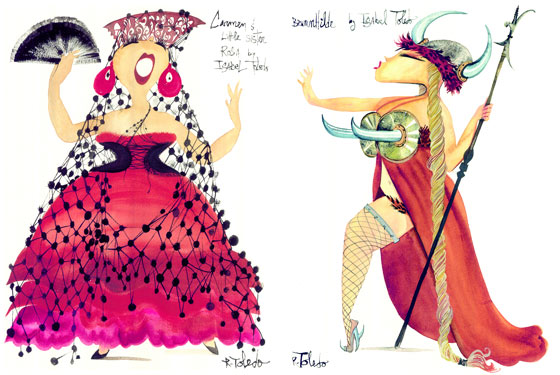
ON THE LEFT – Fashion from then inside out. FIT museum .
ON THE RIGHT- In honor of the New York City Opera’s benefit, DIVAS Shop for Opera.
These two fantastically vampy illustrations by power couple Isabel and Ruben Toledo.
The hot-pink, fan-flapping design is inspired by Carmen from Bizet’s Carmen, and the Viking in the serious “It” helmet is their take on Brunhilde from Richard Wagner’s The Ring Cycle.


























 ADRIANA SASSOON